Skip to content
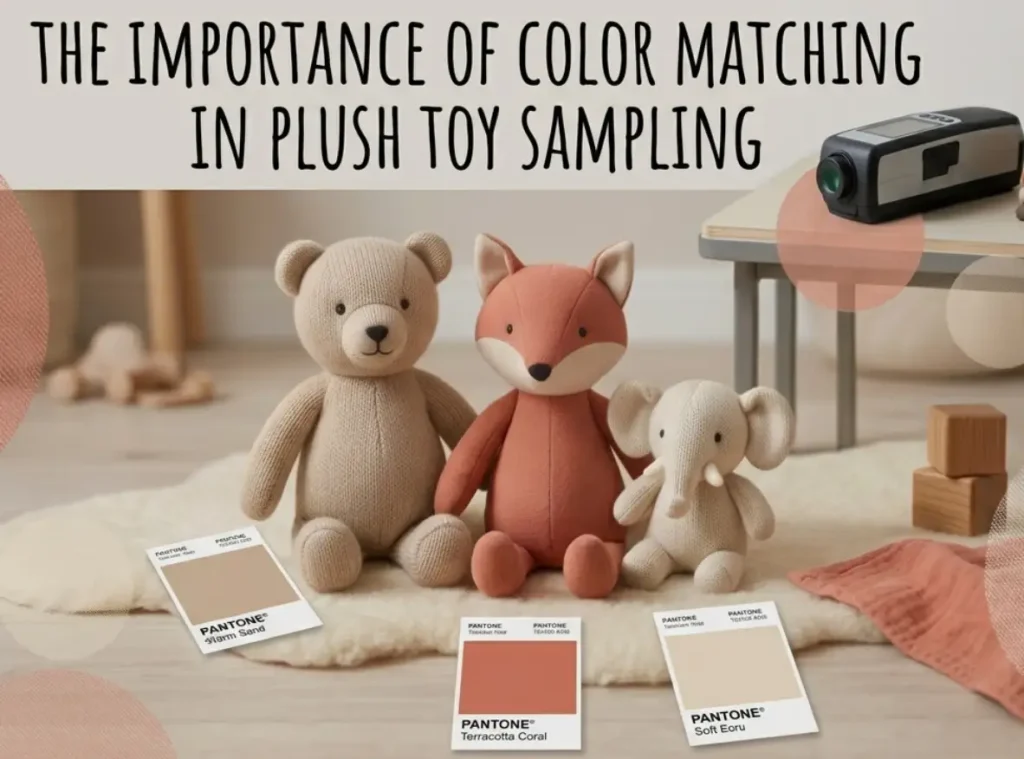
Today, we will discuss the importance of color matching in plush toy sampling. Color is one of the first things a customer notices about a plush toy. Before a product ever reaches a retail shelf or an online listing, it passes through a sampling process where every design decision — including color — is validated against the original specification. For plush toy manufacturers and brand owners, color matching during sampling is not a cosmetic formality. It is a quality control discipline that directly affects production consistency, retail acceptance, and brand integrity.
Getting color right at the sampling stage prevents costly corrections downstream. A shade that drifts even slightly between the approved sample and mass production can trigger rejection from major buyers, require full resampling cycles, and delay product launches by weeks. Understanding why color matching matters — and how to manage it systematically — is one of the most commercially valuable skills in plush toy development.
Why Color Matching Matters More Than You Think
The Gap Between Screen and Physical Fabric
Most plush toy development begins with a digital design file — an illustration, a brand style guide, or a reference image provided by a client. Digital colors exist in RGB or HEX space, calibrated for screen display. Physical plush fabrics absorb, reflect, and scatter light in entirely different ways. A vibrant coral on screen can render as a muted salmon on minky fabric, or as an oversaturated orange on short-pile plush.
This translation gap is the root cause of most color matching failures in sampling. Designers who work primarily in digital environments often underestimate how dramatically fiber type, pile height, dye lot, and surface texture influence perceived color on finished fabric. The sampling process exists precisely to close this gap before production commits.
Brand Color Consistency Across SKUs
For licensed products and brand characters, color matching is not just a quality issue — it is a contractual one. Brand owners typically specify Pantone references for character colors and require that all plush products hit defined tolerances against those references. A stuffed character whose fur color drifts from the approved Pantone specification risks license non-renewal and retail delisting.
Multi-SKU product lines add further complexity. When a plush character is produced in five different sizes or across multiple product types — keychains, large plush, clip-ons — each format uses different fabric weights and constructions. Maintaining color consistency across all formats requires disciplined reference management throughout the sampling process.
The Plush Toy Sampling Process and Color Checkpoints
From Reference to Pre-Production Sample
A typical plush toy sampling workflow moves through several distinct stages, each of which presents a color verification opportunity.
| Sampling Stage | Color Activity | Key Decision |
|---|---|---|
| Design brief received | Pantone or physical swatch reference established | Confirm reference format (Pantone C/U, fabric swatch, RAL) |
| Lab dip / yarn dye sample | Dye house produces color sample on target fiber | Approve or reject against reference under standard lighting |
| Proto sample | First sewn construction with approved fabric | Assess color in context of full product |
| Pre-production sample (PPS) | Full production-spec construction | Final color sign-off before bulk |
| In-line inspection | Random pull from production run | Verify bulk matches approved PPS |
The lab dip stage is where the most important color decisions are made. A lab dip is a small swatch of fabric dyed to match the target reference. Approving the lab dip correctly — under the right lighting conditions and against the correct reference — determines everything that follows.
Lighting Conditions and Metamerism
One of the most misunderstood aspects of color matching is metamerism — the phenomenon where two color samples appear to match under one light source but diverge under another. A plush fabric that matches a Pantone reference perfectly under D65 daylight simulation may appear noticeably different under incandescent retail lighting or fluorescent warehouse lighting.
Professional color evaluation requires a lightbox capable of simulating multiple standard illuminants: D65 (daylight), A (incandescent), TL84 (cool fluorescent), and UV. Buyers for major retail chains specify which illuminant to use for approval. Failing to evaluate under the buyer’s specified lighting condition is a common cause of sample rejection.
| Light Source | Standard Code | Typical Use Context |
|---|---|---|
| Simulated daylight | D65 | Default international standard, most common |
| Incandescent | Illuminant A | North American retail environments |
| Cool white fluorescent | TL84 | European retail environments |
| UV (ultraviolet) | UV | Detecting optical brighteners in fabric |
| Horizon daylight | D50 | Graphic arts and print-matching contexts |
Color Measurement Tools and Tolerances
Spectrophotometers vs. Visual Assessment
Visual color assessment by trained inspectors remains a standard practice in plush manufacturing, but it has well-documented limitations. Human color perception varies between individuals, degrades with fatigue, and is highly sensitive to ambient conditions. Instrument-based measurement eliminates these variables.
A spectrophotometer measures the reflectance of a fabric surface across the visible spectrum and calculates colorimetric values — typically expressed in CIELAB color space (L*, a*, b*). The delta-E (ΔE) value quantifies the total color difference between a sample and a reference. A ΔE below 1.0 is imperceptible to most observers; values above 2.0 are reliably detectable and typically trigger rejection.
| ΔE Range | Perceptibility | Industry Action |
|---|---|---|
| 0.0 – 1.0 | Imperceptible to most observers | Automatic approval |
| 1.0 – 2.0 | Perceptible to trained evaluators | Conditional approval, buyer discretion |
| 2.0 – 3.5 | Clearly perceptible | Rejection in most quality systems |
| 3.5 – 5.0 | Obvious difference | Automatic rejection, re-dye required |
| > 5.0 | Severe mismatch | Full lab dip restart |
Most major toy and character merchandise buyers specify a maximum ΔE of 1.5 to 2.0 for approved production. Manufacturers who invest in calibrated spectrophotometer equipment can provide objective measurement data with sample submissions, significantly reducing back-and-forth rejection cycles.
Pantone TCX and TPG References
The Pantone Fashion, Home + Interiors system — available in TCX (textile, cotton) and TPG (textile, paper) formats — is the industry standard reference system for plush toy color specification. TCX chips are dyed cotton swatches that approximate how a color will behave on natural and synthetic fibers. TPG chips are printed paper references.
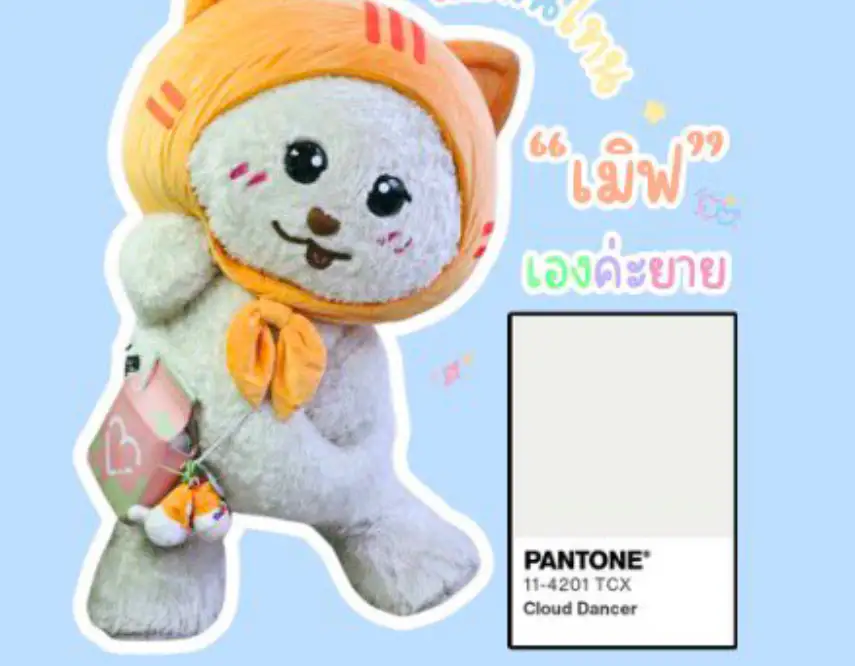
For plush toy applications, TCX references are generally more reliable because they share a physical substrate relationship with fabric. However, Pantone references must be updated regularly — chips fade with exposure to light and should be replaced every two years to maintain calibration accuracy.
Managing Color Approval Across Suppliers and Time Zones
The Communication Chain Problem
International plush toy supply chains typically involve a brand owner in one country, a sourcing or trading partner in another, and a factory in a third. Color references pass through this chain as photographs, scanned images, and written descriptions — all of which introduce distortion.
A photograph of an approved lab dip taken under mixed ambient lighting and compressed as a JPEG tells the factory almost nothing useful about the actual color. Yet this is how color approval decisions are communicated in many supply chains. Physical shipping of reference swatches and approved samples, while slower, remains the only reliable method for color communication across manufacturing partners.
| Communication Method | Color Accuracy | Recommended Use |
|---|---|---|
| Physical Pantone chip or swatch | High | Reference standard setting |
| Physical approved sample (shipped) | High | Sample approval confirmation |
| Calibrated digital photo (color-managed) | Medium | Progress updates only |
| Standard JPEG photo | Low | Not suitable for color decisions |
| Verbal or written color description | Very low | Never suitable |
Establishing a Color Library
Manufacturers who work with repeat clients benefit significantly from maintaining a physical color library of approved lab dips, fabric swatches, and production samples organized by client, project, and date. This library serves as a reference archive when reordering colorways, troubleshooting production variation, or onboarding new dye house partners.
A well-maintained color library reduces sampling cycles on repeat orders by providing the dye house with a physical production reference rather than a Pantone chip alone, since fabric behavior varies between dye lots and fiber batches.
Sustainability Considerations in Color Matching
Growing demand for sustainable plush products introduces additional variables into color matching. Reactive dyes used on organic cotton behave differently from disperse dyes on polyester plush fiber. OEKO-TEX certified dye systems exclude certain high-chroma pigments and optical brighteners, which can narrow the achievable color gamut on certified materials.
Brands specifying sustainable fabrics should account for these constraints early in the design phase. Referencing a vibrant electric blue from a conventional polyester swatch and then specifying GOTS-certified cotton fabric for the final product may result in a color that cannot be matched within the sustainable dye system. Early engagement between designer, fabric supplier, and dye house prevents these mismatches before sampling begins.
Frequently Asked Questions
Why does my approved lab dip look different on the finished plush toy?
A lab dip is produced on a flat, un-piled fabric substrate. The finished plush toy uses fabric with raised pile — loops, cut pile, or minky texture — that creates a three-dimensional surface. Light interacts with this surface differently than with a flat swatch, making the same dye appear lighter, darker, or differently saturated. This is normal and expected.
Experienced manufacturers account for this effect by building a correction factor into the dye formula before bulk production. If your factory does not adjust for pile effect during lab dip production, colors will reliably shift on the finished product.
What Pantone system should I use to specify plush toy colors?
Pantone TCX (Fashion, Home + Interiors, cotton format) is the most appropriate system for plush toy color specification because it is produced on a cotton textile substrate, which behaves more similarly to plush fabric than paper-based references.
Avoid specifying colors using Pantone Coated or Uncoated graphic arts chips, as these are calibrated for printing ink on paper and will not translate reliably to fabric dye systems. If your brand style guide only provides Pantone graphic arts references, ask your manufacturer to convert these to the nearest TCX equivalent and confirm the conversion on a physical lab dip.
How many rounds of lab dips are normal before color approval?
For straightforward colors on standard polyester plush fabric, one to two rounds of lab dips is typical in a well-managed sampling process. Complex colors — very pale neutrals, highly saturated brights, and any color with fluorescent or optical brightener characteristics — may require three or more rounds.
If a factory consistently requires four or more rounds to achieve approval, it is a signal that either their dye house capabilities are mismatched with the specification, or that the reference being provided is insufficiently clear. Agreeing on a physical approved swatch as a production standard before sampling begins reduces iteration cycles significantly.
Can color variation between plush toys from the same production run be controlled?
Within a single dye lot, color variation is generally minimal and well within acceptable tolerances. The primary risk point is dye lot changes — when a production run extends across multiple fabric rolls from different dye batches. Fabric dyed in different lots will show measurable variation even when produced to the same formula.
To manage this, buyers typically specify a maximum ΔE tolerance between dye lots (commonly ΔE ≤ 1.5) and require the factory to cluster dye lots when cutting fabric for a single SKU to minimize visible variation in finished goods.
What is the difference between color fastness and color matching?
Color matching refers to the accuracy of the initial color relative to the approved reference — whether the dye formula achieves the right hue, lightness, and saturation at the point of production. Color fastness refers to how well that color holds up under use conditions — washing, rubbing, perspiration, and light exposure.
A toy can pass color matching on the approved sample but fail color fastness testing if the dye system is not appropriately fixed or if the fiber is incompatible with the dye class. Both are separate test criteria under EN 71 and ASTM F963, and both should be evaluated during the sampling stage, not treated as mutually exclusive concerns.
How should I handle color approval when my design team is remote and cannot physically review samples?
Physical sample shipping remains the only reliable method for color sign-off. For remote teams, establish a designated sample review contact at a central location who receives physical samples and makes approval decisions on behalf of the design team. Color decisions should never be made from photographs alone.
If physical review is genuinely impossible, instruct your factory to provide a spectrophotometer measurement report with each sample submission — ΔE values against the agreed reference give a quantified, objective basis for remote approval decisions that photographs cannot provide. For critical colorways, investing in a calibrated lightbox at your review location closes most of the remaining gap.
Conclusion
Color matching in plush toy sampling is a technical discipline with direct commercial consequences. From the initial translation of digital references to physical fabric, through lab dip approval under standardized lighting, to production-run verification against a signed-off standard, every step in the process is an opportunity to either lock in quality or introduce costly variation.
Manufacturers and brand owners who invest in structured color management — standardized references, instrument measurement, physical sample libraries, and clear communication protocols — spend less time resolving rejections and more time shipping product that meets specification the first time.