Skip to content
Anime plush toys occupy one of the most technically demanding segments of the stuffed toy industry. Character accuracy, IP compliance, fabric fidelity, and embroidery precision are not optional — they are the product. Buyers who treat anime plush development as standard plush production with character graphics applied consistently encounter sample failures, revision spirals, and bulk quality problems that could have been prevented with a clear understanding of what makes this category genuinely different. This guide explains exactly how anime plush toys are manufactured, what drives quality and cost in this segment, and how to manage the development and production process to a successful outcome.
Why Anime Plush Toy Manufacturing Is Fundamentally Different from Standard Stuffed Toy Production
Most categories of plush toy production share a common development and manufacturing logic: define the shape, select appropriate materials, produce a sample, and refine until the physical product is commercially acceptable. Character accuracy, while always relevant, rarely defines the boundary between a successful and failed product in the way it does in the anime segment.
Anime plush manufacturing is different because the product is, by definition, a three-dimensional physical reproduction of a two-dimensional character property that fans know with precision. The target audience for anime merchandise is not a general consumer evaluating whether a stuffed toy is appealing — it is a community of dedicated fans who know exactly how the character’s eyes are shaped, what color the hair highlights are, how the costume folds, and whether the proportions carry the character’s visual identity. A plush toy that misses these elements, even subtly, reads as a failed product to the audience that matters most. This audience does not forgive quality failures quietly — it documents them publicly, and the commercial consequences follow immediately.
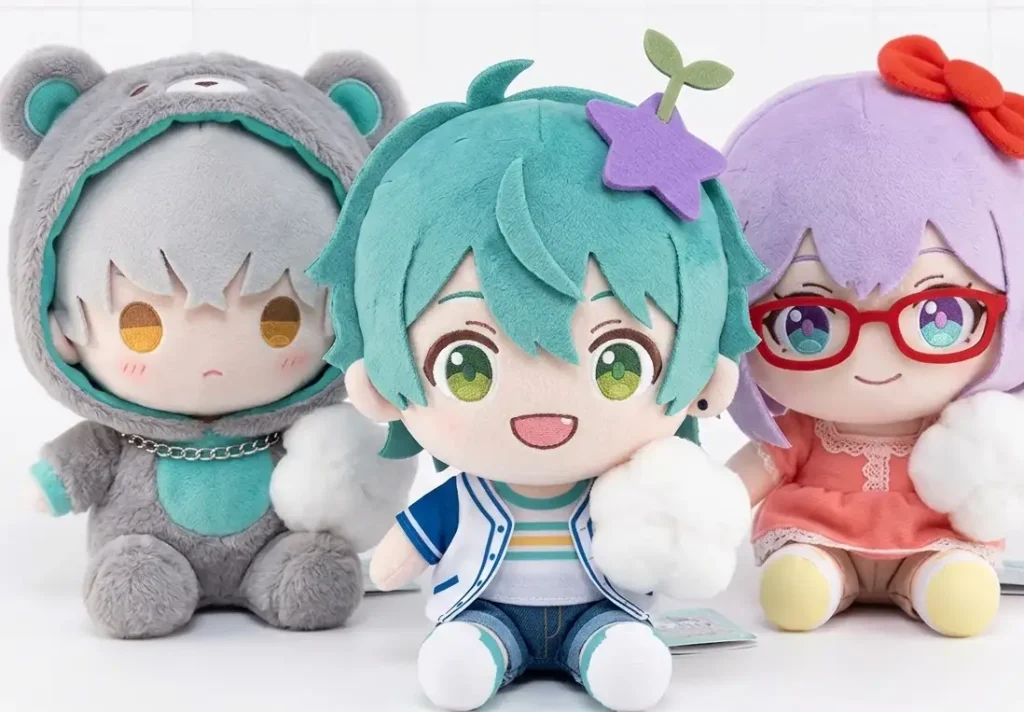
The technical implication is that anime plush development requires a level of specification precision, embroidery accuracy, color management, and IP fidelity that standard plush production does not routinely demand — and that factories without specific experience in licensed character merchandise are not structurally equipped to deliver.
Standard Plush vs. Anime Licensed Plush: Key Production Differences
| Production Dimension | Standard Plush Toy | Anime Licensed Plush Toy | Practical Impact |
|---|---|---|---|
| Design authority | Buyer defines aesthetic freely | IP licensor controls all visual elements | Every design decision requires licensor approval |
| Character accuracy tolerance | General likeness acceptable | Precise facial features, color, and proportion match required | Higher revision round count; tighter QC criteria |
| Color management | Brand palette reference | IP-specific Pantone standards; licensor approval per colorway | Additional approval steps; color-matched material sourcing |
| Embroidery complexity | Simple logo or icon level | Multi-color expressive face; gradient or shading effects | Higher stitch count; specialist digitizing required |
| Documentation requirements | Standard product spec | Style guide, approval matrix, licensor sign-off at each stage | Longer development cycle; additional administrative burden |
| Sampling approval path | Buyer approval only | Factory → Buyer → IP Licensor → Production authorization | 3-party approval loop adds 2–4 weeks per round |
| Accessory complexity | Optional; simple attachments | Character-specific costumes, accessories, and props required | Higher component count; multi-process production |
| Consumer scrutiny level | General market | Dedicated fan community with encyclopedic character knowledge | Zero tolerance for character accuracy failure in market |
The IP Licensing Layer — How It Shapes Every Manufacturing Decision
Every anime plush toy that legitimately reproduces a copyrighted character operates under an IP licensing agreement between the intellectual property holder — the studio, publisher, or rights management company that owns the character — and the manufacturer or brand producing the physical product. This agreement defines not just the right to use the character, but the specific standards to which the physical product must conform, the approval steps required before production can proceed, and the quality benchmarks that finished goods must meet.
Understanding the IP licensing layer is essential for planning anime plush development accurately. The approval process is not a formality — it is a substantive multi-stage review in which licensor representatives compare physical samples against the official character style guide and evaluate whether the product represents the character at the standard the IP owner has established. Products that fall short of this standard are not approved, and production cannot proceed until the standard is met. This means that the development timeline for a licensed anime plush is structurally longer than for an original or generic plush design — and buyers who plan their timelines as if the licensing approval process does not exist consistently discover this difference at the worst possible moment.
Why Most Generic Plush Factories Are Not Equipped for Anime Character Production
The manufacturing capabilities required for high-quality anime plush production go beyond what most general plush factories deploy in standard production. Anime face embroidery demands multi-head embroidery machines capable of tight registration across small facial areas, digitizers experienced in creating expressive face files that translate well to fabric, and machine operators who understand the difference between technically correct embroidery and visually accurate character reproduction.
Character-specific fabric — including specialty plush fabrics matched to particular hair texture representations, or fabrics with specific pile heights that replicate the visual softness of a character’s design — requires material sourcing depth that standard factories often do not have. Gradient color effects in hair or accessories, frequently required in contemporary anime character designs, demand either specialized embroidery techniques or printed fabric components that require a different production workflow entirely.
The correct question when evaluating a factory for anime plush production is not whether they produce plush toys generally, but whether they have produced licensed character merchandise specifically — and whether they can supply reference samples and licensor-approved products that demonstrate their capability in this specific category.
How to Prepare an Anime Character Design Brief That Prevents Sample Failures
The design brief for an anime plush toy is the most important document in the entire development process — more important than it is for any other plush category, because the character accuracy requirements that make or break the product are established here, before the factory touches a single panel or thread. A brief that defines these requirements precisely produces an accurate first sample. A brief that leaves elements undefined produces a sample that reflects the factory’s best interpretation — which is almost never the correct answer when an IP licensor’s style guide exists and must be satisfied.
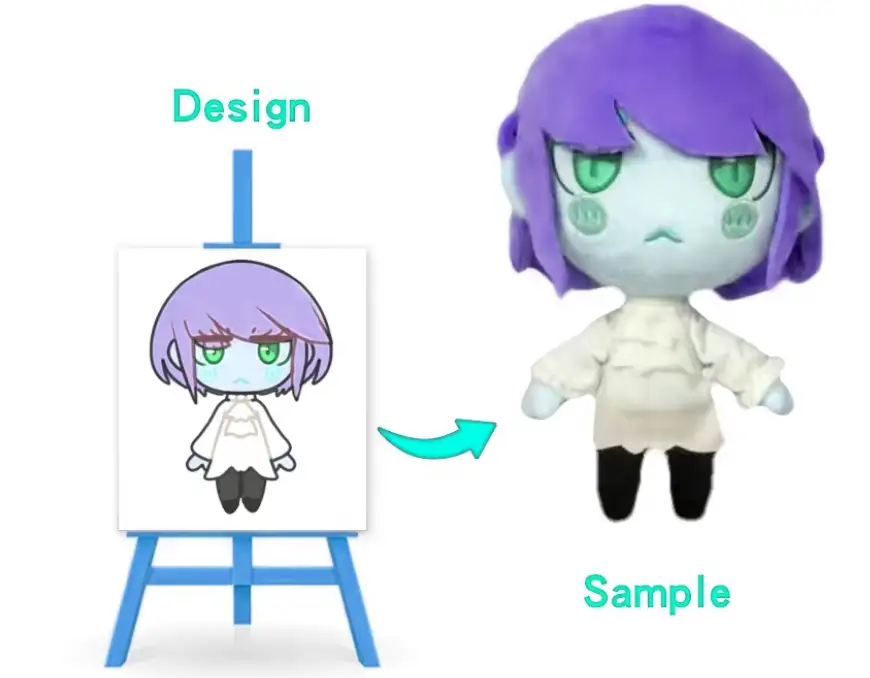
A complete anime plush design brief must define not just the physical product specifications — dimensions, materials, construction approach — but the character-specific elements that determine whether the product will be approved: facial feature placement with precise coordinates, color specifications with official Pantone references for every color area, embroidery style guidance that references the source artwork, and proportion guidance that captures the character’s specific body ratio. For chibi-style anime characters — the dominant form factor in anime plush merchandise — the exaggerated proportions that define the character’s appeal require explicit specification, because standard pattern-making defaults will produce proportions that neutralize the character’s visual identity.
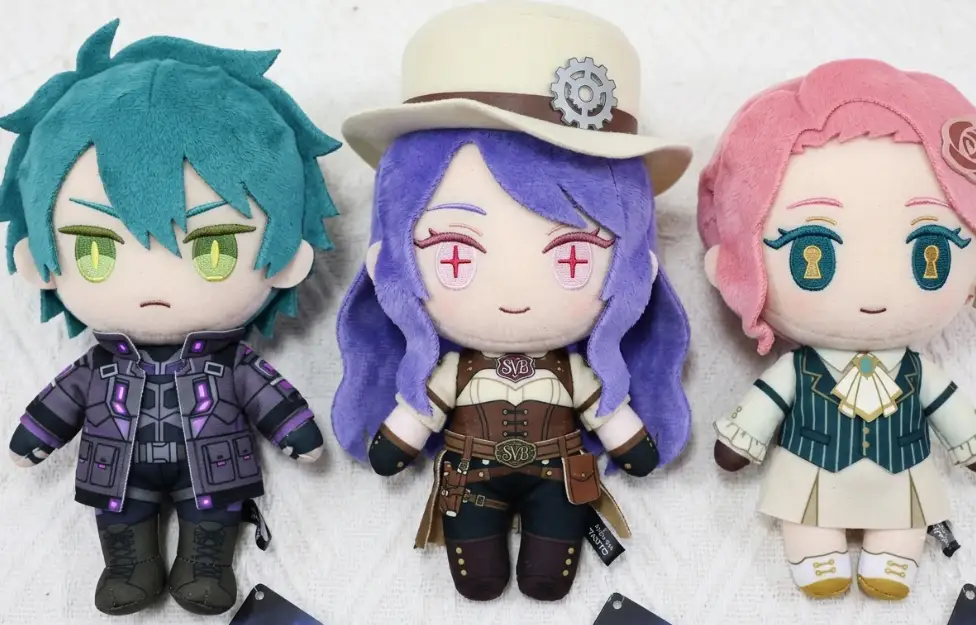
Anime Plush Design Brief Checklist: Required Elements by Category
| Brief Category | Required Specification | Acceptable Format | Consequence If Missing |
|---|---|---|---|
| Character reference artwork | Front, back, 3/4 view from official style guide; close-up face reference | High-resolution digital files; printed and signed style guide pages | Factory interprets character freely; inaccurate first sample |
| Overall proportions | Head-to-body ratio; limb length ratios; finished size range | Annotated dimension sketch with ratio table | Chibi proportions lost; character identity diluted |
| Facial feature placement | Eye position, size, spacing; nose and mouth placement; all in mm from reference points | Annotated face template with coordinate grid | Expression misaligned; character unrecognizable or uncanny |
| Color specification | Pantone TPX code for every color area; approved color priority order | Pantone chip list matched to annotated reference image | Color revision in every sampling round; licensor rejection |
| Fabric specification | Pile height, pile type, and texture for each fabric area | Written spec plus physical swatch references where available | Wrong fabric sourced; visual character mismatch |
| Embroidery design guidance | Thread color codes; stitch style reference; shading and highlight approach | Embroidery artwork file or annotated source reference | Flat, inaccurate embroidery; character expression fails |
| Costume and accessory details | All clothing elements, accessories, weapons, props with material and color | Reference image with annotated materials list | Incomplete character representation; licensor rejection |
| Compliance requirements | Target market standards (ASTM F963, EN71, CPSIA, etc.); age grading | Written compliance specification; applicable standard list | Non-compliant accessories sourced; testing failure |
| Licensor approval requirements | Approval stages; licensor contact and submission format; turnaround commitment | Written approval workflow agreed by all parties | Development stalls at approval stage; timeline overrun |
Why Chibi Proportions Require Explicit Specification — Not Factory Default
Chibi-style proportions — the defining aesthetic of most anime plush merchandise — place the character’s head at approximately one-half to two-thirds of the product’s total height, with compressed limbs and an oversized face that amplifies the character’s most expressive elements. These proportions do not emerge from standard pattern-making practice. They must be explicitly specified as a departure from default proportions, with the head-to-body ratio clearly defined and the limb compression factor stated in the brief.
When a factory produces a chibi anime plush without explicit proportion guidance, the pattern maker defaults to something closer to anatomically plausible proportions — which produces a plush toy that looks generically appealing but does not carry the character’s identity. The head is too small, the limbs are too long, and the face area available for embroidered features is insufficient to reproduce the character’s expression accurately. This is one of the most common first-sample failures in anime plush development, and it is entirely preventable through explicit proportion specification in the brief.
Design Brief Tip
For chibi anime characters, specify the head-to-total-height ratio as a numerical value — for example, “head height = 48% of total product height at 25cm finished size” — rather than describing it as “large head, small body.” Numerical ratios can be verified by measurement at every sampling stage. Descriptive terms cannot be objectively evaluated and generate disagreements between buyer, factory, and licensor about whether the proportion is correct. Include a dimensioned side-view sketch with the ratio values annotated directly on the drawing. This single addition to the brief eliminates the proportion revision round that occurs in most chibi plush development cycles.
The Official Style Guide — How to Use It Correctly and What Happens When It Is Missing
The official IP style guide — produced by the licensor for each licensed character — is the definitive reference document for all design decisions in anime plush development. It specifies the approved color palette, the character’s approved visual representations across different body positions and expressions, the proportion standards for different product categories, and any explicit restrictions on character representation that the licensor has defined. For buyers who have obtained a legitimate license, the style guide is the most important document in the development process, and it should be shared with the factory in its entirety before design brief preparation begins.
When a buyer enters anime plush development without an official style guide — either because they are producing unlicensed fan merchandise or because their license agreement was not accompanied by adequate reference materials — the design brief must compensate by providing the most complete and specific character reference possible from the officially published source artwork. The absence of an official style guide does not reduce the precision required in the brief; it increases the importance of every other specification element that guides the factory’s interpretation.
Which Fabrics and Filling Materials Are Used in Anime Plush Toy Manufacturing?
Material selection for anime plush toys is constrained by the interaction of three requirements that do not always point toward the same material choices: the character’s visual design, the compliance standards of the target market, and the cost structure of the production run. Understanding how these requirements interact — and where the most consequential material decisions are made — is essential for specifying materials that produce both character-accurate and commercially viable products.

The outer fabric of an anime plush toy is not just a structural element — it is a direct visual and tactile representation of the character’s aesthetic. The specific pile height, pile density, and texture of the outer fabric determine how accurately the product reproduces the softness, visual weight, and color saturation of the character’s design. A hair area specified in short, dense minky produces a very different visual result than the same area specified in longer, lighter-density plush — and the correct choice depends entirely on which fabric type best captures the specific character’s visual character as defined in the source artwork and style guide.
Fabric Types Used in Anime Plush Manufacturing: Properties and Applications
| Fabric Type | Pile Height | Visual Character | Best Used For | Embroidery Suitability | Cost Level |
|---|---|---|---|---|---|
| Short minky (velboa) | 1–3mm | Smooth, high sheen, vivid color | Face panels, skin areas, smooth costumes | Excellent — ideal for face embroidery | Low–Medium |
| Standard minky (cuddle) | 3–5mm | Soft, plush, good color saturation | Body panels, limbs, general character body | Good with backing stabilizer | Medium |
| Long pile plush | 8–20mm | Fluffy, dimensional, tactile focus | Hair areas, animal characters, fur effects | Not recommended — pile hides stitching | Medium–High |
| Fur fabric (faux fur) | 15–40mm | Realistic texture, high tactile appeal | Animal companions, yokai characters, fur trim | Not suitable | High |
| Fleece (anti-pill) | Surface nap only | Matte, flat, accurate color print | Costume overlay, accessories, flat features | Good — firm surface supports stitch | Low |
| Woven felt | None | Flat, precise edge, matte finish | Accessory details, weapon props, flat appliqué | Excellent surface; limited color range | Low |
| Sublimation-printed minky | 3–5mm | Full photo-quality color; complex pattern | Gradient hair, complex costume patterns, printed face panels | Combined with print for complex effects | Medium–High |
Filling Material Selection — How It Affects Character Shape Retention
The filling material in an anime plush toy does more than provide softness — it determines whether the character’s distinctive shape is maintained throughout the product’s service life. An anime character plush that gradually loses its defined shape — where the oversized head sags forward, the limb positioning loses definition, or the body loses the firmness that maintains the chibi silhouette — is a product that degrades in character accuracy over time. Filling selection should account for long-term shape retention, not just initial feel.
PP cotton (polyester fiberfill) is the standard filling for anime plush production, but the specific grade, fiber length, and packing density matter significantly. Standard-grade PP cotton at low packing density produces soft, pillow-like products that feel pleasant but lose shape rapidly. Higher-grade PP cotton with longer fiber length and higher packing density produces firmer, more resilient products that maintain the defined shape the character’s proportions require. For the head section of a chibi-style plush — which must maintain a specific rotund, oversized shape — a higher packing density than the body section is typically appropriate to prevent the head from compressing or deforming under its own weight.
Filling Materials for Anime Plush: Properties, Applications, and Shape Retention
| Filling Material | Shape Retention | Softness Level | Best Application | Compliance Notes | Cost |
|---|---|---|---|---|---|
| Standard PP cotton (7D/15D) | Moderate | Soft | General body fill; large plush | Verify REACH/CPSIA for fiber treatment chemicals | Low |
| Premium PP cotton (3D/6D siliconized) | Good | Silky, resilient | Character head; shape-critical sections | As above; confirm siliconization chemistry | Medium |
| High-density PP cotton (compressed) | Excellent | Firm | Head sections; standing poses; structured forms | Standard compliance; density verified by weight spec | Medium |
| Memory foam insert (partial) | Excellent | Medium-firm | Display-quality plush; premium collector items | Chemical certification required; REACH compliance | High |
| Pellet fill (PE/PP beads) | Poseable; settles | Heavy; malleable | Weighted base; bean bag body style | Requires secure inner containment bag; choking hazard control | Medium |
Important Note
For anime plush products targeting markets with children under 3 years as the primary audience — or any product where child accessibility cannot be excluded — pellet fill requires a securely sewn inner containment bag with pass-force-test seam strength, and the outer seam must also meet torque and pull-force requirements appropriate to the applicable standard (ASTM F963 Section 4.6 or EN71-1 Section 8.2). Age grading and accessibility assessment should inform filling material selection before the design brief is finalized, not after compliance testing identifies a problem.
How Anime Character Faces Are Produced — Embroidery, Printing, and Combination Methods
Recommended: Close-up macro photography comparing three facial production methods side by side — hand-finished embroidery face, sublimation-printed face panel, and combination embroidery-plus-print face — on equivalent chibi character plush samples. Dimensions: 960 × 360px.
The character face is the most important production element in any anime plush toy and the single greatest source of quality variation between manufacturers. The face is where the character’s identity is communicated — where the specific eye shape, expression, color, and styling that make the character recognizable to fans is either reproduced accurately or falls short. Getting the face right requires a production approach matched to the character’s design complexity, a machine capability matched to the face size and stitch requirements, and a digitizing approach that produces visually accurate results rather than technically correct but expressively flat embroidery.
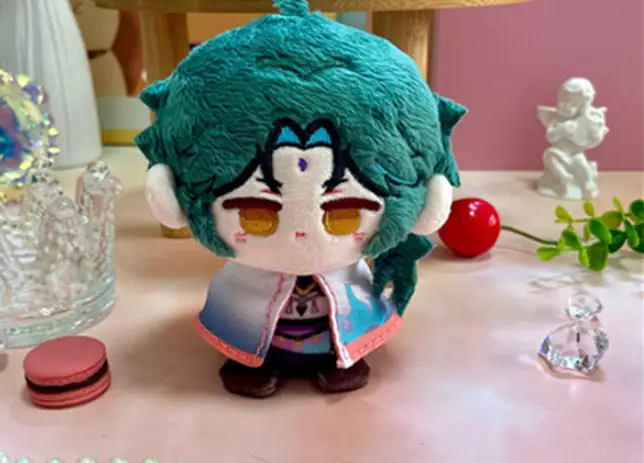
The three primary production methods for anime plush faces — embroidery, sublimation printing, and combination approaches — each have specific strengths, limitations, and appropriate applications. Selecting the right method for a specific character design is one of the most important decisions in the development process, and it should be made before sampling begins — not discovered through a failed first sample using the wrong approach.
Anime Plush Face Production Methods: Comparison Framework
| Method | Best Character Types | Color Complexity | Tactile Quality | Durability | Production Cost | Key Limitation |
|---|---|---|---|---|---|---|
| Multi-color embroidery only | Clean-line anime faces; bold flat color eyes | Medium — limited to thread colors | Raised, dimensional texture | Excellent — wash-resistant | Medium | Gradients and complex shading difficult |
| Full-face sublimation print | Highly detailed art; gradient/shading faces | Unlimited — photographic quality | Flat; no surface dimension | Good — but affected by washing/UV | Low–Medium | No tactile dimension; print-on-pile can mottle |
| Embroidery + printed panel insert | Complex art with expressive line detail | Very high — print for color, embroidery for line | Combined dimensional and flat areas | Good-Excellent depending on materials | Medium–High | Panel-to-face alignment critical; seam visible |
| Appliqué embroidery (layered felt) | Bold graphic faces; retro anime style | Medium — felt color palette | Raised, graphic, tactile layers | Very good — appliqué is stable | Medium | Sharp edges can fray if not properly finished |
| 3D sculptural embroidery | Volumetric features; foam-backed eyes | Medium | Strongly dimensional; premium feel | Excellent | High | Requires specialist digitizing; high skill level |
Embroidery Digitizing for Anime Character Faces — What Separates Accurate from Generic
Embroidery digitizing — the process of converting character artwork into machine-readable stitch files — is a creative and technical skill that determines the quality ceiling of any embroidered anime plush face. A well-digitized embroidery file for an anime character face is not a mechanical conversion of the source artwork into satin and fill stitches. It is a careful interpretation of the artwork that accounts for how thread colors read on fabric, how stitch density affects color vibrancy on textured surfaces, and how stitch direction can be used to add highlights, shadows, and dimensional character that the flat source artwork suggests but cannot directly specify.
The difference between a digitized face that accurately represents the character and one that reads as generic or flat is visible immediately to anyone familiar with the source character — and instantly apparent to the fan audience that will evaluate the product. The key indicators of a high-quality digitized anime face include: eye highlights rendered through underlay color technique or specialty thread rather than printed effects; edge definition achieved through precise satin stitch borders rather than loose outline stitching; and overall thread tension managed to avoid the fabric distortion and puckering that flattens the character’s expression.
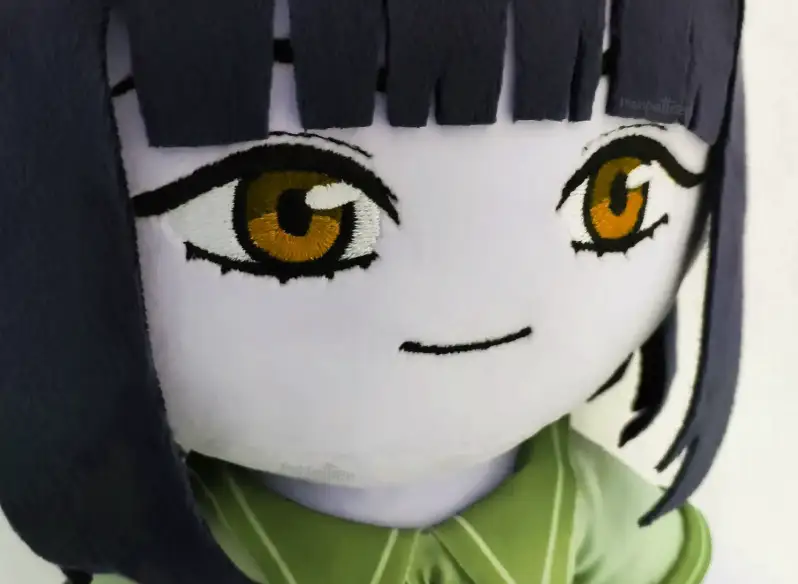
When evaluating a factory’s embroidery capability for anime plush production, requesting face embroidery samples from previously produced licensed character merchandise — not generic logo embroidery — is the most direct assessment possible. The specific challenges of anime character face embroidery are different from logo embroidery in ways that are directly visible in the quality of the samples.
Embroidery Quality Tip
Specify the face embroidery area’s backing stabilizer type in the production specification. Tear-away stabilizer is common in general embroidery production but can leave residue and reduce the softness of the face panel if not cleanly removed. Cut-away stabilizer on a minky face panel provides cleaner long-term support but adds minimal stiffness to the finished face area. For anime plush faces on short-pile fabrics, a water-soluble topping combined with a light cut-away backing produces the cleanest embroidery surface definition without the stabilizer residue that causes surface irregularity in close-up evaluation. Request stabilizer specification disclosure from the factory before sampling and verify on the first sample by pressing the face panel and inspecting under raking light for stabilizer shadow or texture variation.
When Sublimation Printing Produces Better Results Than Embroidery
Sublimation printing on fabric panels has become an increasingly viable method for anime character faces in the last several years, driven by improvements in inkjet print resolution and color management for fabric substrates. For characters with complex gradient eye effects — iris gradients that transition across multiple colors, reflected light highlights created through tone gradation, or facial shadowing that the source artwork renders as smooth color transitions — sublimation printing on a pre-cut face panel can reproduce the character’s visual complexity more faithfully than any embroidery approach.
The critical limitation of sublimation printing for plush faces is substrate management: printing directly onto plush fabric produces mottle and pile interference that degrades print clarity. The correct approach for sublimation-based anime faces is to print on a short-nap or nap-free fabric panel — typically a 100% polyester smooth knit — and construct the face as a pre-printed panel that is attached to or incorporated into the plush construction. This approach requires precise face panel cutting and placement to achieve accurate character positioning, but it produces color reproduction quality that embroidery cannot match for the most complex anime character face designs.
How Quality Control Works in Anime Plush Manufacturing — Standards and Inspection Framework
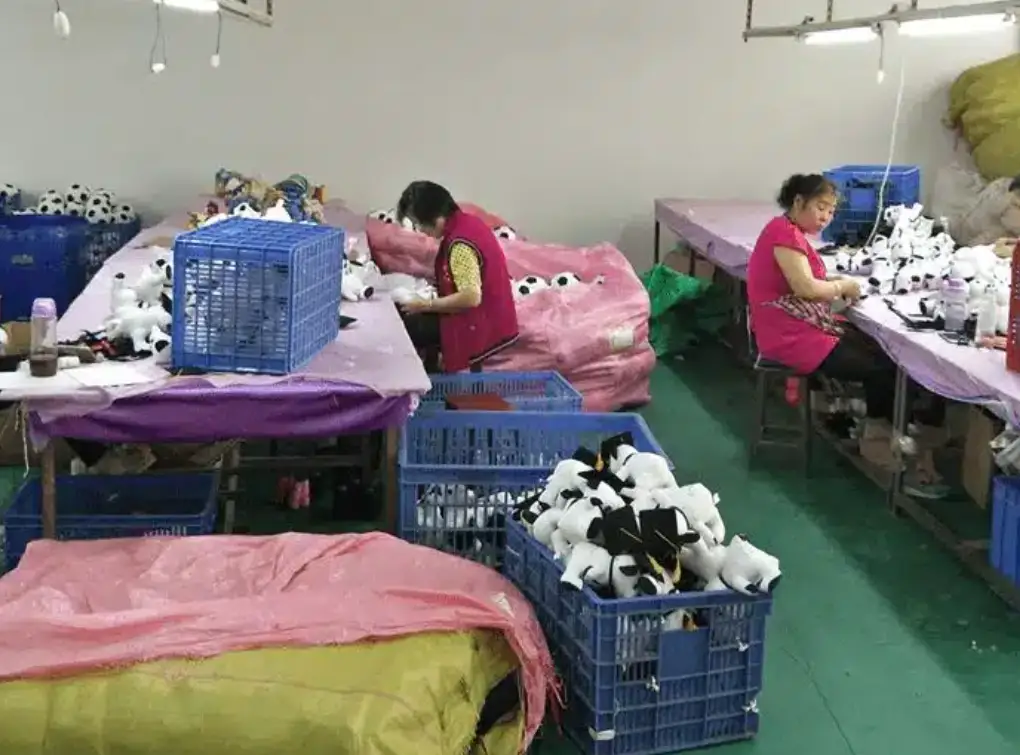
Quality control in anime plush manufacturing operates across three dimensions simultaneously — character accuracy, structural quality, and compliance conformance — and requires a structured inspection framework that addresses all three dimensions at each stage of the production process. Standard plush toy QC focuses primarily on structural quality and compliance. Anime plush QC adds the character accuracy dimension, which requires different evaluation criteria, different reference standards, and different inspection skills from those applied in standard plush production.
The most significant structural difference between anime plush QC and standard plush QC is the approved character reference standard that every inspection checkpoint must use as its evaluation baseline. In standard plush production, the approved sample is the primary reference. In anime plush production, the approved sample must itself be consistent with the official character style guide — and inspectors must evaluate bulk production units not just against the approved sample but against the character standard the approved sample represents. This distinction matters because an approved sample that was accepted at a specific quality level may itself represent the minimum acceptable character accuracy, and bulk production that drifts below the approved sample’s standard fails not just the physical product specification but the character standard.
Anime Plush QC Inspection Framework: Stage, Criteria, and Methods
| Inspection Stage | What Is Inspected | Inspection Method | Accept / Reject Criteria | Who Conducts |
|---|---|---|---|---|
| Incoming material inspection | Fabric color vs. Pantone spec; pile height; filling grade; accessory dimensions | Visual comparison; physical measurement; weight sampling | Color within ΔE 1.5 of standard; pile height ±0.5mm; weight within ±5% | Factory QC team |
| Embroidery first-off inspection | Thread color accuracy; feature placement; stitch density; surface distortion | Comparison against approved embroidery standard; measurement of feature coordinates | Eye placement within ±2mm of spec; no visible puckering; thread colors match standard | Factory QC + embroidery supervisor |
| In-process sewing inspection | Seam allowance consistency; panel alignment; limb attachment angle | Visual inspection; measurement sampling | Seam allowance ±1mm of spec; no visible seam gapping | Production line QC |
| Post-stuffing shape inspection | Head-to-body proportion; overall silhouette; limb positioning | Measurement against dimension spec; comparison to approved sample | Key dimensions within ±5% of spec; silhouette matches approved reference | Factory QC team |
| Final character accuracy inspection | Overall character likeness; face expression; color accuracy; costume completeness | Full comparison to approved sample and style guide reference | Pass/fail based on character accuracy criteria defined in quality standard | Senior QC; buyer pre-shipment or third-party inspector |
| Safety compliance inspection | Eye/accessory pull force; seam strength; small parts assessment; label content | Mechanical pull test; torque test; seam force test; label verification | Per applicable standard (ASTM F963 / EN71-1 / CPSIA) thresholds | QC team; third-party lab for certification testing |
Safety Compliance Requirements for Anime Plush Toys by Market
Anime plush toys sold in major markets are subject to mandatory safety standards that cover mechanical hazards — eye pull-force, seam strength, small parts assessment — as well as chemical requirements covering restricted substances in fabric, dye, and filling materials. Compliance is not optional for market entry in the US, EU, UK, and most developed markets, and the consequences of non-compliance — product recalls, platform delistings, regulatory enforcement actions — are severe enough that compliance planning should begin before material selection, not after sampling reveals a problem.
For anime plush products with decorative eyes — which are a standard design element in the category — the applicable mechanical test requirements are particularly important. Eyes must pass pull-force testing appropriate to the age grade and market: 90 N pull force for products intended for children under 36 months under EN71-1, with equivalent requirements under ASTM F963. The eye attachment method — whether sewn, heat-set, or safety-locked — must be appropriate to pass these requirements, and the eye size must be assessed against small-parts requirements when products are accessible to young children.
Safety Compliance Standards for Anime Plush by Market
| Market | Primary Standard | Chemical Requirements | Mechanical Key Tests | Documentation Required | Age Grading Impact |
|---|---|---|---|---|---|
| United States | ASTM F963-23 | CPSIA (lead, phthalates); REACH equivalents for exports | Pull force 15 lbf (67N) eyes/accessories; small parts cylinder | CPSC Children’s Product Certificate (CPC); test reports | Under 12: full compliance; 3+ niche labeling option |
| European Union | EN71-1, EN71-2, EN71-3 | REACH Annex XVII & SVHC; EN71-9 chemical toys | Pull force 90N (0–36m); seam strength 70N; bite test | CE marking; DoC; EN71 test reports from notified body | Under 36 months most stringent; 3+ allows some relaxation |
| United Kingdom | UK PPTS (mirrors EN71) | UK REACH; restricted substances list | Equivalent to EN71-1 mechanical requirements | UKCA marking; UK Declaration of Conformity | Mirrors EU age grading structure post-Brexit |
| Japan | ST 2012 (Toy Safety Standard) | Food Sanitation Act restrictions; limit on specific dyes | Pull force 3.6 kgf eyes; seam test per ST method | ST mark (voluntary but commercially expected); test records | Under 6 years primary scope; collector items often exempt |
| Australia / New Zealand | AS/NZS 8124 (mirrors EN71) | NICNAS chemical restrictions | Equivalent to EN71-1 mechanical tests | Compliance statement; test reports; supplier declarations | 14 years and under primary scope |
Compliance Planning Tip
For anime plush products that will be marketed as “collector items for ages 15+” or equivalent — a common approach in the category — age grading labeling alone is not sufficient to exclude compliance requirements in most major markets. The age grade must be supported by a genuine marketing restriction that demonstrably limits child accessibility. A product sold through general retail channels, on Amazon, or in environments where children have access cannot rely on an age grade label alone to exclude CPSIA, EN71, or equivalent compliance requirements. Consult the applicable regulatory authority guidance for your specific distribution channels before planning to use age grading as a compliance exclusion mechanism.
How to Manage Anime Plush Sampling and Bulk Production for Consistent Character Accuracy
Managing anime plush production to a consistently high character accuracy standard across the entire sampling and bulk production process requires active quality management at every stage — not just a well-specified brief and a strong approved sample. The most common failure pattern in anime plush production is not the first sample, which receives maximum attention and effort from all parties, but the drift between the first bulk delivery and the third, or between the pre-shipment inspection sample and the units in the middle of the production batch.
Character accuracy in bulk production is maintained through the combination of a precisely documented approved standard, clear and measurable QC criteria that operationalize that standard for production line inspectors, and active monitoring that catches and corrects any drift before it affects more than a small fraction of the production run. When any one of these elements is missing — when the approved standard is not precisely documented, when QC criteria are subjective rather than measurable, or when monitoring is only conducted at the end of the run — character accuracy issues accumulate and are discovered too late to prevent commercial damage.
Sampling Stages for Anime Plush: Purpose, Output, and Approval Requirements
| Sampling Stage | Primary Purpose | Who Must Approve | Typical Timeline | Key Output |
|---|---|---|---|---|
| Design concept mockup | Confirm 3D interpretation of 2D design before full sampling | Buyer (internal alignment) | 5–7 working days | Agreed 3D design direction before pattern investment |
| First development sample (PP1) | Establish initial physical character representation | Buyer → IP Licensor | 18–28 days from brief receipt | First physical character reference; revision feedback basis |
| Revision sample (PP2/PP3) | Address specific deviations from brief and licensor feedback | Buyer → IP Licensor | 10–18 days per round | Converging sample; approved when all parties sign off |
| Counter sample (pre-production) | Confirm approved character can be reproduced in bulk production conditions | Buyer (IP Licensor for first production) | 10–14 days | Production authorization; bulk material + process confirmation |
| First-off production inspection | Verify first units off production line match approved counter sample | Factory QC (buyer spot-check recommended) | Day 1 of production | Go/no-go for full production run |
| Pre-shipment inspection (PSI) | Verify finished bulk units against character and quality standard | Buyer and/or third-party inspection agency | When 80–100% of order is packed | Shipment authorization or corrective action instruction |
Managing the Licensor Approval Cycle Without Losing Timeline Control
The licensor approval cycle — the review and sign-off process required at each sampling stage by the IP rights holder — is the timeline element that most consistently surprises buyers who are new to licensed anime plush development. Licensor review teams manage approval requests across multiple licensees and product categories simultaneously, which means that review timelines are subject to queue effects that the buyer cannot fully control. Planning the development timeline without accounting for licensor approval turnaround time produces schedules that are structurally impossible to achieve.
The most effective approach to managing licensor approval timelines is to establish the expected review turnaround commitment from the licensor before development begins — as part of the license agreement or license compliance procedures — and to build this time explicitly into every stage of the development schedule. For licensors with review cycles of ten to fifteen working days, a three-round sampling process involves thirty to forty-five working days of approval time alone, before factory production time is added. Buyers who understand this arithmetic before they commit to retail launch dates are the ones who deliver on those commitments.
Production Tip
Submit all sampling materials to the licensor as a complete package — not incrementally as individual elements become ready. Licensor review teams evaluate the complete product, and incremental submissions that require multiple separate review actions consume review queue slots that could have been used for a single complete review. A submission that includes the physical sample, the annotated comparison to the style guide, and the buyer’s own self-assessment against the style guide criteria typically receives faster and more specific feedback than an unaccompanied physical sample — because it demonstrates the buyer’s own quality process and gives the reviewer a clear basis for evaluation.
Bulk Production Monitoring — Why Final Inspection Alone Is Not Sufficient
Relying on pre-shipment inspection as the primary quality control mechanism for anime plush bulk production is structurally insufficient — not because pre-shipment inspection is not valuable, but because it operates at the end of the production process when the cost of corrective action is highest. Character accuracy issues that could have been identified and corrected after the first day of production — a slightly off-color embroidery thread batch, a face placement that has drifted by 3mm from the approved standard, a filling density that has decreased slightly in the second week of production — generate thousands of non-conforming units when they are only identified at pre-shipment inspection.
Effective bulk production quality management for anime plush requires first-off inspection at the start of each production day, in-process sampling at defined intervals — typically every 100 to 200 units — and a clear escalation protocol that stops production and corrects the specific deviation before resuming. The cost of this in-process monitoring — primarily the time of factory QC personnel — is consistently lower than the cost of the corrective action, rework, or batch rejection that concentrated end-of-production discovery generates.
Frequently Asked Questions — Anime Plush Toy Manufacturing
Q1: What is the minimum order quantity for custom anime plush toys, and how does MOQ affect development cost?
Minimum order quantities for custom anime plush production vary significantly depending on the factory, the product complexity, and the degree of customization required. For fully custom anime plush with licensed character embroidery, proprietary fabric color matching, and character-specific accessories, most specialist manufacturers set MOQs in the range of 300 to 1,000 units per design. Factories with higher production volumes may set MOQs of 2,000 to 5,000 units, which reduces the per-unit production cost but requires a significantly larger capital commitment before the product is validated in market.
The relationship between MOQ and development cost is important to understand: development costs — sampling fees, pattern making, embroidery digitizing, and licensor approval costs — are fixed regardless of order quantity and are amortized across the production run. At lower volumes, these fixed development costs represent a higher per-unit overhead. For a 500-unit run where development costs total $1,200, the development overhead adds $2.40 per unit. For a 2,000-unit run with the same development costs, the overhead drops to $0.60 per unit.
This arithmetic argues for higher initial order quantities from a cost efficiency perspective — but only when the product’s market viability has been validated, since unsold inventory represents a higher total loss than a higher per-unit development cost on a smaller initial order. For new anime character launches or untested designs, a staged approach — smaller initial order for market validation, larger reorder at confirmed sell-through — is consistently more commercially prudent than maximizing the initial order quantity for cost efficiency alone.
Q2: How many revision rounds should buyers plan for in an anime plush development cycle, and what drives the variation?
The number of revision rounds required in anime plush development varies from one to five or more, with the median for first-time collaborations between a buyer and a new factory typically falling between two and three rounds before licensor-approved sample status is achieved. The primary driver of revision round count is brief quality: development cycles beginning from a precisely specified, completely documented brief with Pantone color references, coordinate-based feature placement specs, and explicit proportion ratios consistently require fewer revision rounds than those beginning from general descriptions or incomplete reference materials.
Factory experience in anime character production is the second most important driver: factories that have produced multiple licensed character products have developed pattern-making intuition, embroidery digitizing experience, and a quality culture that reduces first-sample deviation rates. IP complexity is the third driver: simple character designs with limited color areas and straightforward embroidery requirements naturally generate fewer revisions than characters with gradient hair effects, complex costumes, and multiple small accessories.
For planning purposes, budgeting for three full sampling rounds — including sample fees, domestic shipping, and licensor review time — before production authorization is a reasonable baseline that accounts for the normal variation in this process without over-provisioning for best-case scenarios that rarely materialize for first-time factory relationships.
Q3: What are the key differences between producing an officially licensed anime plush and producing a fan-made or original character plush using an anime aesthetic?
The differences between officially licensed anime plush production and original or fan-made character plush production in an anime aesthetic are significant across legal, technical, and commercial dimensions. On the legal dimension: officially licensed production requires a formal IP licensing agreement with the rights holder, which grants the right to reproduce the character in exchange for royalties, compliance with the licensor’s brand standards, and submission to the licensor’s approval process.
Producing plush toys that reproduce copyrighted anime characters without a license agreement constitutes infringement regardless of the producer’s intentions or market position, and exposes the producer to civil liability that can include damages, injunctions, and destruction of infringing inventory. Original character plush production — designing and producing plush toys in an anime aesthetic without reproducing any specific copyrighted character — requires no license and no licensor approval, and gives the producer full creative control. Fan-made designs that reproduce copyrighted characters are legally in the same category as unlicensed commercial production even when produced in small quantities, though enforcement varies by rights holder and production scale.
On the technical dimension: officially licensed production requires adherence to the licensor’s style guide and accuracy standards, which disciplines the design and increases brief precision requirements. Original character production in an anime aesthetic does not have this external accuracy requirement, which reduces development complexity but also removes the brand recognition that drives consumer demand for licensed merchandise. The commercial implication is that original character plush in an anime style must build its own character identity and audience from scratch, while licensed plush benefits from the existing fan base of the IP — a significant commercial advantage that explains the premium buyers pay for licensing rights.
Q4: How should buyers evaluate whether a factory is genuinely capable of producing accurate anime character embroidery versus simply claiming character plush capability?
Evaluating a factory’s genuine anime character embroidery capability — as opposed to a general plush production capability that the factory represents as including character work — requires specific evidence requests that cannot be satisfied with generic samples or general capability claims. The most direct evaluation approach is to request physical samples of previously produced licensed anime character plush toys — not original character plush, and not samples produced specifically for the evaluation. Previously shipped licensed character merchandise demonstrates real production capability under the actual quality standards that character licensing requires.
When reviewing these samples, the evaluation criteria should focus specifically on face embroidery quality: the accuracy of eye shape and size relative to the character, the color fidelity of embroidery thread to the character’s defined palette, the cleanliness of stitch definition at small feature scales, the absence of fabric puckering or distortion around the embroidery area, and the expressive accuracy of the completed face — whether it actually reads as the character or merely as a generic face in the character’s general color scheme.
Requesting the factory’s embroidery machine specifications is also useful: the number of heads, the needle count, and the machine’s minimum stitch capability indicate whether the machine can physically execute the small-scale, multi-color embroidery that anime character faces require. A factory whose embroidery machines have limited color head counts or cannot work below a minimum face area threshold may be technically incapable of producing the embroidery precision the character requires — regardless of what their sales team represents about their character production capability.
Q5: What is the correct approach when bulk production reveals character accuracy drift that was not present in the approved counter sample?
Character accuracy drift between an approved counter sample and bulk production units — where a specific embroidery placement, color, proportion, or assembly detail has shifted from the approved standard without a material change that explains the deviation — is a production quality failure that requires structured corrective action rather than negotiated acceptance of a lower standard. The correct response begins with a production stop: production of additional units with the identified deviation should be halted immediately until the root cause is identified and corrected.
The root cause investigation should determine whether the drift resulted from a material batch change — a different dye lot of thread, a fabric batch with slightly different pile density — from a machine parameter change, from operator variability in an embroidery or assembly step, or from degradation of the reference standard used by in-process QC inspectors. Once the root cause is established, the corrective action should address the root cause specifically: a material batch change requires material substitution or re-approval; a machine parameter drift requires parameter verification and reset; an operator variability issue requires retraining and enhanced monitoring.
Units already produced with the drift deviation must be evaluated individually against the approved standard and either accepted within a formally agreed tolerance, reworked to bring them within the approved standard, or rejected and replaced. Accepting drifted production units as equivalent to the approved standard without formal evaluation sets a precedent that reduces the credibility of the approved standard for the remainder of the production run — and for the licensor, who may audit production quality against the same standard at any point during the license term.
Conclusion
Anime plush toy manufacturing is not a variation of standard plush production — it is a distinct manufacturing discipline that requires IP compliance infrastructure, character-specific design brief capability, specialized embroidery and fabric selection skills, and quality management practices calibrated to the expectations of one of the most knowledgeable and demanding consumer audiences in the toy industry.
The buyers who achieve consistently strong results in this category are not those who find the lowest unit price and hope the character accuracy follows. They are the ones who invest in precise brief preparation before sampling begins, select factories whose character production capability is demonstrable rather than claimed, manage the licensor approval cycle with accurate timeline planning, and maintain active quality oversight through bulk production rather than relying on end-of-run inspection to catch problems that accumulate across the full batch.
The framework in this guide — from design brief construction through material selection, face production method choice, compliance planning, and bulk production monitoring — provides the structural basis for approaching anime plush development with the rigor this category demands. Every element of this framework exists because a specific failure mode exists that it prevents. Applying it consistently is what separates anime plush products that perform commercially and satisfy licensors from those that absorb development cost, generate warranty exposure, and fail the fan audience that was always the most important judge.