Skip to content
When choosing materials for plush toys, understanding the differences between Minky Fabric vs Velboa for Plush Toys can help you achieve the ideal balance of softness, durability, appearance, and cost.
An in-depth reference for product developers, brand buyers, and sourcing managers evaluating fabric selection, tactile performance, compliance considerations, and cost trade-offs in plush toy production.
Understanding the Two Dominant Plush Fabrics
When it comes to selecting surface fabric for stuffed toys and plush products, two materials dominate commercial manufacturing: minky fabric and velboa. Both are 100% polyester knit constructions, both are widely available from tier-one fabric mills, and both meet the general flammability and chemical content requirements demanded by major toy safety frameworks including ASTM F963 and EN 71. Yet the two fabrics produce dramatically different finished products — in terms of tactile quality, manufacturing behavior, color expression, and cost structure.
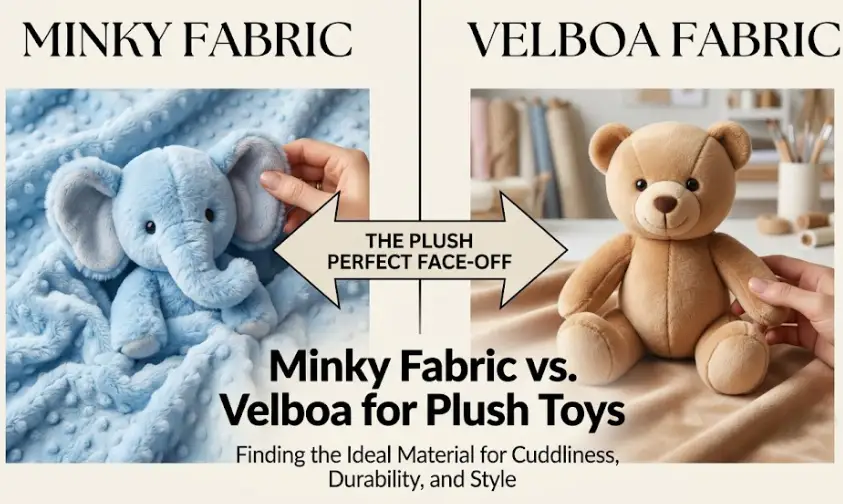
Understanding the differences between minky and velboa is not merely an aesthetic decision. Fabric choice affects sewing throughput, seam allowance specifications, print compatibility, retail price positioning, and the sensory experience that ultimately drives consumer purchasing decisions. For any product developer briefing a contract manufacturer on a new plush line, fabric specification is one of the earliest and highest-leverage choices in the development process.
Fabric type A
Minky
High-pile polyester knit with pronounced softness, directional nap, and a premium tactile profile. Pile height typically 1.5 – 3 mm. Associated with luxury-tier plush, infant products, and premium gift categories.
Fabric type B
Velboa
Short-pile polyester plush with a dense, uniform surface texture and strong color vibrancy. Pile height typically 0.5 – 1.5 mm. Associated with mass-market plush, character toys, and high-volume production runs.
Fabric Construction and Physical Properties
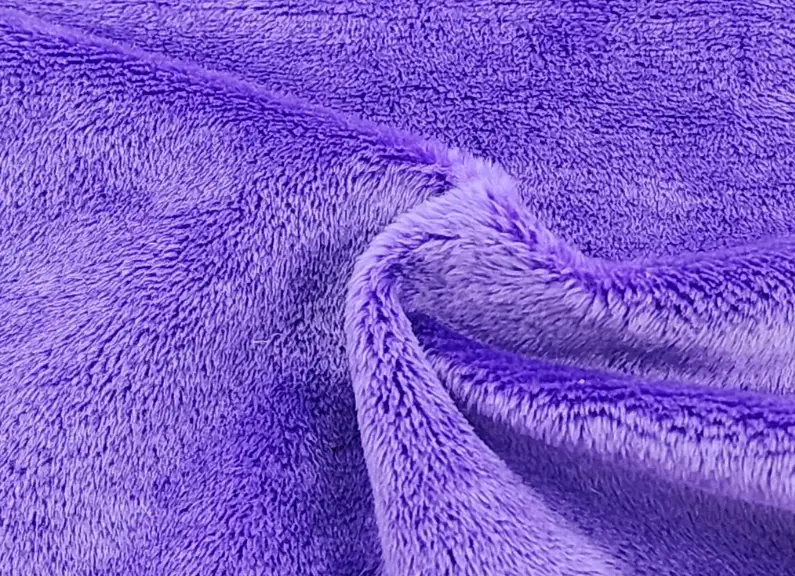
Minky fabric — also sold under the trade terms cuddle fleece, Shannon minky, or plush minky — is constructed from fine-gauge polyester yarn knitted into a base with a raised, ultra-dense pile surface. The signature characteristic is its directional nap: the pile lies in a consistent direction and produces a subtle sheen change when viewed from different angles. This directionality requires pattern pieces to be cut on the same grain during manufacturing, adding a material efficiency consideration that typically increases fabric consumption by 8–12% compared to non-directional fabrics.
Velboa (also spelled velboa plush or vel-boa) is a short-pile woven or knitted polyester fabric with a more uniform, non-directional surface. Its pile is denser and shorter than minky, resulting in a smoother appearance and higher dimensional stability during cutting and sewing. Velboa’s tighter surface structure also makes it more receptive to heat transfer printing and screen printing applications, which is a key reason it remains the preferred substrate for character plush with detailed graphic elements.
Physical Property Comparison: Minky vs Velboa
| Property | Minky | Velboa |
|---|---|---|
| Pile height | 1.5 – 3 mm (high pile) | 0.5 – 1.5 mm (short pile) |
| Pile direction | Directional nap | Non-directional |
| Base construction | Polyester knit | Polyester knit/woven |
| Fabric weight | 280 – 380 gsm | 180 – 260 gsm |
| Stretch behavior | High stretch; 4-way | Moderate stretch; 2-way typical |
| Surface texture | Ultra-soft, plush, slightly silky | Dense, smooth, velvety |
| Color expression | Slightly muted; nap affects saturation | High vibrancy; strong color pop |
Tactile Performance and Consumer Perception
Tactile quality is the primary sensory driver for plush toy purchasing decisions, and this is where minky and velboa diverge most meaningfully. Minky fabric consistently scores higher in softness evaluations across consumer research — its longer pile and fine-gauge yarn construction produce a surface that many describe as silky, cloud-like, or reminiscent of a newborn animal’s coat. This tactile richness has made minky the default material of choice for infant comfort products, premium cuddly toys, and licensed character plush at higher retail price points.
Velboa offers a different but entirely valid tactile proposition. Its shorter, denser pile has a firmer, more uniform feel that many consumers associate with quality and durability. In product categories where visual detail is prioritized over raw softness — such as collectible character figures, mascot plush, or promotional items — velboa’s cleaner surface definition actually outperforms minky by preserving embroidered and printed detail more crisply.
For products intended for children under 18 months, softness metrics carry additional importance as a product safety consideration: softer fill and softer surface materials reduce abrasion risk on sensitive infant skin. Minky’s superior softness rating makes it a more defensible material choice for this age segment.
Tip for product developers: When conducting consumer or retailer sample reviews, always present fabric swatches alongside the assembled prototype — fabric softness is perceived differently on a flat swatch versus a stuffed, shaped product. A minky prototype with appropriate fill density will almost always outperform a velboa sample in blind tactile testing at equivalent price points.
Manufacturing Behavior: What Happens on the Sewing Line
The choice between minky and velboa has significant implications for production efficiency, and understanding these implications helps buyers set realistic expectations for lead times, yield rates, and per-unit costs.
Cutting and Pattern Efficiency
Minky’s directional nap requires all pattern pieces to be cut in a single direction, which limits how efficiently pieces can be nested on a cutting lay. This increases material waste per unit compared to non-directional fabrics. For a standard medium-sized plush (25–35 cm), directional cutting typically adds 10–15% to fabric material cost versus an equivalent velboa design. Automated cutting tables can mitigate this to some degree, but the geometric constraint remains.
Velboa’s non-directional surface allows free-form pattern nesting, maximizing fabric utilization and reducing per-unit material waste. For high-volume production runs where material cost is tightly controlled, velboa’s cutting efficiency is a meaningful economic advantage.
Sewing Behavior and Seam Integrity
Minky’s high stretch factor — typically 4-way stretch — requires experienced operators and appropriate needle and thread selection to prevent seam distortion. Overlock stitching with polyester thread at 3–4 mm stitch length is standard for minky seam construction. Under-experienced handling can produce wavy seam lines or pile bleed at seam edges, both of which are visible defects in finished products. Quality control inspection rates for minky plush are typically higher than for velboa.
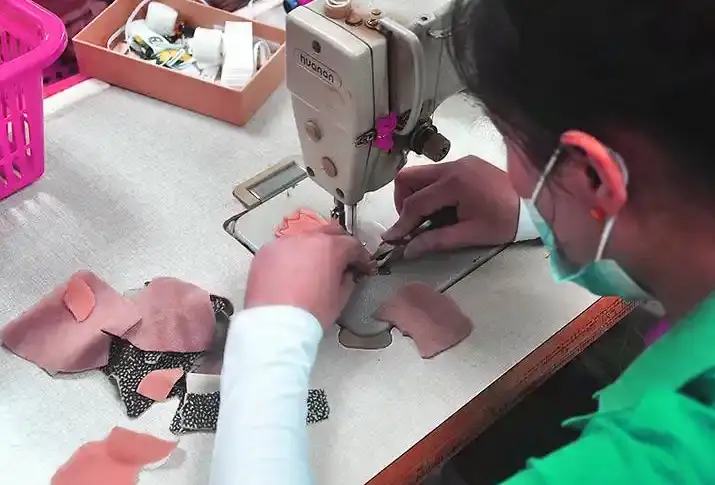
Velboa’s lower stretch and more stable base construction make it more forgiving on the sewing line. Seam allowances are more predictable, and the fabric’s firmer backing reduces pile bleed at cut edges. For manufacturers new to plush production or for programs prioritizing throughput efficiency, velboa typically yields a more consistent first-pass quality rate.
Manufacturing Behavior Comparison: Minky vs Velboa
| Production Factor | Minky | Velboa |
|---|---|---|
| Cutting method | Directional cut required | Free-form nesting possible |
| Material yield | Lower (8–15% more waste) | Higher; efficient nesting |
| Sewing difficulty | Moderate–high; stretch management needed | Low–moderate; stable base |
| Recommended stitch | Overlock, 3–4 mm, polyester thread | Overlock or straight stitch |
| Pile bleed at seams | Moderate risk; needs trimming | Low risk |
| Print compatibility | Limited; surface texture diffuses print | High; ideal for heat transfer |
| QC inspection rate | Higher recommended | Standard |
Color, Print, and Surface Detail Capability
Surface detail fidelity is a key differentiator between the two fabrics, particularly for licensed character products and branded plush where visual accuracy to a reference artwork is contractually important.
Velboa’s shorter, denser pile provides a more stable printing substrate. Heat transfer printing and sublimation printing on velboa produce sharper edge definition, more accurate color matching, and better resistance to image degradation over wash cycles. This makes velboa the material of choice for any plush product where printed surface graphics — eyes, facial features, body markings, brand logos — are a primary design element.
Minky’s longer pile diffuses fine detail, making it unsuitable for detailed surface printing. On minky products, facial features and surface details are almost exclusively achieved through embroidery, appliqué, or sewn-on components rather than printing. Embroidery on minky requires a stabilizer backing to prevent the base fabric from distorting under stitch tension. This adds a production step that velboa typically does not require.
Tip for sourcing managers: If your design relies heavily on printed surface graphics — particularly any image with fine line detail smaller than 5 mm — specify velboa as the base fabric in your product brief. Attempting to reproduce the same print on minky will require significant design simplification and will likely still produce a noticeably softer edge definition. Confirm print capability and resolution limits with your factory before artwork is finalized.
Surface Detail and Color Performance: Minky vs Velboa
| Attribute | Minky | Velboa |
|---|---|---|
| Print suitability | Low; pile diffuses edge detail | High; clean edge definition |
| Embroidery behavior | Requires stabilizer backing | Standard; no stabilizer typically needed |
| Color range | Wide; slight nap-related tone variation | Very wide; high saturation achievable |
| Color consistency batch-to-batch | Moderate; nap direction affects appearance | High; uniform surface aids consistency |
| Surface feature detailing | Best via appliqué or embroidery | Print, embroidery, or appliqué all viable |
Cost Structure and Price Positioning
Raw material cost is one of the most direct points of difference between minky and velboa. Minky fabric commands a consistent price premium over velboa across all major sourcing markets, reflecting its higher yarn count, longer pile construction, and more complex finishing process. Typical mill pricing from Chinese and Korean fabric suppliers places minky at 1.4 to 2.2 times the per-meter cost of comparable velboa grades.
This cost differential compounds through the production process. Minky’s lower cutting yield, higher QC inspection requirements, and embroidery stabilizer costs all add incremental manufacturing cost that is not present in velboa production. For a standard small-to-medium plush product, the total landed cost of a minky version typically runs 20–35% higher than an equivalent velboa design — a significant gap that must be supported by either a higher retail price point or a brand premium justification.
For mass-market programs targeting price-sensitive retail channels — discount stores, crane machine operators, high-volume promotional buyers — velboa’s cost structure is often the decisive factor in fabric selection. For premium gift lines, boutique character plush, or infant and nursery products where softness is the primary value driver, the minky price premium is typically well-supported by consumer willingness to pay.
Cost and Commercial Positioning: Minky vs Velboa
| Factor | Minky | Velboa |
|---|---|---|
| Typical fabric cost premium | 1.4× – 2.2× velboa baseline | Baseline reference |
| Total unit cost vs velboa equiv. | +20% – 35% higher | Lower cost baseline |
| Supported retail price tier | Mid-premium to premium | Value to mid-market |
| Volume order suitability | Moderate; cost limits very high volumes | High; ideal for large-run programs |
| Brand/gift positioning | Premium gift, infant, licensed premium | Character plush, promotional, mass-market |
| MOQ flexibility | Lower MOQ acceptable at premium price | Benefits from higher volume |
Frequently Asked Questions
Is minky fabric safe for babies and infants?
Minky fabric is widely used in infant products and is generally considered safe for babies when it meets applicable chemical content and flammability standards. In the United States, infant plush toys must comply with CPSIA requirements, which include restrictions on lead content, phthalates, and certain flame retardants. In the European Union, EN 71 Part 9 covers chemical requirements for textile toys. Minky fabric sourced from reputable mills and tested through third-party laboratories — typically SGS, Bureau Veritas, or Intertek — can readily achieve compliance with both frameworks.
The key safety consideration for infant minky products is not the fabric itself, but the construction: seam integrity, stuffing security, and the absence of small removable parts are all critical for the under-18-months age group. From a skin-contact perspective, minky’s ultra-soft, low-friction surface is actually advantageous for infant skin, and it is preferred over shorter-pile fabrics for products intended for newborns and very young infants. Buyers should always request fabric test reports alongside production samples and verify that the test standard matches their target market.
Can minky and velboa be used together in the same plush toy?
Yes, combining minky and velboa in a single plush product is a well-established design technique in the industry. This approach allows designers to leverage the tactile premium of minky for large body areas — where the softness is most perceptible to the consumer’s hands — while using velboa for detail-heavy panels, facial features, or printed elements where surface clarity is important.
A common construction approach is to use minky for the main body and head, and velboa for the face panel, paw pads, or any area carrying printed or embroidered design details. From a manufacturing standpoint, combining the two fabrics in one product requires careful attention to seam construction at fabric junctions, since their different stretch behaviors can create pucker or misalignment if not managed with appropriate stitching technique.
A well-briefed manufacturer will adjust stitch tension and use a walking foot or differential feed setting at the transition seams. Mixed-fabric plush products are slightly more labor-intensive than single-fabric designs, which typically adds 5–10% to the sewing cost, but the resulting product can offer a compelling balance of tactile appeal and visual quality that neither fabric achieves alone.
Which fabric is better for machine washing durability?
Both minky and velboa are polyester-based fabrics and share broadly similar washability characteristics, but there are meaningful differences in how each fabric holds up over repeated wash cycles. Velboa’s shorter, denser pile is more resistant to matting and pilling after repeated washing, making it the more durable choice for products that will be frequently laundered — such as children’s comfort toys, pet toys, or plush products used in commercial or institutional settings.
Minky’s longer pile is more susceptible to matting if washed aggressively, though this can be mitigated significantly with appropriate care instructions. Cold-water gentle cycle washing and air drying are strongly recommended for minky plush; tumble drying on high heat will cause irreversible pile compression and reduce the tactile quality that makes the material premium.
For product specification purposes, if the intended use case involves frequent washing — or if the product will be marketed with a machine-washable claim — velboa offers a more reliable long-term performance profile. For products where washing frequency is low, such as display pieces or collectibles, minky’s superior initial tactile quality may outweigh the durability advantage of velboa. Care instructions on product labeling should reflect the specific fabric used.
What is the difference between minky and faux fur fabric for plush toys?
Minky and faux fur are both pile polyester fabrics, but they are distinct materials with different pile structures, visual profiles, and manufacturing behaviors. Minky features a uniform, fine-textured pile of 1.5 to 3 mm that creates a smooth, consistent surface — more reminiscent of a plush blanket than an animal coat. Faux fur, by contrast, is engineered to mimic animal pelts, with longer, more irregular pile heights (typically 10–40 mm), visible pile variation, and often a multi-tone dye pattern designed to replicate the visual complexity of real fur. Faux fur is used for realistic-looking stuffed animals — bears, wolves, foxes — where visual realism is a design priority.
Minky is used where tactile softness and a clean, modern aesthetic are the goal. From a manufacturing standpoint, faux fur is the most demanding of the three main plush fabrics: its long pile requires specialized cutting equipment, generates significant shedding during production, and creates complex seam finishing challenges. Velboa occupies the middle ground — shorter and more uniform than faux fur, more structured and detail-capable than minky. The three fabrics serve distinct product categories rather than being directly interchangeable alternatives.
How do I choose between minky and velboa for a new plush product line?
The choice between minky and velboa should be driven by four primary considerations: target retail price point, design detail requirements, intended age group, and production volume. For products in the premium or gift tier — typically retailing above USD 20–25 — minky’s tactile superiority provides a material justification for higher consumer pricing and supports a stronger unboxing experience. For mass-market products retailing under USD 15, velboa’s cost efficiency and production reliability make it the more rational choice.
On design requirements: if your product relies heavily on printed surface graphics, detailed facial features, or complex color blocking with high saturation requirements, velboa will deliver better results. If the product’s appeal is primarily sensory — softness, cuddle quality, the feel of the fabric — minky will outperform velboa at every consumer touch point. For products targeting infants under 18 months, minky’s softness profile provides a tangible product benefit worth the cost premium.
For school-age or general-audience character plush, velboa’s versatility and cost profile typically make it the better commercial choice. When in doubt, request fabric samples in both materials from your manufacturer and conduct a simple side-by-side consumer preference test before finalizing your specification.