Skip to content
What Makes a High-Quality Plush Toy is all about the materials, stitching precision, safety standards, and thoughtful design that come together to create a soft, durable, and lovable product. A materials and construction guide to what separates a plush toy that lasts for years from one that falls apart within weeks.
A high-quality plush toy is the product of dozens of individually small decisions — fabric weight, stuffing density, stitch type, seam allowance, fastening method — that compound into a finished item that feels good to hold, survives years of handling, and passes safety testing without compromise.
To a shopper, quality often reads as a single impression: does this toy feel substantial, soft, and well-made? Behind that impression sits a specific, testable set of manufacturing and material choices. This guide breaks down exactly what those choices are, how they’re evaluated, and what separates premium plush construction from low-grade product that looks acceptable on a shelf but fails quickly in a child’s hands.
Why Plush Toy Quality Is Hard to Judge at a Glance
Plush toys are deceptively difficult to evaluate visually. Two toys can look nearly identical in a product photo — same silhouette, similar color, comparable size — while differing enormously in fabric grade, stuffing density, and seam construction. The differences that actually determine how long a toy lasts are almost entirely hidden beneath the surface: the tightness of the stitching, the fiber content of the plush pile, the density of the fill, and the strength of the seam allowances at stress points like limb joints and neck seams.
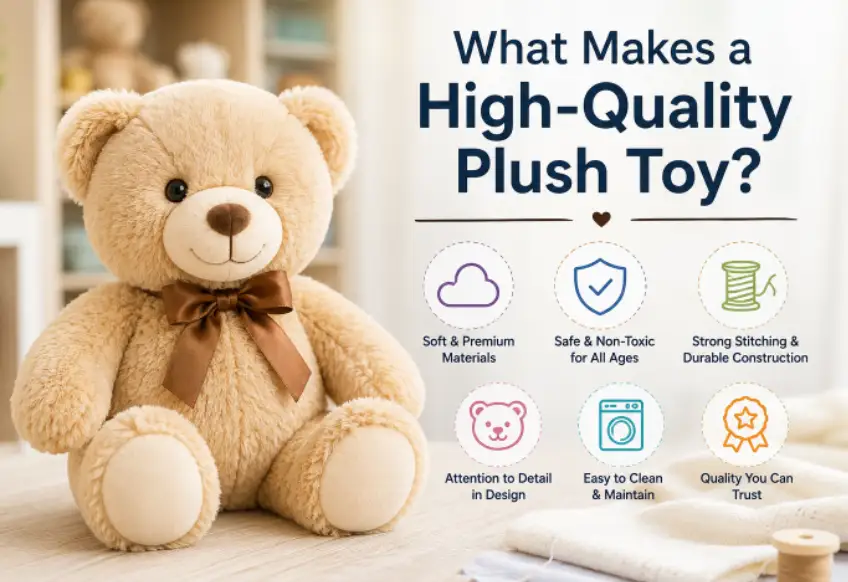
This is why plush toy quality assessment relies on a combination of tactile evaluation, construction inspection, and formal testing rather than visual review alone. A toy that looks premium in a listing photo can fail a seam-strength pull test within seconds, while a plainer-looking toy built with dense stuffing and reinforced stitching can survive years of daily handling. Understanding the underlying quality factors is the only reliable way to distinguish the two before a toy has already been in use — and often failed — for months.
Fabric and Pile Quality
Fiber Content: Polyester, Acrylic, and Blends
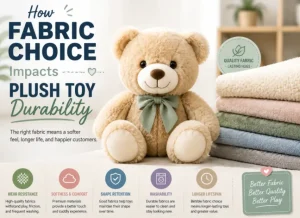
The overwhelming majority of plush toy exteriors are made from polyester pile fabric, valued for its softness, colorfastness, durability, and relatively low cost compared to natural fibers. Acrylic pile offers a slightly different hand-feel, often described as fluffier, but tends to pill more readily under repeated friction than polyester. Higher-end plush frequently uses a polyester-acrylic blend or a specifically engineered microfiber pile to combine softness with improved wear resistance, and fabric quality is frequently the single factor a shopper notices first when comparing two plush toys side by side.
Pile Density and Backing Weight
Pile density — how tightly the fibers are woven or tufted into the backing fabric — directly determines how plush and full a toy feels, and how well it resists matting and bald patches from repeated handling. A denser pile also better conceals the backing fabric and internal seams, contributing to a more finished, premium appearance. Backing fabric weight matters independently of pile density, since a lightweight backing is more prone to seam tearing under stress even if the surface pile itself looks dense and full.
Colorfastness and Print Durability
Printed or dyed details on plush fabric — facial markings, pattern accents, brand graphics — need to withstand repeated washing and UV exposure without fading, bleeding, or cracking. Colorfastness testing, typically involving repeated wash cycles and rub testing against a white cloth, verifies that dye will not transfer onto skin, clothing, or other toys during normal use, which is both a quality and a safety consideration for products intended for young children.
Tip: Run a simple pile recovery test on sample fabric before committing to a production run: press the pile flat with a finger for several seconds, release, and observe how quickly and fully it springs back. Fabric that recovers slowly or incompletely is more likely to develop permanent flat or matted patches after repeated handling in the finished toy.
Common Plush Pile Fabrics and Their Quality Characteristics
| Fabric Type | Hand-Feel | Durability | Typical Use |
|---|---|---|---|
| Standard polyester pile | Soft, smooth | High; resists pilling and matting | General-purpose plush across most price tiers |
| Acrylic pile | Fluffy, voluminous | Moderate; more prone to pilling | Decorative or shorter-life plush items |
| Microfiber/minky plush | Very soft, dense | High | Premium plush, baby-safe comfort items |
| Polyester-acrylic blend | Balanced softness and fullness | Moderate to high | Mid-to-premium tier plush toys |
Stuffing Material and Fill Quality
Fiber Fill Types
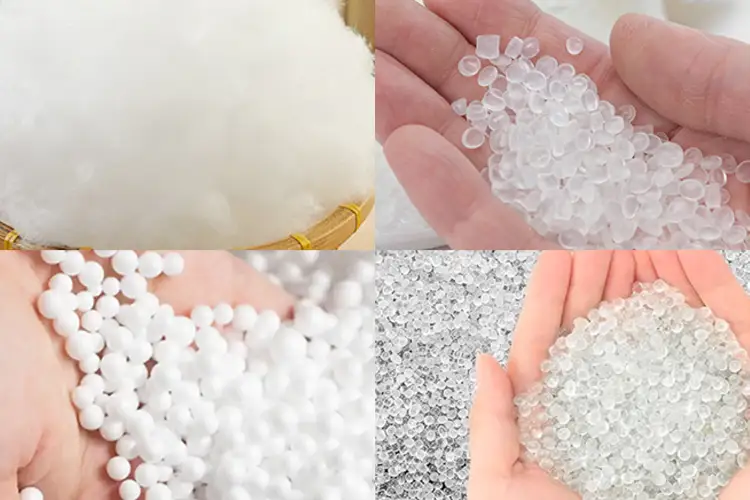
Polyester fiberfill is the standard stuffing material across the plush toy industry, prized for being lightweight, hypoallergenic, machine-washable, and consistent in performance across production runs. Fiberfill quality varies by denier (fiber thickness) and by whether the fiber has been treated with a silicone coating, which improves loft and resilience, helping the toy hold its shape rather than compacting flat after repeated squeezing.
Stuffing Density and Distribution
Stuffing density is one of the most immediately noticeable quality indicators to a shopper handling a toy: underfilled plush feels floppy and loses its shape, while overfilled plush can feel unnaturally stiff and place excess stress on seams. Even consistent distribution throughout the toy — particularly in narrow areas like limbs, ears, and tails — matters as much as overall density, since uneven stuffing produces visible lumps, thin spots, and localized seam stress that accelerates wear at exactly those points.
Weighted Fill and Bean Bag Inserts
Some plush designs incorporate weighted fill — plastic or glass beads, or specialized weighted pellets — in the base or paws to improve how the toy sits or balances. Weighted inserts must be securely double-stitched into an inner pouch, fully separate from the outer shell seam, since a failure at this point creates both a quality defect and, if small beads escape, a choking hazard.
Tip: Squeeze a finished sample firmly at its narrowest points — ears, tails, limb ends — and check for any shifting, lumping, or thinning of the fill. These narrow areas are the first place uneven stuffing distribution becomes noticeable, and they’re also the areas most subject to repeated grabbing and pulling in actual use.
Stitching, Seams, and Construction
Stitch Type and Stitches Per Inch
Seam strength is determined largely by stitch type and stitch density. A tight, consistent lockstitch with a high stitches-per-inch count distributes stress more evenly along the seam than a loose or inconsistent stitch pattern, directly reducing the likelihood of seam failure under the repeated pulling and squeezing a plush toy experiences in normal use. Double-stitched or reinforced seams at high-stress points — limb joints, neck seams, and any area where an accessory or embellishment attaches — provide meaningfully better durability than a single pass of stitching throughout.
Seam Allowance and Turning
Seam allowance — the distance between the stitch line and the fabric edge — needs to be wide enough to prevent the fabric from fraying loose or the seam pulling apart under tension, but not so wide that it creates bulk or interferes with turning the piece right-side-out during assembly. Proper turning technique at tight curves, such as around ears or paws, prevents puckering and ensures the finished shape matches the intended design rather than appearing distorted or asymmetric.
Attachment Points for Eyes, Noses, and Embellishments
Safety eyes, noses, and any hard embellishments must be secured using a locking washer mechanism on the interior of the fabric, professionally embroidered rather than glued, or otherwise permanently fixed in a way that resists the pull-force testing required for children’s products. Glued-on embellishments are a common quality shortcut that fails both durability expectations and, more importantly, safety testing requirements for toys intended for young children.
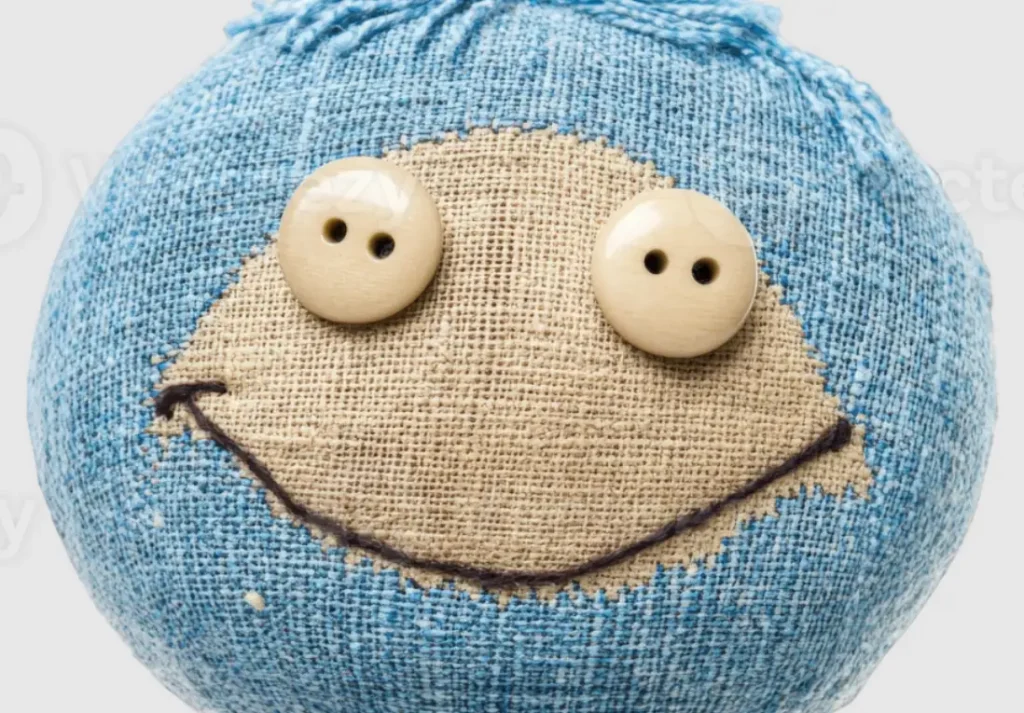
Plush Toy Seam and Attachment Quality Indicators
| Construction Element | High-Quality Indicator | Common Quality Shortfall |
|---|---|---|
| Seam stitching | Tight, consistent lockstitch; reinforced at stress points | Loose, uneven stitching; single-pass seams at high-stress joints |
| Seam allowance | Adequate width to prevent fraying without added bulk | Minimal allowance that frays or pulls apart under tension |
| Eyes/nose attachment | Locking washer mechanism or embroidered detail | Glued-on components that detach under pull-force testing |
| Limb and joint seams | Double-stitched reinforcement | Single-stitch construction prone to splitting |
| Weighted insert pouches | Fully sealed inner pouch, independently stitched | Loose fill mixed directly with weighted beads |
Safety Testing and Compliance
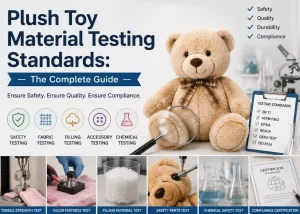
Quality and safety are inseparable in plush toy manufacturing, particularly for products intended for children under three, where small-parts and choking hazard regulations apply with the greatest strictness. Pull-force testing on all attached components — eyes, noses, bows, tags — verifies that nothing can be dislodged under the force a child might realistically apply during play. Flammability testing confirms the fabric and fill meet required burn-rate standards, while chemical testing screens for restricted substances in dyes, coatings, and any plastic components.
Age grading drives which specific test protocols apply: toys labeled for children under three face the most rigorous small-parts testing, since this age group is most likely to place toys or components in their mouths. A toy that passes testing appropriate for an older age grade but is marketed toward a younger one represents both a compliance failure and a genuine safety risk, which is why accurate age grading during the design phase — not just at final testing — is a foundational part of a sound quality program.
Core Safety Test Categories for Plush Toys
| Test Category | What It Verifies | Most Relevant Age Group |
|---|---|---|
| Pull-force / tension testing | Attached components resist detachment under applied force | All ages, strictest for under 3 |
| Small parts testing | No detachable piece fits within the small parts cylinder | Under 3 years |
| Flammability testing | Fabric and fill meet the required burn-rate limits | All ages |
| Chemical/heavy metals testing | Dyes, coatings, and materials meet restricted substance limits | All ages, strictest for under 3 |
| Seam/stitch strength testing | Seams withstand repeated stress without opening | All ages |
Finishing Details That Signal Craftsmanship
Embroidered vs. Printed Facial Features
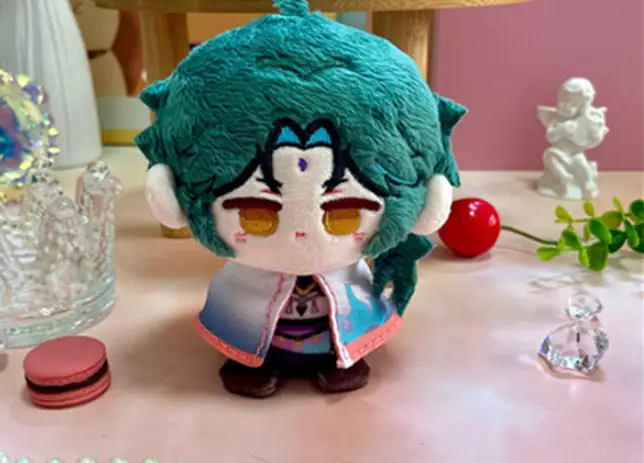
Embroidered facial features generally outlast printed ones, since embroidery is physically stitched into the fabric and resists fading, cracking, and wear far better than a printed or heat-transferred design, which can crack or peel after repeated washing and handling. Embroidery also tends to read as a more premium construction choice, contributing meaningfully to the overall perceived quality of the finished toy even when it represents a relatively small portion of total manufacturing cost.
Symmetry and Proportion Consistency
Consistent symmetry — matching ear placement, even limb length, aligned facial features — is a subtle but important quality marker, particularly across a production run where minor pattern-cutting or assembly variation can accumulate into visibly inconsistent finished toys. Quality inspection at the finishing stage typically includes a visual symmetry check against an approved reference sample specifically to catch this kind of drift before it reaches packaging.
Packaging and Tag Presentation
While packaging does not affect the toy’s physical durability, tag attachment quality, care label accuracy, and packaging presentation all contribute to a shopper’s overall quality impression at the point of purchase, and required compliance labeling — age grading, care instructions, safety certifications — must be present, accurate, and securely attached as part of a complete quality program rather than treated as an afterthought.
Tag security itself is worth specific attention: a tag that detaches easily during normal handling not only looks unfinished but can create a small-parts concern depending on tag size and attachment method, particularly for products aimed at very young children. Reinforced tag stitching, positioned at a seam rather than a single point of attachment, reduces this risk while also holding up better through repeated washing over the toy’s lifetime.
Comparing Quality Tiers: What Changes Across Price Points
Plush toy quality generally scales predictably with price, though not always in obvious ways. Entry-level plush typically uses lower pile density fabric, lighter stuffing weight, single-pass stitching, and printed rather than embroidered details. Mid-tier plush usually upgrades fabric density and stitching reinforcement at key stress points while keeping cost-sensitive choices like printed detailing in less-visible areas.
Premium plush typically applies the highest standards across every category simultaneously — dense, high-grade pile fabric, generous and evenly distributed stuffing, reinforced double-stitched seams throughout, and embroidered rather than printed detailing — which is why premium plush toys command meaningfully higher production costs even when overall silhouette and size are comparable to a lower-tier product.
Understanding where a specific toy falls across these categories is useful well beyond simple price comparison. It helps a buyer set realistic expectations for durability, guides a designer on where a limited budget will have the greatest impact on perceived quality, and gives a quality inspector a clear reference framework when evaluating incoming samples against an intended target tier rather than relying on a purely subjective impression of “good” or “bad.”
Plush Toy Quality Tier Comparison Across Key Construction Factors
| Construction Factor | Entry-Level Tier | Mid Tier | Premium Tier |
|---|---|---|---|
| Pile fabric | Standard, lower-density polyester | Higher-density polyester or blend | Dense microfiber/minky or premium blend |
| Stuffing density | Light to moderate, may feel underfilled | Moderate to firm, evenly distributed | Firm, generous, evenly distributed throughout |
| Stitching | Single-pass stitching, minimal reinforcement | Reinforced at key stress points | Double-stitched reinforcement throughout |
| Facial detailing | Printed or heat-transferred | Mixed embroidery and printing | Fully embroidered detailing |
| Eye/nose attachment | Basic locking washer or glued (lower-grade) | Locking washer mechanism | Reinforced locking washer or embroidered |
Tip: When budgeting a plush toy design, prioritize stuffing density and seam reinforcement over cosmetic upgrades if trade-offs are necessary. Shoppers and end users notice softness and shape retention immediately, and seam failures are the most common cause of returns and complaints — both matter more to perceived and actual quality than incremental fabric or detailing upgrades.
Frequently Asked Questions
Q1. What fabric makes the softest, most durable plush toys?
Microfiber or “minky” plush fabric generally delivers the best combination of softness and durability, offering a very fine, dense pile that feels soft to the touch while resisting matting and pilling better than standard acrylic fabric. Standard polyester pile remains an excellent, cost-effective choice across most price tiers, balancing softness, colorfastness, and durability well. Acrylic pile feels notably fluffy but tends to pill more quickly under repeated handling, making it better suited to shorter-life or decorative plush items than to toys expected to withstand years of daily use.
Q2. How can I tell if a plush toy is well-stuffed?
A well-stuffed plush toy feels substantial and evenly filled when squeezed, without floppy, underfilled areas or unnaturally stiff, overfilled sections. Pay particular attention to narrow areas like ears, tails, and limb ends, since uneven stuffing distribution shows up first in these spots as thin patches or lumping. The toy should hold its shape reasonably well when set down rather than collapsing flat, and repeated squeezing should not cause visible shifting or clumping of the internal fill.
Q3. Why do plush toy seams split, and how is that prevented?
Seams typically split due to a combination of loose or low stitch-density stitching, insufficient seam allowance, and inadequate reinforcement at high-stress points such as limb joints and neck seams. Prevention comes down to construction discipline: using a tight, consistent lockstitch with an appropriate stitches-per-inch count, applying double-stitched reinforcement at known stress points, and using an adequate seam allowance that resists fraying under tension. Seam strength testing during quality control, which applies repeated pulling force to sample seams, is the standard way to verify that these construction choices hold up before a toy reaches production volume.
Q4. Are embroidered features really better than printed ones?
In terms of durability, yes. Embroidered features are physically stitched into the fabric and hold up significantly better than printed or heat-transferred designs over repeated washing, handling, and general wear, where printed details are prone to cracking, peeling, or fading over time. Embroidery does carry a higher manufacturing cost, which is why it’s more commonly found on mid-tier and premium plush products, while printed detailing remains common on entry-level plush where cost efficiency is prioritized over long-term surface durability.
Q5. What safety tests should a plush toy pass before it’s sold?
At minimum, a plush toy intended for children should pass pull-force testing on all attached components, small parts testing appropriate to its labeled age grade, flammability testing to confirm the fabric and fill meet required burn-rate standards, and chemical testing to screen dyes, coatings, and any plastic elements for restricted substances. Toys labeled for children under three face the strictest testing standards, particularly around small parts and choking hazards, since this age group is most likely to place toys in their mouths during play.
Q6. Does a higher price always mean better plush toy quality?
Generally, yes, though not perfectly. Price differences across plush toys typically reflect real underlying differences in fabric pile density, stuffing weight and quality, stitching reinforcement, and finishing details like embroidery versus printing. That said, price can also reflect brand positioning, licensing costs, or packaging rather than construction quality alone, so price is a useful general signal but not a substitute for directly evaluating fabric feel, stuffing density, and seam construction when assessing a specific toy.
Q7. How long should a well-made plush toy last with normal use?
A well-constructed plush toy, built with quality pile fabric, adequate stuffing density, and reinforced seams, should reasonably withstand years of regular handling, including repeated washing, without major seam failure, significant matting, or fill compaction. Actual lifespan depends heavily on usage intensity — a toy that is machine-washed frequently and subjected to daily rough handling from a young child will naturally show wear sooner than one used more gently — but construction quality remains the single largest factor separating a toy that lasts for years from one that fails within weeks.