Skip to content
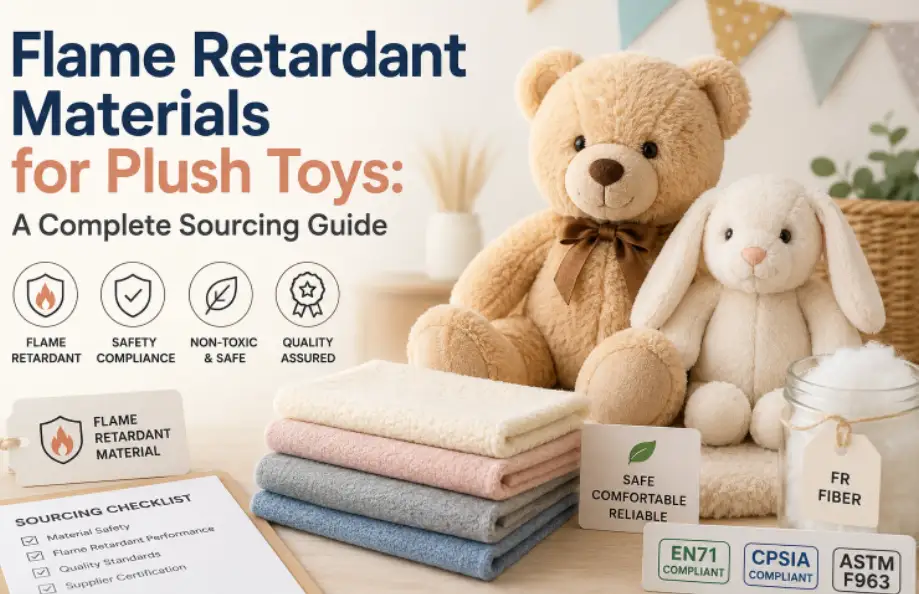
Flame Retardant Materials for Plush Toys play a vital role in improving toy safety, meeting international compliance standards, and helping manufacturers create reliable products for global markets.
Flame retardancy is one of the most heavily regulated performance requirements in plush toy manufacturing, and one of the easiest to get wrong when fabric and filling choices are made before compliance requirements are confirmed. This guide covers the material options, testing standards, and sourcing practices that keep flame-retardant plush toys both compliant and comfortable.
A plush toy’s softness comes from the same features that make textiles inherently flammable: loose fiber structure, high surface area, and low density. Flame retardant materials address this risk without requiring a plush toy to look or feel like a technical safety product, but only when fabric, filling, and finishing decisions are made together, with compliance requirements confirmed before production rather than tested for after the fact.
This guide walks through how flame retardant fabrics and fillings work, which testing standards apply, and the sourcing mistakes that most often turn a compliant design into a failed shipment.
Because flammability testing evaluates the finished product as an assembled system, flame retardant material sourcing cannot be treated as a single-material decision. Fabric, filling, and any additional trims or accessories all contribute to how a plush toy behaves under a flame source, and a specification that addresses only the most visible material — the outer fabric — while leaving filling or trim materials unspecified is one of the most common reasons a product that looks compliant on paper fails an actual laboratory test.
What Does “Flame Retardant” Actually Mean for a Plush Toy?
A flame retardant plush toy is one whose fabric and filling have been engineered — either through fiber chemistry or a topical treatment — to resist ignition, slow the spread of flame, and self-extinguish once an ignition source is removed, rather than continuing to burn on its own. Flame retardancy is not the same as fireproof; no textile-based plush toy is immune to fire under sustained direct flame exposure, and flammability standards are written around limiting how fast a flame spreads and how easily a material ignites in the first place, not eliminating combustibility entirely.
This distinction matters for how buyers evaluate suppliers and materials. A supplier claiming a fabric is “flame retardant” should be able to specify which mechanism produces that property and which standard the material has been tested against, because the term itself does not indicate a specific, verifiable performance level without a named test method attached to it.
It is also worth distinguishing flame retardancy from related but separate material properties that buyers sometimes conflate with it, such as heat resistance or general durability. A fabric can be highly heat resistant in the sense that it does not melt or deform at elevated temperatures while still igniting and burning readily when exposed to an open flame — heat resistance and flame retardancy are governed by different material characteristics and are tested through different methods, so a claim about one should never be assumed to imply the other.
Why Flame Retardancy Is a Core Safety Requirement, Not an Optional Feature
Flame retardancy is treated as a mandatory safety requirement in nearly every major toy market because plush toys are marketed heavily to infants and young children, who are the demographic least able to react quickly to a fire hazard and most likely to have prolonged, close physical contact with the product. Regulatory bodies in the United States, the European Union, and most other major markets require flammability testing as a condition of market entry for textile-based children’s products, which places plush toys squarely within scope regardless of whether a specific product design appears to carry elevated fire risk.
Because flammability testing is mandatory rather than optional in these markets, treating flame retardant material selection as a late-stage or discretionary decision creates direct compliance risk. A product that fails flammability testing cannot legally be sold in a regulated market, and correcting a failure discovered late in production is significantly more expensive than specifying compliant materials from the start.
Tip: Confirm the specific flammability standard required for each target market before finalizing fabric and filling selection, not after sampling. Different markets test differently, and a material that passes one standard is not automatically compliant with another.
Types of Flame Retardant Fabrics and Treatments
Flame retardant performance in plush toy fabric comes from one of two general approaches: fibers that are inherently flame resistant due to their chemical structure, or standard fibers that have been topically treated with a flame retardant chemical finish after weaving or knitting. Each approach has different durability, cost, and performance characteristics that affect which is appropriate for a given product and price point.
Inherently Flame Resistant Fibers
Inherently flame resistant fibers, such as certain modacrylic and polyester formulations, have flame resistance built into the polymer structure itself rather than applied as a surface coating. This means the flame retardant property does not wash out, wear off, or degrade significantly over the useful life of the product, which makes inherently FR fibers the more durable long-term option, particularly for products expected to withstand repeated washing.

Topically Treated Flame Retardant Fabrics
Topical flame retardant treatments apply a chemical finish to a standard fabric after it has already been woven or knitted, achieving flame resistance without changing the base fiber. Topical treatments are generally less expensive than switching to inherently FR fiber, but the treatment can diminish with repeated washing or extended wear, which means products relying on topical treatment need washing-durability testing to confirm the treatment holds up across the product’s expected use cycle, not just at the point of initial production.
Flame Retardant Fabric Approaches Compared
| Approach | How It Works | Durability | Relative Cost |
|---|---|---|---|
| Inherently FR fiber | Flame resistance built into fiber chemistry | Permanent, does not wash out | Higher |
| Topical FR treatment | Chemical finish applied to standard fabric | Can diminish with washing/wear | Lower |
| FR-treated natural fiber blends | Treatment applied to cotton or wool blends | Moderate, treatment-dependent | Moderate |
| Untreated synthetic pile (standard) | No flame retardant mechanism | Not applicable | Lowest |
Tip: If a product will be marketed as machine washable, request wash-cycle durability data for any topically treated fabric before approving it. A fabric that passes flammability testing on a fresh sample can fail after repeated laundering if the treatment is not formulated to withstand it.
Flame Retardant Filling Materials
Filling material plays a larger role in overall plush toy flammability than buyers often expect, because filling makes up the bulk of a plush toy’s mass and burns differently than the outer fabric shell once ignition occurs. PP cotton (polypropylene fiberfill) is the dominant filling choice in plush toy manufacturing and is available in flame-retardant grades formulated with FR additives blended into the fiber during production, while standard-grade PP cotton offers no specific flame-retardant property beyond the baseline behavior of the base polymer.
Recycled PET filling, increasingly used for sustainability-focused product lines, requires the same explicit confirmation of flame retardant grade as virgin PP cotton, since recycled content does not inherently carry flame retardant properties and must be specifically formulated or treated to meet the same standard.
Common Plush Toy Filling Materials and Flame Retardant Availability
| Filling Material | FR Grade Available | Typical Use Case |
|---|---|---|
| Standard PP cotton (fiberfill) | Yes, as a specified FR-grade option | General-purpose plush toys |
| Recycled PET fiberfill | Yes, it must be specifically formulated | Sustainability-marketed plush lines |
| Memory foam/bead blends | Limited, depends on bead material | Weighted or textured plush products |
| Natural fiber filling (cotton, kapok) | Rare, typically requires added treatment | Niche natural-material product lines |
Because filling is enclosed inside the fabric shell during normal use, it is easy to underestimate its contribution to overall flammability performance. Flammability testing standards generally evaluate the complete assembled product, which means an FR-rated outer fabric paired with standard, non-FR filling does not guarantee the finished plush toy will pass testing — both components need to be considered together as a system rather than approved independently.
Flammability Testing Standards for Plush Toys
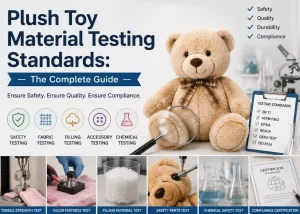
Flammability testing standards for plush toys vary by target market, and each standard specifies its own test method, ignition source, and pass/fail criteria. The most widely referenced standards are 16 CFR Part 1610 in the United States, EN71-2 in the European Union, and BS 5852 for products sold in the United Kingdom that fall under additional furniture and furnishings flammability regulations.
Key Flammability Standards Referenced in Plush Toy Compliance
| Standard | Primary Market | What It Evaluates |
|---|---|---|
| 16 CFR Part 1610 | United States | Surface flammability and rate of flame spread on textiles |
| EN71-2 | European Union | Flammability requirements specific to toys, including plush |
| BS 5852 | United Kingdom | Ignition resistance for upholstered and filled products |
| ASTM F963 | United States | A broader toy safety standard that includes flammability provisions |
Testing against the correct standard for the intended market, rather than assuming a general “flame retardant” claim is sufficient, is one of the most important compliance decisions in the entire sourcing process. A product tested only against one market’s standard and then sold into a second market without additional verification carries meaningful compliance risk, since pass criteria and test methods differ enough between standards that a pass on one does not guarantee a pass on another.

Test frequency is another detail buyers often overlook. A flammability test result from a fabric’s initial approval does not automatically remain valid indefinitely, particularly if the fabric supplier, dye lot, or finishing process changes on a later order. Building periodic retesting into an ongoing sourcing relationship — rather than treating the original approval test as a one-time event that covers every future reorder — closes a gap that has caused compliance issues for buyers who assumed material consistency without verifying it.
Tip: Request the actual test report, not just a certificate summary, when reviewing flammability test results from a supplier or lab. The full report shows the specific standard, test conditions, and measured results, which allows a buyer to confirm the test actually matches the product and market in question.
Balancing Flame Retardancy with Softness, Feel, and Safety
Flame retardant treatments and fibers can, in some formulations, alter the hand-feel of a plush fabric — making it feel slightly stiffer, coarser, or less plush than an untreated equivalent, particularly with heavier topical treatments. Managing this trade-off without compromising either compliance or product feel requires evaluating flame retardant fabric options specifically for tactile quality during sampling, rather than assuming any FR-compliant fabric will perform acceptably from a feel standpoint.
Fabric suppliers have made substantial progress in recent years in formulating flame-retardant fabrics that closely match the softness of untreated equivalents, particularly with inherently FR fiber approaches, which distribute the flame-retardant property through the fiber rather than adding a surface layer that can affect texture. Requesting multiple FR fabric options during development, rather than accepting the first compliant option offered, is a reasonable practice given how much variation exists between suppliers and formulations.
Tip: Include a hand-feel comparison as a formal step in fabric approval, not just a compliance document review. Have the same evaluator compare treated and untreated swatches side by side under consistent conditions before finalizing a flame retardant fabric choice for a soft-touch product.
Common Mistakes in Sourcing Flame Retardant Plush Materials
Most flame retardant compliance failures in plush toy sourcing trace back to a small number of recurring mistakes rather than genuinely difficult technical problems. Recognizing these patterns in advance allows a buyer to build verification steps that catch them before they affect a full production run.
These mistakes tend to share a common thread: each one involves treating a compliance assumption as confirmed fact without direct verification. Building a habit of requesting documentation and retesting whenever any material, supplier, or specification detail changes closes nearly all of them, and costs far less in time and money than correcting a compliance failure discovered after a shipment has already been produced.
Common Flame Retardant Sourcing Mistakes and Corrective Practices
| Mistake | Consequence | Corrective Practice |
|---|---|---|
| Approving fabric FR status but not filling FR status | Assembled product fails testing despite compliant fabric | Confirm FR grade for both fabric and filling as a system |
| Testing against the wrong market standard | Compliance gap when the product reaches the actual target market | Map required standards to each specific market before testing |
| Accepting a generic “flame retardant” claim with no test data | No verifiable performance level behind the claim | Request the specific standard and full test report |
| Not retesting after a fabric or filling substitution | Undetected compliance drift on reorders | Retest whenever any material component changes |
Frequently Asked Questions
Is flame retardant treatment required on every plush toy, or only certain product types?
Flammability testing requirements apply broadly to textile-based children’s products, including nearly all plush toys, in major regulated markets such as the United States and the European Union. While the specific pass criteria and test method vary by market and sometimes by product category, the presence of some form of flammability requirement is close to universal for plush toys sold through regulated retail and e-commerce channels, which makes flame retardant material selection a standard part of product development rather than an optional add-on for higher-risk designs only.
Does flame retardant fabric cost significantly more than standard plush fabric?
Flame retardant fabric typically carries a cost premium over standard, untreated fabric, with the size of the premium depending on which approach is used — topical treatments generally add a smaller cost increase than switching to inherently flame-resistant fiber. The exact premium varies by fabric type, supplier, and order volume, but buyers should expect flame retardant material costs to represent a specific, quotable line item rather than a negligible rounding difference in overall material cost.
Can a flame retardant treatment wash out of a plush toy over time?
Topically applied flame retardant treatments can diminish with repeated washing, depending on the specific chemical formulation and how well it bonds to the fabric surface, which is why washing-durability testing is an important verification step for any product expected to be laundered regularly. Inherently flame-resistant fibers, by contrast, do not lose their flame retardant property through washing because the property is built into the fiber’s chemical structure rather than applied as a surface treatment.
Do flame retardant chemicals used in plush toys raise separate chemical safety concerns?
Some flame retardant chemical classes have raised documented health and environmental concerns, which is why chemical safety regulations such as REACH in the European Union and various state-level restrictions in the United States specifically regulate which flame retardant chemistries are permitted in children’s products. Buyers should confirm that any flame retardant treatment or additive complies with applicable chemical restriction lists for their target market, not only the flammability performance standard, since the two are separate compliance requirements that both apply to the same product.
If the outer fabric is flame retardant, does the filling also need to be flame-retardant?
Yes. Flammability testing standards evaluate the complete assembled plush toy, not the fabric shell in isolation, which means a flame retardant outer fabric paired with standard, non-FR filling does not guarantee the finished product will pass testing. Both fabric and filling need to be specified and verified as flame retardant components of a single compliant system, and confirming FR status for one material component while assuming it applies to the other is one of the most common compliance mistakes in plush toy sourcing.
How can a buyer verify a supplier’s flame retardant material claims before placing a large order?
The most reliable verification method is requesting the actual flammability test report — not just a compliance certificate summary — showing the specific standard tested, the testing lab, the date of the test, and the measured results for the exact fabric or filling lot in question. Buyers should also confirm the test was conducted on the same material specification being used in current production, since a test report from a different fabric weight, color, or supplier batch does not reliably confirm the compliance status of the current material.