Skip to content
Everything sourcing teams, brand owners, and quality managers need to know about age grading, tracking labels, fiber content disclosure, care symbols, and safety warnings across the world’s major plush toy import markets.
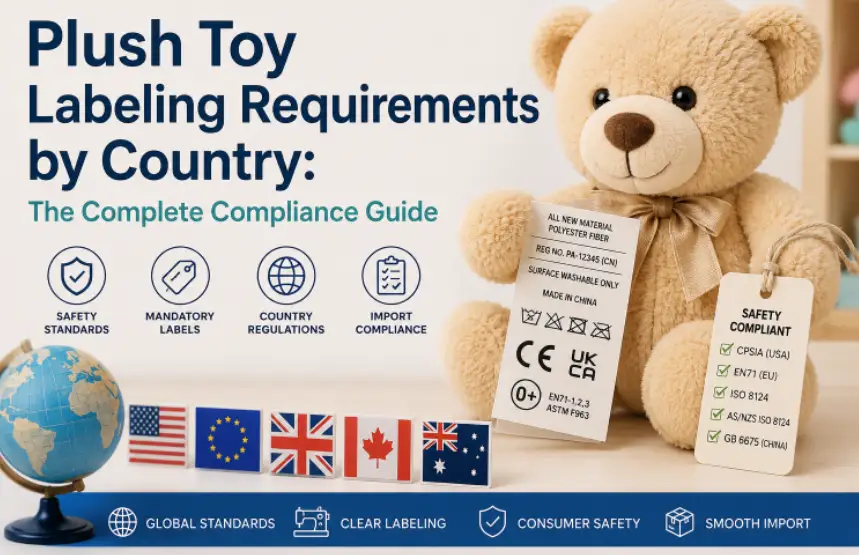
Plush toy labeling requirements differ by country, but the underlying goal is the same everywhere: a buyer, a parent, or a customs officer must be able to look at a single tag and immediately know who made the toy, what it is filled with, what age group it suits, and how to care for it. A plush toy that passes every safety test in the lab can still be refused at customs, pulled from a retail shelf, or hit with a retroactive recall notice if the label itself does not meet the destination market’s format, wording, and placement rules. Labeling is not a footnote to product safety compliance — it is where compliance becomes visible and enforceable.
This guide walks through the labeling frameworks that matter most for stuffed animals, character plush, licensed plush, and plush toy accessories sold into the United States, the European Union, the United Kingdom, Canada, Australia and New Zealand, and Japan. It covers permanent tracking labels, age grading and choking hazard statements, fiber content and stuffing material disclosure, care and washing symbols, country of origin marking, and the small print differences that trip up new exporters — hang tag wording, sewn-in label placement, minimum font size, and language requirements.
Why Plush Toy Labeling Is a Compliance Issue, Not a Design Choice
A plush toy label carries legal weight in every market where the product is sold. Regulators treat the label as the primary evidence of compliance during a recall investigation, a customs inspection, or a retailer’s incoming quality audit. If the physical toy meets flammability, chemical, and mechanical safety standards but the label omits a required tracking code, uses the wrong age grading format, or lists fiber content in the wrong language, the shipment can still be detained, or the listing can still be removed from an online marketplace.
Three separate regulatory concerns typically converge on a single plush toy label: toy safety law (which governs choking hazard warnings and age grading), textile or apparel labeling law (which governs fiber content and care instructions), and general consumer product law (which governs country of origin, manufacturer identification, and traceability). Treating these as one integrated label — rather than bolting on a hang tag as an afterthought — is the difference between a smooth customs clearance and a shipment sitting in a bonded warehouse.
Tip: Build a single master label file per SKU that maps every required data field against every destination market before production starts. Retrofitting labels after a mold or fabric run is already cut is far more expensive than designing the label matrix during the sampling stage.
United States: CPSIA Tracking Labels and Age Grading
In the United States, plush toy labeling sits under the Consumer Product Safety Improvement Act (CPSIA) and ASTM F963, the mandatory toy safety standard enforced by the Consumer Product Safety Commission. The single most distinctive US requirement is the permanent tracking label, sometimes called a manufacturer tracking label, which must be present on the product itself and on its packaging.
Permanent Tracking Label Requirements
Every plush toy manufactured after August 2009 for the US market must carry information that allows the specific production run to be traced. At minimum, the tracking label must identify the manufacturer or private labeler, the location and date of production, and details of the manufacturing process such as a batch or run number. This information must appear on the product and, to the extent practicable, on the packaging as well. For plush toys, this typically means a sewn-in fabric label plus a printed hang tag or a stamped element on the polybag, since a single sewn label is rarely large enough to hold every required data field legibly.
Age Grading and Choking Hazard Warnings
Plush toys intended for children under three years old must not contain small parts, detachable eyes, noses, or accessories that fit inside a small parts cylinder. If any component of the plush line is intended for children three years and older but small parts are present, federal law requires a specific choking hazard warning statement, formatted and worded according to regulation, printed on the retail packaging in a defined type size and in immediate proximity to the age grading statement.
Tip: Age grading on a hang tag is a marketing decision as much as a safety one. If a plush character is clearly aimed at toddlers but includes plastic safety eyes rather than embroidered eyes, US labeling law requires the choking hazard statement even if the internal age grade says three-plus — do not let the art department set the age grade independently of the engineering bill of materials.
United States Plush Toy Label Data Points at a Glance
| Label Element | Governing Requirement | Typical Placement | Common Compliance Gap |
|---|---|---|---|
| Permanent tracking label | CPSIA Section 103 | Sewn-in label plus packaging | Missing batch/run code on the polybag |
| Age grading statement | ASTM F963 labeling section | Hang tag, front panel | Age grade not aligned with small parts testing |
| Choking hazard warning | 16 CFR 1500.19 / CPSIA | Adjacent to age grade, defined font size | Font size below minimum or wrong wording |
| Manufacturer/importer identity | CPSIA general certificate of conformity | Label or packaging | Generic “Made in China” with no responsible party |
| Fiber content of shell fabric | Textile Fiber Products Identification Act | Sewn-in label | Missing percentage breakdown for blended fabrics |
| Stuffing material disclosure | State stuffed toy laws (where applicable) | Sewn-in “law label” | Label omitted for reprocessed or secondhand fill |
State-Level Stuffed Toy “Law Labels”
Several US states maintain their own bedding and stuffed toy laws that require a registered manufacturer number and a fill content disclosure — commonly called a law label — sewn into any item filled with soft material. These state requirements predate CPSIA and still apply in parallel to federal toy safety rules, particularly for filled products sold through certain wholesale and bedding-adjacent distribution channels. Confirming whether a state law label is required and securing the associated registration number is a step that is easy to miss when a plush toy program is developed primarily against federal ASTM F963 requirements.
European Union: CE Marking, EN71, and Textile Labeling
The European Union requires plush toys to carry the CE mark, which signals that the product complies with the EU Toy Safety Directive and its harmonized standards, principally the EN71 series covering mechanical and physical properties, flammability, and chemical migration. Labeling in the EU combines toy-specific requirements with general textile labeling rules under the EU Textile Regulation.

CE Marking Placement and Format
The CE mark must be affixed visibly, legibly, and permanently to the toy or its packaging. For plush toys, this is usually printed on the hang tag and, where practical, on the swing tag attached to the product rather than on the fabric itself, since embroidering or printing directly onto plush fur can distort the mark’s proportions. The mark must not be reduced below a minimum height and must maintain its vertical-to-horizontal proportions exactly as defined in the regulation.
Manufacturer and Importer Traceability
EU toy safety law requires the name, registered trade name, and postal address of the manufacturer to appear on the toy or its packaging. Where the manufacturer is based outside the EU, an EU-based importer or authorized representative must also be identified, along with their contact address, so that market surveillance authorities always have an EU point of contact for any product on the shelf.
Tip: Keep the EU importer’s address on a separate, easily updated sticker or removable card layer rather than permanently printed into the main hang tag artwork. Import structures change more often than product artwork, and a fixed print run tied to a specific importer address becomes obsolete stock the moment that relationship changes.
Textile Fiber Content and Care Labeling
Under EU textile labeling rules, the fiber composition of the outer shell fabric must be disclosed by percentage using the regulation’s approved fiber names — “polyester,” “cotton,” “acrylic,” and so on — rather than generic marketing terms like “premium fur” or “soft touch fabric.” Where the shell fabric is a blend, each fiber above a defined threshold must be listed in descending order of weight. Stuffing material, while not always covered by the same textile fiber rules as the shell fabric, is commonly disclosed voluntarily using ISO care symbols alongside washing, drying, and ironing instructions.
European Union Plush Toy Labeling Requirements by Category
| Requirement | Regulatory Basis | Language Rule | Notes |
|---|---|---|---|
| CE marking | Toy Safety Directive 2009/48/EC | Not language-dependent (a symbol) | Minimum height and proportion rules apply |
| Manufacturer/importer address | Toy Safety Directive, Art. 11 | N/A (address format) | EU importer required if maker is outside the EU |
| Safety warnings (age, choking hazard) | EN71-1 / Toy Safety Directive | Local official language(s) of each member state sold into | Often requires multilingual hang tags for pan-EU distribution |
| Fiber content of shell fabric | EU Textile Regulation 1007/2011 | Local official language(s) | Approved fiber names only; no marketing substitutes |
| Care instructions | Voluntary but market-expected | Symbols preferred (language-neutral) | ISO 3758 care symbols are widely used |
United Kingdom: UKCA Marking After Brexit
Following its departure from the EU single market, the United Kingdom introduced its own conformity marking, UKCA, alongside its own Toys (Safety) Regulations, which mirror the substance of EN71 but operate as a distinct legal framework enforced by UK market surveillance authorities rather than EU ones. For most plush toy exporters already CE-marked, the underlying safety testing evidence can typically be reused, but the label itself must carry the correct mark and the correct UK-based responsible person’s details.
UKCA and CE Dual Marking in Practice
Many plush toy brands selling into both the EU and Great Britain print both the CE mark and the UKCA mark on the same hang tag, alongside two separate responsible-person addresses — one in the EU, one in the UK. This dual-marking approach avoids running two separate print jobs for what is otherwise an identical product, though it does require the label layout to accommodate two full compliance blocks without either one becoming illegibly small.

Confirming current UKCA transition and enforcement timelines before finalizing artwork is worthwhile, since UK authorities have adjusted the acceptance window for CE-marked goods more than once, and a label built with both marks from the outset avoids a costly re-label exercise if a grace period is later tightened.
Product Registration and Notified Body Involvement
Certain plush toy categories, particularly electronic or “smart” plush containing sound modules, lighting, or connectivity features, may require additional notified body assessment beyond the standard self-declaration route available to purely mechanical plush items. Where a notified body is involved, its identification number typically must appear alongside the CE mark on the label, and omitting this number when it is legally required is treated as a distinct labeling deficiency from a missing or malformed CE mark itself.
Canada: CCPSA and Bilingual Labeling
Canada regulates plush toy safety under the Canada Consumer Product Safety Act (CCPSA) and the associated Toys Regulations, enforced by Health Canada. The labeling requirement that most frequently surprises new exporters is not a safety data point at all — it is language. Canadian federal labeling law generally requires consumer product labels to appear in both English and French, and this applies to age grading statements, choking hazard warnings, and care instructions on plush toys sold nationally.
Bilingual Label Construction
Rather than producing two separate SKUs, most plush toy programs destined for the Canadian market build a single bilingual hang tag with English and French text presented in parallel columns or stacked blocks of equal prominence. Neither language can be visually subordinated to the other — using a smaller font size for French text relative to English text is a common and easily avoidable compliance gap.
Canada Plush Toy Label Requirements Summary
| Element | Requirement | Language |
|---|---|---|
| Age grading and warnings | Toys Regulations under CCPSA | English and French, equal prominence |
| Fiber/stuffing content | Textile Labelling Act | English and French |
| Dealer/importer identity | CCPSA general safety requirement | N/A (name and address) |
| Care symbols | Voluntary, CAN/CGSB-based symbols common | Symbols preferred; text bilingual if included |
Australia and New Zealand: Mandatory Standards
Australia applies a mandatory toy safety standard for children’s toys, closely aligned with international mechanical and flammability benchmarks, enforced through the Australian Competition and Consumer Commission’s product safety regime. New Zealand largely aligns its own toy safety expectations with Australian and international standards, though it does not always mirror every Australian mandatory standard exactly, so cross-checking both jurisdictions independently before a single ANZ label run is standard practice.
Country of Origin Labeling in Australia
Australia maintains its own country-of-origin labeling framework separate from toy safety law, with specific claim formats such as “Made in [Country]” carrying defined legal meaning tied to the proportion of production cost incurred domestically or overseas. For imported plush toys, this generally simplifies to a clear, unambiguous country of manufacture statement, but brands should avoid origin language that implies domestic Australian manufacture unless that claim can be substantiated.
Tip: When a single global hang tag is used across Australia, New Zealand, and other English-language export markets, keep origin wording literal and unembellished — “Made in [Country]” rather than any phrase suggesting local assembly or finishing — to avoid inadvertently triggering Australia’s origin-claim substantiation requirements.
Japan: ST Mark and Care Label Symbols
Japan’s voluntary but widely adopted ST Mark (Safety Toy) certification, administered by the Japan Toy Association, signals compliance with Japanese toy safety standards covering mechanical, chemical, and flammability properties. While the ST Mark scheme is not a strict legal mandate in the way CE or CPSIA compliance are, most major Japanese retailers will not stock plush toys without it, making it a de facto market-access requirement.
Japanese Care Symbols and Household Goods Labeling
Japan separately regulates household and textile goods labeling under its Household Goods Quality Labeling Act, which specifies its own care symbol system distinct from the ISO 3758 symbols common in Europe and North America. Plush toys sold through Japanese retail channels often need Japan-specific care symbols on the sewn-in label in addition to, or instead of, the ISO symbol set used for other markets.
Japan Plush Toy Compliance and Labeling Snapshot
| Element | Scheme | Mandatory or Voluntary | Retail Impact |
|---|---|---|---|
| ST Mark | Japan Toy Association | Voluntary in law, effectively required by major retailers | Absence typically blocks large chain retail listings |
| Care symbols | Household Goods Quality Labeling Act | Mandatory for covered textile goods | Japan-specific symbol set required on label |
| Language of warnings | Consumer protection norms | Japanese is required for retail sale | English-only tags generally rejected by distributors |
China Domestic Market and South Korea: Labeling for Two Fast-Growing Retail Channels
Plush toy programs built primarily for export sometimes overlook the labeling expectations of China’s own domestic retail market and South Korea, even though both have grown into significant direct-to-consumer channels for plush and character merchandise in their own right. Both markets operate labeling frameworks that differ meaningfully from the US, EU, and Japanese systems already covered, and a label built only for export compliance will not automatically satisfy either one.
China GB Standards and the CCC Mark
Toys sold within mainland China are governed primarily by the GB 6675 series of national safety standards, which cover mechanical and physical properties, flammability, and migration of certain elements, alongside GB 6675.4 provisions specific to labeling and instructions. Many toy categories fall under compulsory China Compulsory Certification (CCC), which requires the CCC mark to appear on the product or packaging once certification has been obtained through an approved testing and certification body. Domestic Chinese labeling additionally expects age grading, warning statements, and manufacturer identity to appear in Simplified Chinese, and a label built only in English for an export-labeled version of the same plush toy will not satisfy domestic retail requirements even if the underlying product construction is identical.
South Korea’s KC Mark and Safety Certification
South Korea requires children’s products, including plush toys, to carry the KC (Korea Certification) mark, issued following safety certification aligned with Korean national standards for children’s products. The KC mark, the certification number, and manufacturer or importer details are expected to appear on the product label, and Korean-language warning and care text is standard practice for retail distribution, particularly through major domestic marketplaces and department store channels where compliance screening at the listing stage has become increasingly strict.
Comparing the two systems side by side is useful for planning purposes: China’s domestic framework centers on the GB 6675 series as the primary standard, with the CCC mark applying to covered toy categories, Simplified Chinese as the required label language, and domestic registration details expected for the manufacturer of record. South Korea’s framework centers on national children’s product safety standards, with the KC mark as the relevant conformity mark, Korean as the required label language, and importer details expected on the label for any foreign-made plush toy entering Korean retail channels.
Treating a domestic China or South Korea listing as its own label variant from day one, rather than a translated copy of the export tag, matters because certification numbers, mark formats, and required disclosure language are specific enough to each domestic system that a direct find-and-replace translation of an export label frequently misses a required field entirely.
Universal Label Elements Every Plush Toy Needs
Despite the country-by-country differences, a handful of label elements repeat across almost every regulated market and form a practical baseline for any plush toy program, regardless of final destination.
Fiber Content and Stuffing Material
Nearly every jurisdiction with textile labeling law expects the shell fabric composition to be disclosed by fiber type, and many expect the stuffing or fill material to be identified as well — commonly polyester fiberfill, though recycled fiberfill, cotton, or bead fill each carry their own disclosure expectations and, in the case of bead or pellet fill, additional small parts and choking hazard scrutiny.
Age Grading Consistency
Age grading should be internally consistent between the physical construction of the toy (eye attachment method, presence of small accessories, cord or ribbon length), the small parts and mechanical testing performed, and the age statement printed on the label. A mismatch between any two of these three is one of the most common findings in third-party compliance audits.
Country of Origin and Manufacturer Identity
Almost every market requires a country of origin statement, and most require some form of manufacturer, importer, or responsible party identification with a physical address, not just a brand name or logo.
Tip: Design the sewn-in label as the fixed, minimum-viable compliance record — manufacturer identity, tracking code, fiber content, country of origin — and push everything market-specific and changeable (age grading language, importer address, CE/UKCA marks) onto the removable hang tag. This split reduces the number of full re-labeling events needed when a single market’s requirements shift.
Environmental and Sustainability Claims
As recycled polyester fill, organic cotton shells, and reduced-plastic packaging have become more common in plush toy sourcing, labels increasingly carry environmental claims alongside the required safety and content disclosures. These claims are subject to their own layer of regulation in most markets — general consumer protection law in the US, specific green claims guidance in the EU and UK, and similar frameworks elsewhere — that require any environmental statement to be accurate, specific, and substantiated rather than vague.
A label stating “recycled fiberfill” should be able to point to a verifiable recycled content percentage if challenged, and broad, unqualified terms such as “eco-friendly” or “sustainable” without supporting detail are increasingly scrutinized by advertising standards and consumer protection authorities as potentially misleading. Where a plush toy program does carry a genuine environmental claim, pairing it with a specific, verifiable data point — a recycled content percentage, a certification scheme name, or a defined packaging reduction figure — is both more defensible and more useful to the end buyer than a generic marketing phrase.
Label Lifecycle and Version Control
A plush toy label is rarely a one-time design exercise. Fabric suppliers change, fiber blends shift slightly between production runs, age grading can change if a design detail like an attached accessory is modified, and regulatory text itself is periodically updated by national authorities.
Maintaining version control over label artwork — tracking which label version shipped with which production batch, and cross-referencing that against the corresponding test report — is what allows a brand to respond quickly and precisely if a single batch is later found to have a labeling or compliance issue, rather than needing to investigate the entire product history from scratch. This record-keeping discipline is also what regulators and retail compliance teams expect to see documented during a post-market audit, independent of whether an issue has actually occurred.
Cross-Market Comparison of Core Plush Toy Label Requirements
| Requirement | United States | European Union | Canada | Japan |
|---|---|---|---|---|
| Conformity mark | Not mark-based; GCC certificate on file | CE mark required | Not mark-based; declaration on file | ST Mark (voluntary, retailer-driven) |
| Tracking/batch code | Mandatory permanent tracking label | Traceability info required, format flexible | Required under CCPSA record-keeping | Recommended, retailer-dependent |
| Bilingual/multilingual text | English (Spanish is common but not mandatory) | The local language of each member state is sold | English and French are mandatory | Japanese is required for retail |
| Fiber content disclosure | Required, TFPIA | Required, EU Textile Regulation | Required, Textile Labelling Act | Required, Household Goods Quality Labeling Act |
Common Labeling Mistakes That Trigger Customs Holds
Certain labeling errors recur with enough frequency across plush toy shipments that they are worth treating as a dedicated pre-shipment checklist rather than an afterthought during final quality inspection. Most of these errors are not the result of a missing regulation on file somewhere — they happen because label artwork, test reports, and bill-of-materials documents are managed by different teams on different timelines, and no single review step confirms that all three still agree by the time a container is loaded. Building that final cross-check into the pre-shipment quality process, rather than assuming the original label design remains valid indefinitely, closes the gap that produces most of the issues below.
- Age grade printed but not matched to testing scope. A “0+” hang tag on a toy that was only tested and certified for the 3+ small parts exemption threshold is a direct mismatch between label claim and test evidence.
- Generic fiber descriptions instead of regulated fiber names. Terms like “supersoft plush” or “eco fabric” do not satisfy the fiber content disclosure law in any of the markets covered in this guide.
- Single-language labels shipped to bilingual or multilingual markets. This is the single most common reason plush toy shipments are held at Canadian and EU ports of entry for relabeling before release.
- Conformity marks are reproduced below the minimum size or with distorted proportions. CE and UKCA marks both have defined minimum dimensions; shrinking either mark to fit a small hang tag without checking the minimum size rule invalidates the mark.
- No physically addressable responsible party. A brand name and website URL alone do not satisfy manufacturer or importer identification requirements in the EU, UK, or Canada.
Tip: Run the final label proof against the actual test report and bill of materials — not against the previous season’s artwork — every time a plush toy program is renewed. Age grading, fiber blends, and eye attachment methods often change slightly between production seasons even when the character design looks identical, and outdated labels are a frequent, entirely avoidable root cause of compliance failures.
Frequently Asked Questions
Do plush toys need a permanent tracking label if they are sold only online?
Yes. In the United States, the permanent tracking label requirement under CPSIA applies regardless of sales channel — it is tied to the product and its manufacturing origin, not to whether the toy is sold in a physical store or through an e-commerce marketplace. Online-only plush toy sellers are held to the same tracking label standard as brick-and-mortar retailers, and marketplace compliance reviews increasingly check for this label specifically.
Can one hang tag be used for both the EU and UK markets?
A single hang tag can often serve both markets if it carries both the CE mark and the UKCA mark, along with a responsible party address for each jurisdiction. This dual-marking approach is common practice for plush toy brands distributing across both regions, though the label must have enough physical space to present both compliance blocks clearly and at full legal minimum size, which sometimes requires a larger tag format than a single-market design would need.
What is the difference between the age grading on the box and the ASTM small parts test result?
The age grading statement is the label claim presented to the consumer, while the small parts test result is the underlying laboratory evidence that determines whether that claim is legally supportable. A toy can only carry a “not for children under 3” exemption from small parts rules if it is genuinely intended and marketed for older children; conversely, if a toy is marketed toward toddlers, it must pass small parts testing for that younger age group regardless of what a separate internal age grade might otherwise suggest based on complexity or size.
Are ISO care symbols accepted worldwide, or does every country need its own version?
ISO 3758 care symbols are widely recognized and accepted across the EU, UK, Canada, Australia, and many other markets, but Japan operates its own distinct care labeling symbol system under its Household Goods Quality Labeling Act. This means a plush toy program selling into Japan alongside Western markets typically needs a Japan-specific care symbol variant on labels destined for that market, rather than relying on the ISO symbol set alone.
Does stuffing material need to be disclosed separately from the outer fabric on a plush toy label?
In most regulated markets, yes — fiber content disclosure rules generally expect the shell fabric composition and the stuffing or fill material to be identified, since they are functionally and often legally distinct components of the finished product. Common stuffing disclosures include polyester fiberfill, recycled fiberfill, cotton fill, or bead/pellet fill, with bead and pellet fill typically drawing additional scrutiny under small parts and choking hazard rules due to the loose, granular nature of the material if the seam fails.
What happens if a plush toy shipment arrives with the wrong labeling for the destination country?
Outcomes vary by market and by the nature of the labeling gap, but common consequences include the shipment being held at the port of entry pending relabeling, the importer being required to apply corrective labels under customs or market surveillance supervision before release, or, in more serious cases involving safety-relevant omissions such as missing choking hazard warnings, the product being refused entry or subject to a compliance notice. Relabeling after arrival is almost always more expensive and slower than building the correct label into the original production run.
Is a country of origin statement always required even if the brand’s compliance mark already discloses the manufacturer’s address?
Yes, country of origin and manufacturer or importer identification are generally treated as separate legal requirements, even though they often sit in the same section of a plush toy label. A manufacturer’s registered address satisfies traceability and responsible-party rules, while a country of origin statement satisfies separate customs and consumer disclosure rules; omitting either one, even when the other is present, can still result in a labeling deficiency during import review.