Skip to content
When sourcing a custom plush toy, most buyers focus on the unit price — but the sampling phase is where unexpected costs quietly accumulate. Understanding how plush toy sampling costs work helps brands, startups, and toy companies budget accurately, negotiate effectively, and avoid costly surprises before mass production begins.
What Is a Plush Toy Sample and Why Does It Cost Money
A plush toy sample is a pre-production prototype built to verify design intent, material selection, dimensional accuracy, and functional performance before committing to a full production run. Unlike off-the-shelf products, custom plush toys require skilled pattern-making, hand-cutting, hand-sewing, and iterative adjustments — all performed by experienced artisans working in small quantities. The absence of production-line efficiencies at the sample stage means labor costs per unit are disproportionately high compared to bulk manufacturing.
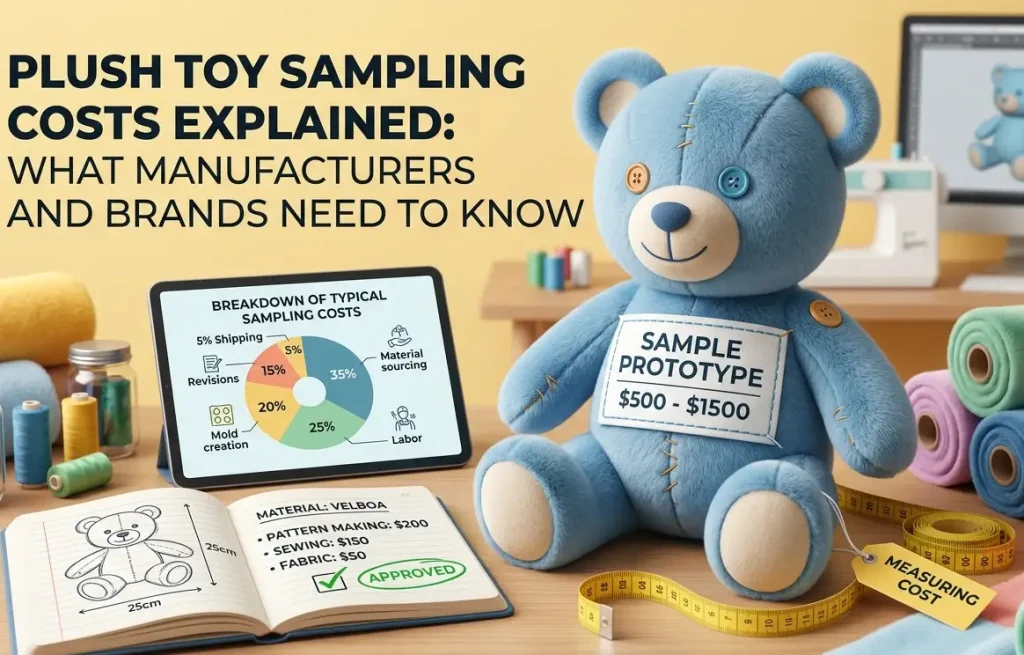
Manufacturers invest real resources — time, materials, and specialized skill — into every sample. Those costs must be recovered regardless of whether the buyer proceeds to mass production.
The Main Components That Drive Sample Pricing
Pattern Development and Technical Design
Before a single piece of fabric is cut, a pattern maker must interpret 2D artwork or a 3D brief into a precise cutting pattern. Complex shapes — animals with articulated limbs, character plush with multiple facial features, or toys with internal wire armatures — require significantly more pattern engineering than a simple round bear. Pattern development alone can account for 20–35% of total sample cost.
Material Procurement in Small Quantities
Production runs benefit from bulk material pricing. Samples, however, require small yardage of specific fabrics, specialty furs, safety eyes, embroidery threads, and stuffing materials. Manufacturers often pay retail or near-retail prices for these quantities, and minimum order thresholds from fabric suppliers may force the purchase of far more material than the sample actually consumes.
Skilled Hand Labor
Plush toy sampling is labor-intensive by nature. Each prototype is assembled almost entirely by hand. Embroidery, joint insertion, face shaping, and final stuffing density are all manually controlled and repeatedly adjusted during the approval process. A single sample iteration may represent 4–10 hours of skilled craftsperson time.
Revision Cycles
Most plush toy projects require two to four sample revisions before a buyer approves production. Each revision iteration — even a minor color correction or size adjustment — triggers a new round of material cutting, sewing, and quality review. Factories typically charge per revision or bundle a set number of revisions into the initial sample fee, with surcharges for additional rounds.
Industry Benchmark: Plush Toy Sampling Cost Ranges
The table below summarizes typical sampling cost structures based on product complexity and factory tier.
| Product Type | Complexity Level | Typical Sample Cost (USD) | Average Revision Rounds | Lead Time (Days) |
|---|---|---|---|---|
| Basic plush animal (simple shape) | Low | $80 – $150 | 1 – 2 | 10 – 15 |
| Character plush with facial features | Medium | $150 – $300 | 2 – 3 | 15 – 20 |
| Multi-component licensed character | High | $300 – $600 | 3 – 4 | 20 – 30 |
| Oversized or weighted plush | Medium–High | $250 – $500 | 2 – 3 | 18 – 25 |
| Plush with sound/electronic inserts | High | $400 – $800+ | 3 – 5 | 25 – 40 |
Sample Fee Refund Policies and MOQ Negotiation
Many manufacturers offer partial or full sample fee rebates when the buyer proceeds to a qualifying production order. A standard policy offsets the sample charge against the total invoice once a minimum order quantity (MOQ) — typically 500 to 2,000 pieces — is confirmed. Buyers should clarify this policy in writing before paying a sample fee, including the exact threshold, eligible products, and whether the rebate applies per SKU or per order.
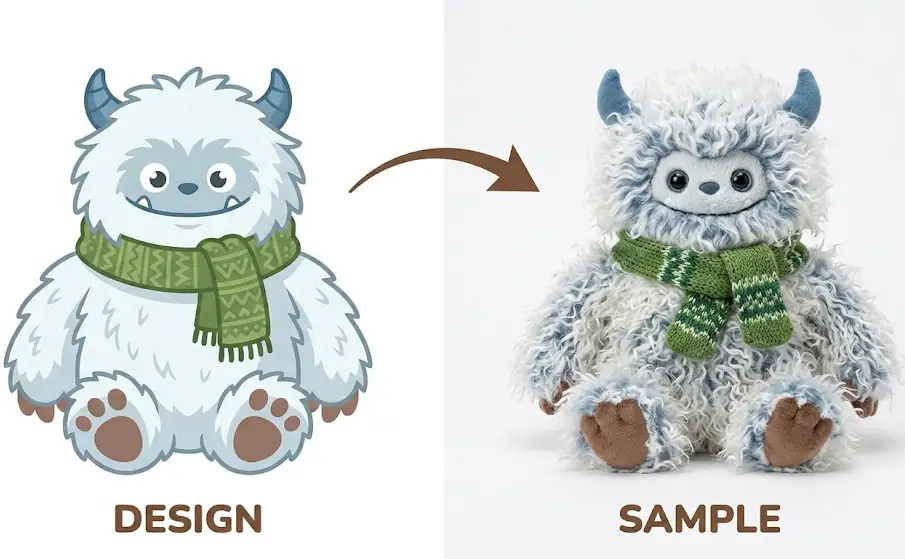
When negotiating, larger brands with established purchasing history can often request one complimentary counter-sample (an exact copy of an approved sample) or reduced revision fees. New buyers without order history generally pay the full rate.
Material and Compliance Testing Costs Within the Sampling Phase
For brands targeting the US, EU, or other regulated markets, plush toy samples must also undergo safety testing before production approval. Compliance testing adds a separate but closely related cost layer.
| Compliance Requirement | Target Market | Typical Testing Cost (USD) | Scope |
|---|---|---|---|
| CPSIA (16 CFR 1501) | United States | $300 – $600 | Choking hazard, flammability, lead content |
| EN 71-1 / EN 71-2 / EN 71-3 | European Union | $400 – $800 | Mechanical safety, flammability, chemical migration |
| ASTM F963 | United States | $200 – $450 | Toy safety standard (mechanical & physical) |
| CA Prop 65 | California (USA) | $150 – $350 | Heavy metal and chemical disclosure |
| REACH Regulation | European Union | $250 – $500 | Chemical substance restriction |
Testing is not included in factory sample fees and must be budgeted separately. Many buyers overlook this cost, which can add $600–$1,500 to the pre-production budget for a single product entering regulated markets.
How Factory Location Influences Sample Pricing
China-Based Manufacturers
The majority of the global plush toy supply chain is concentrated in Guangdong Province, China — particularly in Yangjiang, Dongguan, and Shenzhen. Chinese factories offer the broadest range of materials, the deepest pattern-making expertise, and competitive sample pricing. A mid-complexity character plush sample typically costs $150–$300 from an established Guangdong factory, inclusive of one or two revisions.
Southeast Asian Manufacturers (Vietnam, Bangladesh, Indonesia)
These markets offer lower base labor costs but often have less specialized pattern-making capability for complex licensed characters. Sample pricing may appear lower at $100–$200, but buyers frequently encounter more revision rounds, extending total time-to-approval and eroding the cost advantage.
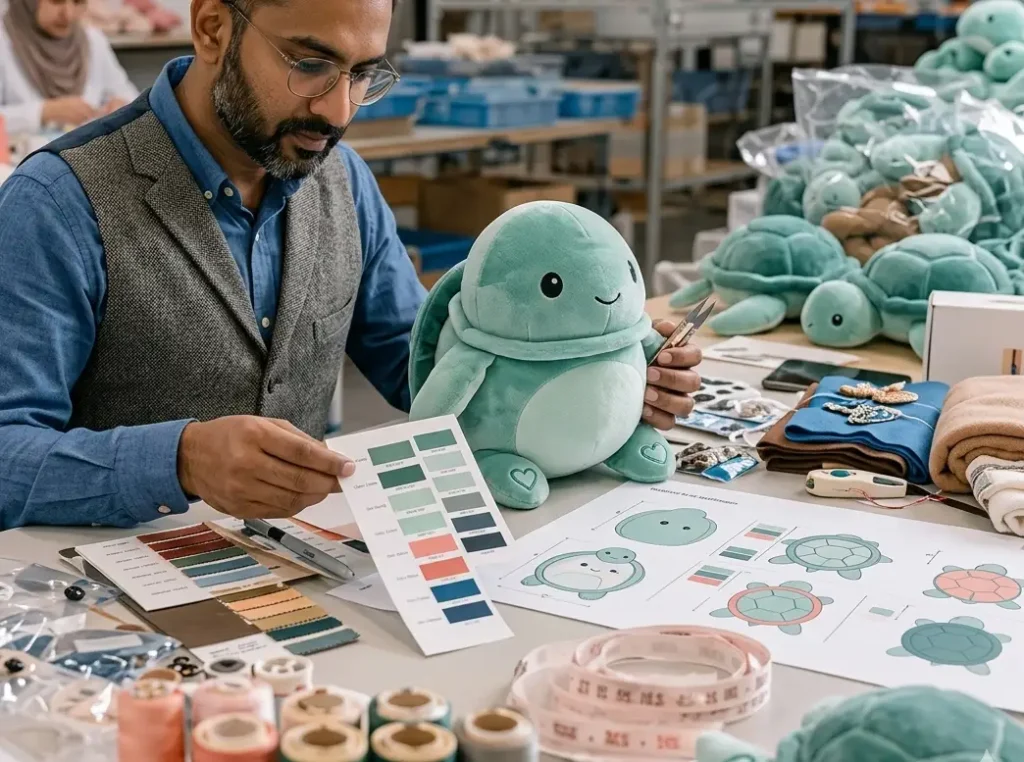
US/EU Sampling Studios
Boutique sampling studios in the US and Europe provide premium hand-crafted prototypes with fast turnaround and direct communication advantages. Costs are substantially higher — commonly $500–$2,000 per sample — but are appropriate for high-end, limited-edition, or IP-sensitive products where design confidentiality is a priority.
Digital Prototyping: Reducing Physical Sample Costs
Advances in 3D digital prototyping have introduced an intermediate validation step that can reduce the number of costly physical revisions. Using software tools to create photorealistic renders of the plush toy before cutting any fabric allows buyers to approve color, proportion, and surface texture digitally. Factories offering this service typically charge $50–$200 for a digital render package, which can eliminate one or two physical revision cycles and reduce total sampling expenditure by 15–30%.
Cost Comparison: Sampling Approaches
| Sampling Approach | Upfront Cost | Revision Speed | Best For |
|---|---|---|---|
| Factory physical sample only | $150 – $600 | 10–20 days/round | Standard B2B orders |
| Digital render + physical sample | $200 – $800 | 3–5 days (digital) + 10–15 days (physical) | Complex characters, new suppliers |
| Domestic studio sample | $500 – $2,000 | 5–10 days/round | IP-sensitive, premium retail |
| Counter-sample (copy of approved) | $50 – $150 | 5–10 days | Production consistency verification |
Shipping and Import Duties on Samples
Sample shipments are frequently misclassified, leading to unexpected import duties. In the United States, plush toy samples imported for development purposes may qualify for duty-free treatment under HTS 9811.00.60 if properly documented as samples not for sale.
Without correct documentation, import duty rates for plush toys (HTS 9503.00) typically range from 0% to 12% depending on country of origin and applicable trade agreements. Buyers should consult a licensed customs broker when importing samples from new suppliers.
Key Data Reference: Sample Budget Planning
| Budget Item | Low Estimate (USD) | High Estimate (USD) | Notes |
|---|---|---|---|
| Initial sample fee | $80 | $800 | Depends on complexity and factory |
| Additional revision fees | $30/round | $150/round | Varies by factory policy |
| Compliance testing | $300 | $1,500 | Per market; required for retail |
| Digital prototyping (optional) | $50 | $200 | Can reduce physical revision rounds |
| Shipping (DHL/FedEx express) | $40 | $120 | Per sample shipment |
| Import duties | $0 | ~12% of declared value | Depends on classification |
| Total pre-production estimate | $500 | $2,800+ | Per SKU, per target market |
Packing and Documentation Fees Often Missed
Some manufacturers charge separate documentation fees for samples: safety data sheets, bill of materials (BOM), or material certificates for compliance purposes. These fees typically range from $20–$80 per sample and are easy to overlook during initial quotation. Always request an itemized quotation that explicitly lists all potential charges, including documentation, packaging, and courier handling.
Frequently Asked Questions
Are plush toy sample fees refundable if I proceed to production?
In most cases, yes — partially or fully, depending on the factory’s policy. The standard arrangement is a sample fee rebate applied against your first production order once you meet the minimum order quantity, which typically falls between 500 and 2,000 units per SKU. Always confirm the rebate threshold and terms in writing before paying, as policies vary significantly between factories and are not automatically applied.
How many sample revisions should I expect before production approval?
For a mid-complexity plush toy — such as a character with facial embroidery and multiple fabric colors — two to three revision rounds is typical. More intricate designs with accessories, electronic inserts, or licensed character accuracy requirements may require four or five iterations. Preparing detailed technical design packages with accurate color references, dimension callouts, and material specifications upfront is the most effective way to reduce revision cycles.
What is a counter-sample and why would I need one?
A counter-sample is a copy of the approved prototype, produced by the factory to confirm that production tooling, material sourcing, and workmanship standards have been locked in before the full run begins. It serves as the production-quality benchmark. Most buyers ordering more than 1,000 units should request a counter-sample as a quality assurance step, particularly when working with a new factory for the first time.
Is compliance testing part of the sample fee?
No. Compliance testing is a separate cost paid directly to an accredited third-party testing laboratory such as SGS, Intertek, or Bureau Veritas. Factory sample fees cover manufacturing of the prototype only. For a plush toy entering the US retail market, CPSIA testing and ASTM F963 evaluation combined typically cost $500–$1,000 per product and must be completed on the production sample or pre-production sample before goods can ship.
Can I get a plush toy sample without providing a factory with my design files?
Yes, though it adds complexity. Some buyers share only physical reference objects, sketches, or limited design briefs rather than full technical packages due to IP concerns. Working with domestic sampling studios or factories with signed NDAs is the appropriate route when design confidentiality is critical. Be aware that limiting information to the factory typically increases revision rounds and total sample cost.
Why does a small plush toy cost more to sample than to manufacture in bulk?
The economics differ fundamentally between sampling and production. Bulk manufacturing benefits from automated cutting, assembly-line labor specialization, pre-negotiated material pricing, and amortized setup costs across thousands of units. Sampling involves manual pattern-making, individual hand assembly, small-quantity material procurement at higher per-unit cost, and senior craftsperson labor for quality iteration — none of which scales favorably at one or two pieces.
How do I evaluate whether a sample fee is reasonable?
Compare the quoted fee against the product complexity, number of included revision rounds, and factory tier. A $150 sample for a simple bear with two revision rounds from an established Chinese manufacturer is reasonable. A $600 quote for the same product with no revisions included would warrant negotiation or sourcing comparison. Request itemized breakdowns — pattern fee, material cost, labor, and revision policy — rather than accepting a single lump-sum figure without visibility into its components.
What happens if I reject a sample after paying the sample fee?
If you reject the sample due to quality or capability issues that are the factory’s fault, a reputable manufacturer will either revise at no charge or offer a partial refund. If rejection is due to a change in your design brief, the factory is generally not obligated to refund the fee, though some will apply a credit toward a new sample. Establishing clear acceptance criteria — dimensions, materials, color standards — in the original purchase order protects both parties and provides a basis for dispute resolution if needed.