Skip to content
A detailed guide to the most common fill materials used in plush toys — covering softness, safety, sustainability, durability, and washability for manufacturers, designers, and informed consumers.
Walk into any toy store or browse any online marketplace, and you will find hundreds of plush toys that look nearly identical on the outside. What most buyers never consider is what lies beneath the fabric: the stuffing material that gives a plush toy its shape, weight, feel, and longevity. The choice of fill material is one of the most consequential decisions in plush toy manufacturing, influencing everything from how a toy feels in a child’s arms to how it performs after dozens of machine washes, and whether it meets international safety standards for juvenile products.
This guide compares all major plush toy stuffing materials — from the ubiquitous polyester fiberfill to natural alternatives like organic cotton, wool, and buckwheat — across the dimensions that matter most to manufacturers, sourcing teams, product designers, and parents making informed purchasing decisions.
Why Stuffing Material Matters More Than You Think
The internal fill of a plush toy is responsible for far more than aesthetics. It determines loft retention over time — whether the toy stays plump or goes flat after months of handling. It governs how the toy responds to compression and recovery, which affects the tactile experience that children and collectors value so highly. Fill materials also play a central role in allergy risk, flammability compliance, moisture resistance, and washability — all factors that influence both product safety certification and long-term customer satisfaction.
From a manufacturing standpoint, stuffing material affects production speed (some fills are easier to machine-stuff than others), product weight (which impacts shipping costs at scale), and raw material sourcing complexity. Understanding the full profile of each material is therefore essential for anyone involved in the plush toy supply chain.
Polyester Fiberfill: The Industry Standard
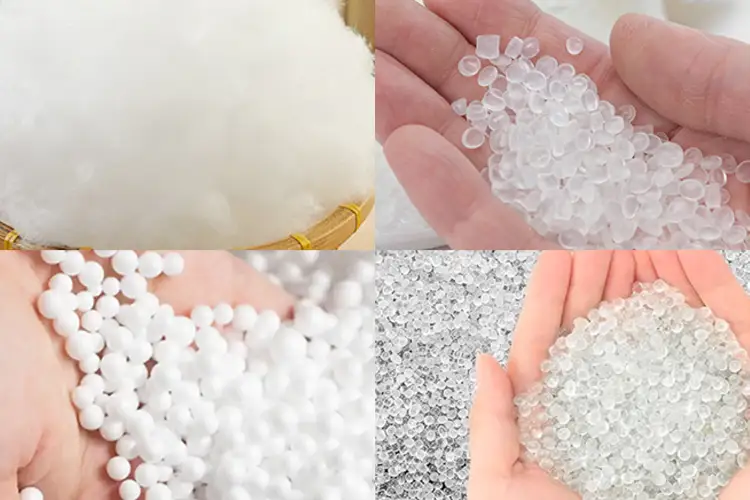
Polyester fiberfill — often referred to as polyfill or virgin polyester fiber — is by far the most widely used stuffing material in commercial plush toy production. It is manufactured by extruding polyethylene terephthalate (PET) into fine fibers, which are then crimped and cut to create a fluffy, compressible fill. The result is a lightweight, odorless, non-allergenic fill that is easy to machine-stuff, holds its shape reliably, and costs significantly less than natural alternatives.
One of polyester fiberfill’s most important practical advantages is its washability. High-quality polyester fill retains its loft and bounce-back after repeated machine washing and tumble drying, making it the obvious choice for children’s plush toys that will see frequent laundering. It is also inherently resistant to mold, mildew, and dust mite colonization — a meaningful advantage over organic fills in humid climates.
The primary drawback of virgin polyester fiberfill is environmental: it is derived from petroleum and is not biodegradable. Increased consumer awareness around plastic waste has prompted many manufacturers to explore recycled alternatives, which are addressed separately below.
Polyester Fiberfill: Key Performance Properties
| Property | Rating | Notes |
|---|---|---|
| Softness | Excellent | Ultra-fine denier options available for premium feel |
| Loft retention | Good to excellent | Varies by fiber grade; siliconized fiber retains loft longer |
| Washability | Excellent | Machine wash and tumble dry safe; loft recovers well |
| Allergen risk | Very low | Non-organic; does not support dust mite growth |
| Moisture resistance | Good | Dries faster than natural fills |
| Environmental impact | Poor (virgin) / Moderate (recycled) | Non-biodegradable; recycled PET options reduce footprint |
| Cost | Low | Most affordable mass-production option |
Recycled Polyester Fill: Sustainability Without Sacrifice
Recycled polyester fiberfill — most commonly produced from post-consumer PET plastic bottles — has grown substantially in market share as toy brands respond to consumer demand for more sustainable products. The manufacturing process converts shredded and melted plastic bottles into polyester fiber that is functionally comparable to virgin fiberfill in terms of softness, loft, and washability.
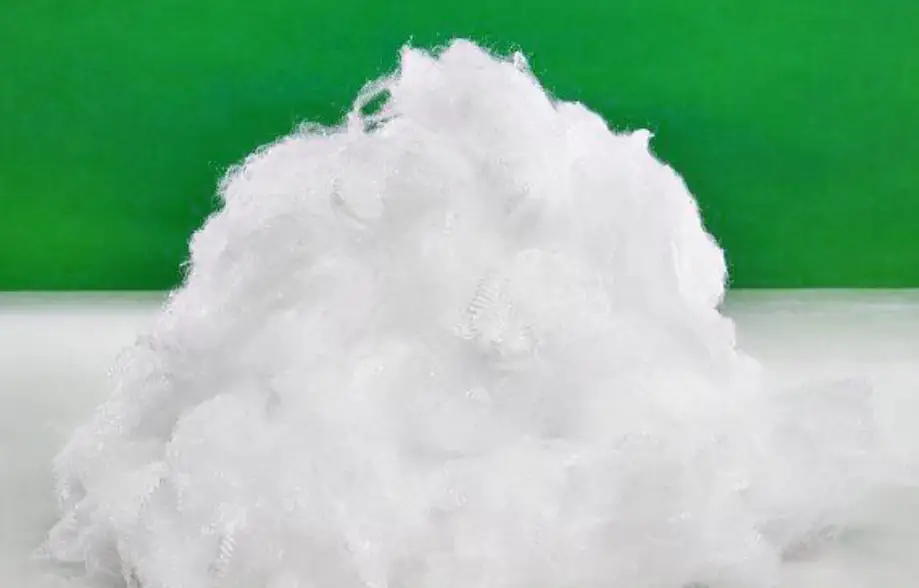
From a performance standpoint, high-quality recycled polyester fill is largely indistinguishable from its virgin counterpart. The primary appeal is environmental: using recycled PET reduces reliance on new petroleum feedstocks, diverts plastic waste from landfill and ocean environments, and typically generates lower carbon emissions per kilogram of fiber produced. Several international certifications — including the Global Recycled Standard (GRS) and OEKO-TEX STANDARD 100 — help manufacturers and buyers verify the authenticity and safety of recycled fill materials.
Virgin vs. Recycled Polyester Fiberfill Comparison
| Attribute | Virgin Polyester | Recycled Polyester (rPET) |
|---|---|---|
| Raw material source | Petroleum-derived PET resin | Post-consumer PET bottles/textile waste |
| Carbon footprint | Higher | Lower by approximately 30–55% depending on process |
| Softness and loft | Excellent | Excellent (comparable quality achieved) |
| Certification options | OEKO-TEX STANDARD 100 | GRS, OEKO-TEX, Bluesign available |
| Price premium | Baseline | 5–20% above virgin depending on volume |
| Biodegradability | No | No (still synthetic polymer) |
| Consumer perception | Neutral | Positive; growing demand signal |
Natural Cotton Fill: Clean, Simple, and Breathable
Cotton stuffing — particularly organic cotton certified to GOTS (Global Organic Textile Standard) — is one of the oldest fill materials used in soft toys and remains popular for artisan, handmade, and premium eco-conscious plush products. Cotton fill has a dense, slightly firm texture compared to polyester, which gives stuffed animals a more solid, weighted feel that many parents and collectors find reassuring and high-quality.
Cotton is naturally breathable, hypoallergenic when unbleached and chemical-free, and biodegradable — a strong combination for environmentally motivated buyers. However, it presents some practical challenges. Cotton fill is heavier than polyester per unit of volume, which increases shipping weight and cost at scale. It absorbs moisture readily and takes longer to dry, increasing the risk of mold or mildew if a toy is not dried thoroughly after washing. Loft retention is also lower than polyester — cotton tends to compress and clump over time with heavy use.
Wool Fill: Temperature-Regulating and Naturally Flame-Resistant
Wool stuffing is a premium natural fill option valued for its unique combination of properties that no synthetic material can fully replicate. Wool fibers are naturally crimped, giving the fill a springy, lofty texture. Wool is inherently flame-resistant, meeting some flammability requirements without the addition of chemical flame retardants — a significant advantage in markets with strict juvenile product safety regulations. It is also temperature-regulating: wool absorbs and releases moisture vapor, keeping the fill comfortable in both warm and cool conditions.
The limitations of wool fill include its higher cost, its susceptibility to felting and matting if machine-washed incorrectly (requiring gentle or hand-wash care instructions), and its potential as an allergen for a minority of sensitized individuals. For high-end plush toys positioned in the natural or Waldorf-inspired toy segment, wool fill remains a highly compelling choice.
Natural Fill Materials: Side-by-Side Comparison
| Property | Organic Cotton | Wool | Kapok |
|---|---|---|---|
| Feel / texture | Dense, firm, smooth | Springy, slightly textured | Ultra-light, silky |
| Biodegradable | Yes | Yes | Yes |
| Flame resistance | Low (burns) | High (naturally self-extinguishing) | Moderate (can be flammable when loose) |
| Washability | Machine washable; dries slowly | Gentle / hand wash only | Spot clean or hand wash recommended |
| Allergen potential | Very low (organic, unbleached) | Low to moderate | Very low |
| Moisture absorption | High | High (moisture-wicking) | Low (naturally water-resistant) |
| Relative cost | Moderate | High | Moderate to high |
Kapok Fiber: The Overlooked Natural Alternative
Kapok is a natural plant fiber harvested from the seed pods of the Ceiba tree, native to tropical regions of South America, West Africa, and Southeast Asia. It is one of the lightest natural fibers in existence — approximately eight times lighter than cotton by equivalent volume — with a naturally silky, almost waxy surface that makes it feel uniquely soft and smooth. Kapok has been used as a fill material for pillows, mattresses, and stuffed animals for centuries, and it is experiencing renewed interest from sustainable toy brands.
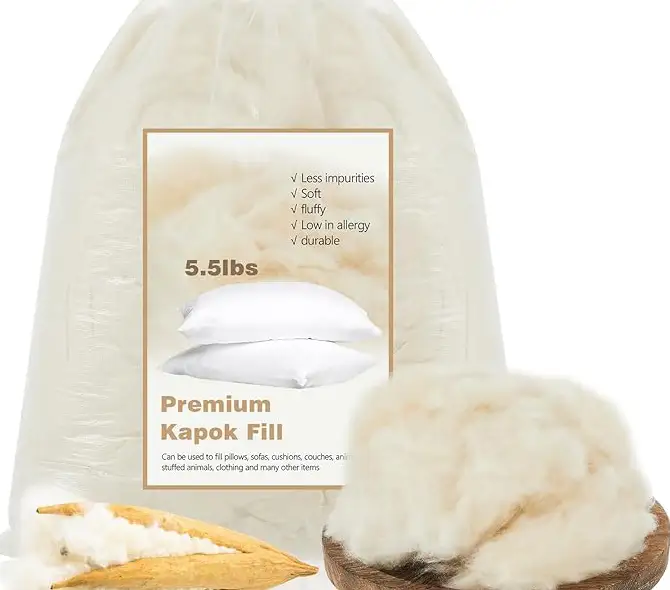
Unlike cotton, kapok is naturally water-resistant due to a thin waxy coating on its hollow fibers, which also makes it resistant to mold and mildew in normal conditions. It is 100% biodegradable, grows without pesticides in its native habitat, and requires no irrigation — giving it an exceptionally low environmental footprint. The main practical limitation is that kapok fibers are short, slippery, and somewhat difficult to machine-stuff uniformly, which is why it is more commonly found in handmade or small-batch plush products.
Specialty and Alternative Fill Materials
Memory Foam and Shredded Foam
Shredded foam — including memory foam offcuts repurposed from mattress and furniture manufacturing — is occasionally used as a stuffing material in larger plush toys and floor cushion-style stuffed animals. Foam fill provides a firmer, heavier feel with good shape retention. However, it is not washable (foam deteriorates rapidly when machine washed), heavier than fiberfill, and more difficult to distribute evenly during the stuffing process. Its use is generally confined to large novelty items or weighted plush toys where density is a deliberate design feature.
Buckwheat Hulls and Weighted Fill
Weighted plush toys have grown significantly in popularity, particularly as sensory tools for children with autism spectrum disorder, anxiety, and sensory processing differences. Weighted fill materials — including plastic pellets, glass beads, and steel shot beads — are distributed within an inner pouch inside the plush toy, providing deep pressure stimulation. Buckwheat hulls are a natural alternative used in some products for their conforming, moldable texture. All weighted fill products must comply with weight guidelines for the intended age group and require robust inner containment seaming to prevent fill escape.
Specialty Fill Materials: Applications and Considerations
| Fill Material | Typical Application | Key Advantage | Key Limitation |
|---|---|---|---|
| Shredded foam | Large novelty plush, floor cushions | Good shape retention; firm feel | Not machine washable; heavy |
| Memory foam | Weighted/therapeutic plush | Pressure-conforming; durable | Not washable; requires breathable outer fabric |
| Plastic pellets (PE/PP) | Weighted sensory toys, beanbag plush | Precise weight control; compact | Choking hazard risk if seam fails; not eco-friendly |
| Glass beads | Premium weighted plush | Heavy, smooth; small volume | Breakage risk; requires robust containment |
| Buckwheat hulls | Natural weighted/sensory plush | Biodegradable; moldable texture | Not washable; can shift and settle unevenly |
| Steel shot beads | High-weight therapeutic toys | Densest option; long-lasting | Heaviest; potential rust if containment breached |
Safety Standards and Certification Requirements
Regardless of which stuffing material is selected, plush toys sold in major markets must comply with applicable toy safety standards. In the United States, ASTM F963 governs toy safety, including requirements for fill material flammability and chemical content. In the European Union, EN 71 sets equivalent standards. Both frameworks restrict the use of certain chemical compounds in fill materials — including specific dyes, heavy metals, and flame retardants — that could pose a risk to children through inhalation, ingestion, or skin contact.
OEKO-TEX STANDARD 100 certification is widely used in the industry as a fill material-level safety signal: certified fills have been tested for harmful substances including pesticide residues, formaldehyde, phthalates, and heavy metals. For products targeting infants and toddlers — the most sensitive age group — selecting OEKO-TEX certified or equivalent tested fill materials is considered best practice regardless of whether it is a regulatory requirement in the target market.
Stuffing Material Safety and Certification Overview
| Fill Material | OEKO-TEX Eligible | Key Safety Consideration | Relevant Standard |
|---|---|---|---|
| Virgin polyester fiberfill | Yes | Check for antimony residue in PET processing | ASTM F963, EN 71 |
| Recycled polyester (rPET) | Yes (with GRS) | Verify source stream purity; test for contaminants | GRS, OEKO-TEX, EN 71 |
| Organic cotton | Yes (GOTS preferred) | Ensure no residual pesticides; bleach-free processing | GOTS, OEKO-TEX, ASTM F963 |
| Wool | Yes | Check for moth-proofing chemical treatments | EN 71, OEKO-TEX |
| Kapok | Yes | Flammability testing required; loose fiber caution | ASTM F963, EN 71 |
| Weighted pellets/beads | Varies | Choking hazard; seam strength testing critical | ASTM F963 Section 4.6, EN 71-1 |
How to Choose the Right Stuffing Material for Your Plush Toy
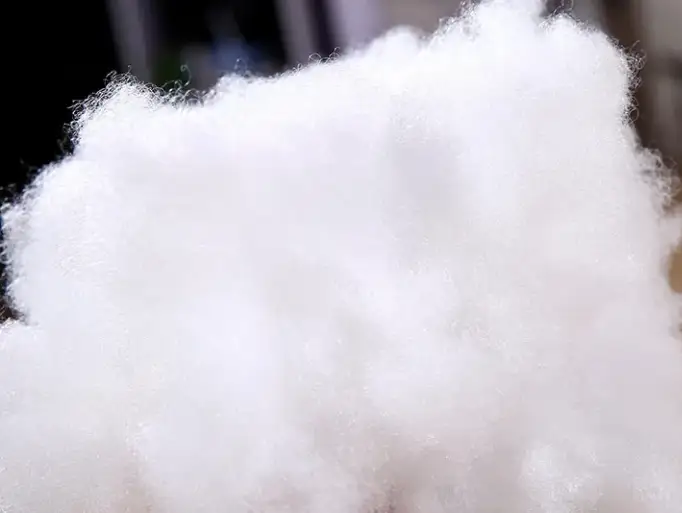
There is no single best stuffing material for all plush toys. The right choice depends on the product’s intended use, target age group, price positioning, sustainability commitments, and the regulatory markets it will be sold in. For mass-market children’s toys that will be washed frequently, high-quality siliconized polyester fiberfill or recycled rPET fill delivers the best combination of performance, washability, safety, and cost-efficiency.
For premium, eco-positioned, or Waldorf-inspired products, organic cotton or wool fill communicates product values authentically and delivers a distinctive tactile experience. For sensory or therapeutic plush toys, weighted fill with appropriate safety design is a specialized category that requires careful attention to weight guidelines and containment integrity.
Manufacturers launching new plush products should build material selection into the earliest stages of product development — before tooling, pattern grading, or fabric sourcing is finalized. The stuffing material affects seam allowance requirements (denser fills require stronger seams), label requirements (care instructions, age warnings), and packaging weight. Addressing these interdependencies early prevents costly redesigns later in the development process.
Frequently Asked Questions
1. What is the safest stuffing material for babies and infants?
For plush toys intended for infants and children under three years old, the safest fill options are OEKO-TEX STANDARD 100 certified polyester fiberfill or GOTS-certified organic cotton. Both materials have been tested for harmful chemical residues including heavy metals, phthalates, formaldehyde, and pesticides.
Polyester fiberfill has the additional advantage of being non-allergenic, moisture-resistant, and resistant to mold and dust mite growth — all important considerations for very young children who may mouth or sleep with their toys. Weighted fill materials (pellets, beads) are generally not recommended for children under three due to choking hazard risk if seams fail.
2. How does stuffing material affect the washability of a plush toy?
Stuffing material is one of the primary determinants of wash care requirements. Polyester fiberfill — both virgin and recycled rPET — is machine washable and tumble dryer safe, and recovers its loft and shape well after washing. Organic cotton fill is machine washable but takes significantly longer to dry and can clump or compress if not properly agitated during the spin cycle.
Wool fill is sensitive to heat and agitation, felting irreversibly if machine washed at the wrong settings — hand washing in cool water is strongly recommended. Specialty fills such as foam, buckwheat hulls, and plastic pellets are generally not machine washable and require spot cleaning or complete fill removal and replacement when washing is necessary.
3. Is recycled polyester fill as soft and durable as virgin polyester fiberfill?
In practical terms, high-quality recycled polyester fiberfill is functionally equivalent to virgin polyester for most plush toy applications. Modern rPET fiber processing has advanced to the point where leading manufacturers produce recycled fill with comparable denier, crimp, and loft characteristics to virgin fiber.
Some premium recycled fills are siliconized — meaning the fibers are coated with a silicone finish that reduces inter-fiber friction and enhances softness and loft retention — just as high-grade virgin fills are. The main difference lies in traceability and certification: buyers should look for GRS-certified rPET fill to verify that the recycled content claim is independently verified and that the source material has been tested for contaminants.
4. What stuffing material is best for weighted plush toys?
The most common weighted fill materials are plastic poly pellets (polyethylene or polypropylene), glass beads, and steel shot beads, each offering different density, feel, and cost profiles. Plastic pellets are the most widely used due to their low cost, consistent sizing, and light-to-moderate weight capacity. Glass beads offer a denser, smoother feel in a smaller volume — making them popular for premium weighted sensory toys.
Steel shot beads achieve the highest weight-to-volume ratio but require robust inner containment pouching to prevent rust exposure if the lining is breached. All weighted fill products should include a double-stitched inner containment pouch, meet applicable weight guidelines for the target age group, and be tested to seam strength standards to ensure fill cannot be accessed by children.
5. What is siliconized polyester fiberfill, and is it worth the cost premium?
Siliconized polyester fiberfill is standard polyester fiber that has been coated with a thin layer of silicone lubricant during manufacturing. The silicone coating reduces friction between individual fibers, allowing them to slide past one another more easily when compressed. This results in a fill that recovers its loft more quickly and completely after compression, maintains a softer and bouncier feel over extended use, and stuffs more smoothly during production (reducing machine jams and improving fill consistency).
For plush toys positioned in the mid-to-premium tier — particularly those where a plump, full appearance is a key quality signal — siliconized fill is generally worth the modest cost premium (typically 10–20% above standard polyester fill). For basic promotional or low-price-point plush, standard non-siliconized fill is usually adequate.
Conclusion
Plush toy stuffing materials span a wide spectrum — from high-performance synthetic fills engineered for maximum washability and loft to biodegradable natural alternatives that prioritize environmental footprint and tactile authenticity. Each material brings a distinct combination of properties, cost implications, safety considerations, and consumer communication value that must be weighed against the specific requirements of the product being developed.
Polyester fiberfill remains the dominant choice in commercial production for good reason: it is affordable, safe, washable, and performs consistently at scale. Recycled rPET fill is increasingly closing the gap in cost while offering meaningful sustainability credentials. Natural fills — cotton, wool, and kapok — serve distinct market segments where the feel, origin, and biodegradability of the fill material are part of the product story. And specialty fills like weighted pellets expand the functional range of plush toys into therapeutic and sensory applications.
For anyone designing, sourcing, or buying plush toys, understanding what is inside the toy is as important as what is on the outside. The right stuffing material, properly specified and certified, makes the difference between a plush toy that delights for years and one that goes flat, clumps, or fails safety testing before it ever reaches a child’s hands.