Skip to content
Everything sourcing managers, brand owners, and importers need to know about spotting warning signs during plush toy factory selection — from sample quality and compliance documentation to communication patterns and pricing behavior.
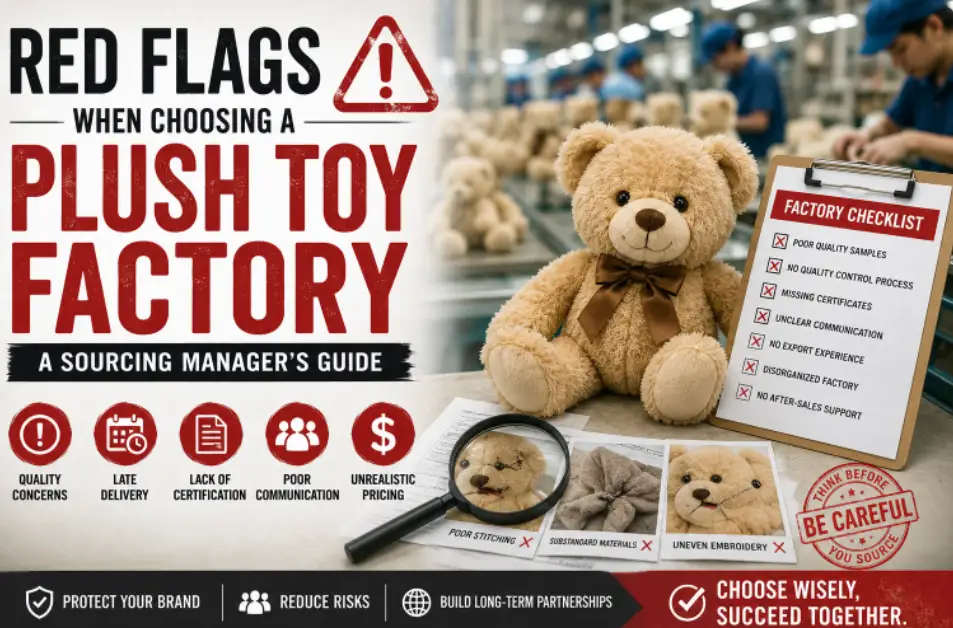
Red flags when choosing a plush toy factory are the warning signs — in documentation, communication, sampling, and pricing behavior — that indicate a manufacturer is unlikely to deliver consistent quality, meet compliance obligations, or protect a buyer’s production timeline. Spotting these signals during the vetting stage is far less costly than discovering them after a deposit has been paid and a production slot has been booked.
This guide walks through the most common and most costly red flags encountered when evaluating a plush toy factory, organized by the stage of the sourcing relationship where they typically surface — from the first inquiry response through sampling, compliance documentation, factory audits, and contract negotiation — with reference data that sourcing teams can apply directly to a supplier evaluation checklist.
Why Plush Toy Factory Vetting Matters More Than It Appears To
Plush toy manufacturing looks deceptively simple from the outside: cut fabric, sew, stuff, finish. In practice, a reliable plush toy factory must simultaneously manage fabric consistency, fiberfill density control, embroidery and safety-eye attachment strength, chemical compliance testing, and on-time case-pack delivery — and a factory that is weak in any one of these areas can generate returns, compliance holds, or reputational damage long after the purchase order is placed.
Because plush toys are a soft-goods category with relatively low tooling barriers to entry compared with hard-goods manufacturing, the plush toy supplier landscape includes a wide range of operational maturity — from vertically integrated factories with in-house testing labs to loosely coordinated trading companies that subcontract production to unaudited workshops. Distinguishing between these tiers early in the sourcing process is the single highest-leverage step in avoiding a costly production failure.
The financial exposure created by a poor factory choice is rarely limited to the cost of the goods themselves. A failed shipment can trigger retailer chargebacks, missed seasonal delivery windows that eliminate an entire selling period, disposal or rework costs for non-compliant inventory, and long-term reputational damage with a retail buyer that may take years to rebuild.
Because these downstream costs typically dwarf the unit price difference between a well-vetted factory and a cheaper unvetted one, red-flag screening should be treated as a risk-management function with real budget and time allocated to it, rather than an informal afterthought squeezed into a broader sourcing timeline.
Sourcing Tip: Treat the first two weeks of communication with a prospective plush toy factory as a data-gathering exercise, not just a price negotiation. How a factory answers technical questions in this window is often more predictive of production reliability than the quote itself.
Communication Red Flags During the Inquiry Stage
The earliest and most accessible red flags appear before any sample has even been requested, in the pattern and substance of a factory’s communication.
Vague or Deflected Answers to Technical Questions
A factory that consistently avoids specific answers about fiberfill type, fabric GSM, safety-eye attachment method, or in-house testing capability is signaling either a lack of technical depth or an unwillingness to be held accountable to stated specifications later. Reputable plush toy manufacturers typically answer material and process questions with specific figures — fiberfill density in grams, fabric composition and pile height, needle detection pass thresholds — rather than generic assurances such as “our quality is very good.”
Inconsistent Company Information Across Channels
Discrepancies between the factory name on a business license, the name used in email signatures, and the name printed on sample packaging can indicate that the entity a buyer is communicating with is a trading intermediary rather than the actual manufacturing site — which is not disqualifying on its own, but should be disclosed and clarified rather than left ambiguous.
Unrealistic Response Speed or Universal Agreement
A factory that agrees immediately to every requested specification, timeline, and price point without raising a single technical constraint is a subtler but meaningful red flag. Experienced plush toy manufacturers routinely push back on unrealistic lead times, flag material availability issues, or ask clarifying questions about ambiguous specifications — a factory that never does this is either inexperienced or telling the buyer what they want to hear rather than what is operationally true.
Communication Red Flags at the Inquiry Stage
| Red Flag | What It Often Indicates | Recommended Response |
|---|---|---|
| Vague answers on fiberfill, fabric, or testing specs | Limited technical depth or unwillingness to commit to specifics | Request written specification sheets before proceeding to sampling |
| Mismatched company names across license, email, and packaging | Possible unlicensed subcontracting or trading intermediary | Request a business license and clarify the manufacturing site directly |
| No pushback on unrealistic lead times or pricing | Inexperience, or a pattern of over-promising to secure the order | Cross-check lead time claims against stated production capacity |
| Reluctance to schedule a video call or virtual factory tour | The facility may not match the images or claims presented | Request a live video walkthrough of the actual production floor |
| Pressure to skip sampling and move straight to bulk order | Attempt to avoid scrutiny before deposit collection | Treat sampling as non-negotiable regardless of the discount offered |

Sampling Stage Red Flags
The sampling stage is the most information-dense phase of plush toy factory vetting because it is the first point where claims can be checked against a physical product.
Sample Quality That Doesn’t Match Photos or Catalog Claims
A sample that arrives with looser stitching, thinner fabric, or a different fiberfill density than what was described or shown in reference photography suggests either inconsistent quality control or a deliberate practice of presenting a best-case sample while planning to substitute cheaper materials in bulk production. This gap is one of the most common and costly plush toy sourcing failures because it is not always detectable until a full production run has already shipped.
Reluctance to Provide Multiple Sample Rounds
Legitimate plush toy manufacturers expect that a first sample will require revision — adjusting stuffing firmness, correcting color match, or reinforcing a weak seam — and typically build two to three sample rounds into their standard development process. A factory that resists a second sample round, or charges an unusually high fee for minor revisions, may be trying to rush a buyer into bulk production before quality issues are fully resolved.
Missing or Inconsistent Safety Component Attachment
Safety eyes, noses, and joints that are glued rather than mechanically locked, or that pull free with light hand pressure on a sample, indicate a process control gap that will very likely persist into bulk production and create a genuine choking hazard risk. This is one of the few red flags that should be treated as an immediate disqualifier rather than a negotiation point, given the direct safety implications.
Sourcing Tip: Apply a firm, sustained pull test to every safety eye, nose, and joint on a sample — not just a light tug — and repeat the test after the sample has been laundered once if the product is expected to be washable. Attachment strength that seems adequate dry can fail after a single wash cycle.
Sampling Stage Red Flags in Plush Toy Sourcing
| Red Flag | Risk Level | Typical Root Cause |
|---|---|---|
| Sample quality below catalog photos or claims | High | Best-case sample presentation vs. planned bulk-production substitution |
| Resistance to a second sample revision round | Medium | Pressure to move to deposit collection before issues are resolved |
| Safety eyes/joints that pull free with light pressure | Critical | Inadequate mechanical locking process or missing washer backing |
| Fiberfill lumping or uneven density in the sample | Medium | Manual stuffing without density control or calibrated stuffing equipment |
| Fabric color or texture drifts from the approved swatch | Medium | Dye-lot variance not controlled or communicated by the factory |
Compliance and Documentation Red Flags
Because plush toys are children’s products in most markets, compliance documentation is not optional paperwork — it is the evidentiary basis for every safety claim printed on the product’s packaging.
Inability to Produce Valid Test Reports
A factory that cannot produce a current, product-specific test report from an accredited third-party lab covering the relevant standards — such as EN71, ASTM F963, or CPSIA, depending on the destination market — is one of the clearest disqualifying red flags in plush toy sourcing. Equally concerning is a factory that provides a test report for a similar but different product, hoping the buyer will not check the product description and specifications listed on the report itself.
Reused or Expired Test Reports
Chemical and physical test reports have a validity window and are tied to a specific production batch and material lot. A factory that reuses the same test report across multiple unrelated orders, or presents a report with an expired date, is treating compliance as a paperwork formality rather than a genuine safety verification process.
No Traceable Batch or Lot Coding System
Without batch or lot traceability, a factory cannot isolate which specific production run a defect or compliance failure originated from, which turns any quality issue into a full-shipment problem rather than a contained, batch-level one. This absence is a structural red flag that indicates weak internal quality systems well beyond the specific order being discussed.

Sourcing Tip: Always verify a submitted test report directly with the testing laboratory’s report-lookup portal rather than trusting the PDF at face value. Fabricated or altered test reports are a documented risk across soft-goods sourcing, and a five-minute verification step can prevent a serious compliance exposure.
Compliance Documentation Red Flags by Category
| Documentation Gap | Why It Matters | Verification Method |
|---|---|---|
| No accredited third-party test report available | No independent evidence that the product meets safety standards | Request report directly; confirm lab accreditation status |
| The test report describes a different product or spec | The report may not reflect the actual product being ordered | Cross-check the product description, dimensions, and material list on the report |
| Expired or reused test report across multiple orders | Compliance is treated as a formality rather than verification | Check the report issue date and the specified production batch |
| No lot/batch coding system in place | Cannot isolate defective production runs if issues arise | Request a sample of the batch coding system on prior shipments |
| Missing business license or export registration | Legal and customs risk; possible unlicensed operation | Request and independently verify the business license number |
Factory Audit and Facility Red Flags
For orders above a meaningful volume threshold, an in-person or live video factory audit surfaces red flags that are difficult to detect through documentation and samples alone.
Refusal or Repeated Postponement of an Audit
A factory that repeatedly delays or declines a scheduled audit — whether in-person or via live video walkthrough — is one of the strongest behavioral red flags in plush toy sourcing, since a confident, well-run facility typically has little to lose from transparency and can often benefit from demonstrating its capability directly.
Facility Conditions That Don’t Match Production Claims
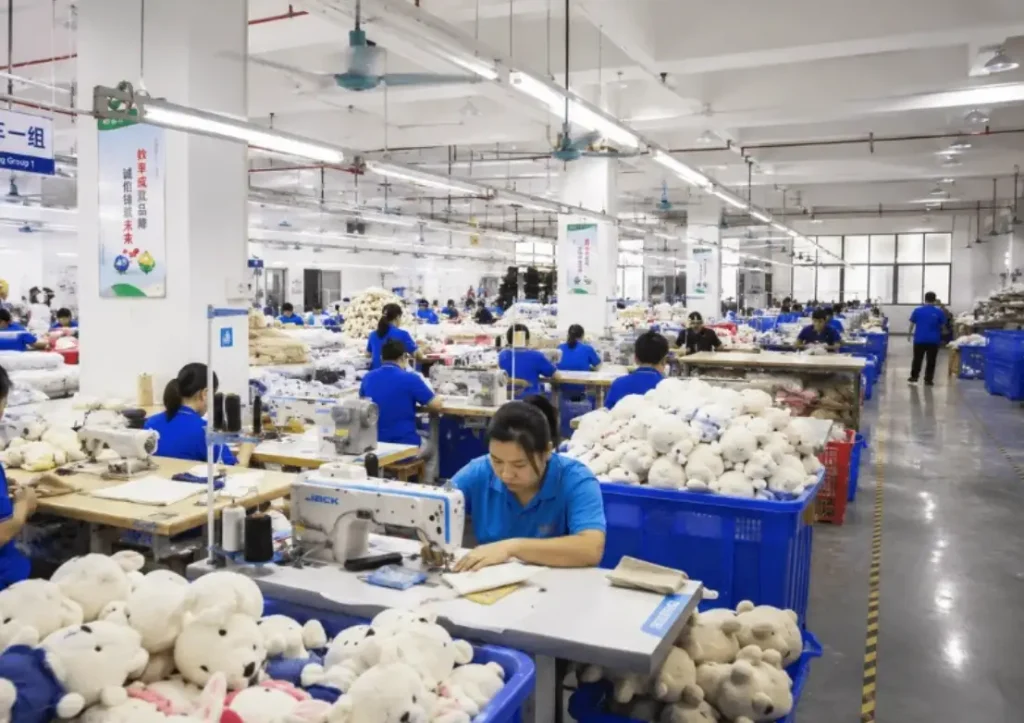
During an audit, mismatches between the stated production capacity and the observed number of active sewing stations, or between claimed in-house testing capability and an absent or non-functional testing lab, indicate that some of the factory’s stated capabilities may be outsourced or exaggerated without disclosure.
Poor Working Conditions and Labor Compliance Gaps
Overcrowded workstations, absent fire safety equipment, unclear wage documentation, or underage-appearing workers on the floor are serious ethical and reputational red flags that extend well beyond product quality risk and should be treated as an immediate disqualifier regardless of pricing or sample quality.
Factory Audit Red Flags and Severity
| Audit Finding | Severity | Recommended Action |
|---|---|---|
| Repeated postponement or refusal of audit access | High | Treat as disqualifying unless a credible reason is documented |
| Sewing station count inconsistent with stated capacity | Medium-High | Request clarification on subcontracted vs. in-house production |
| No functioning in-house testing lab despite claims | Medium | Confirm which tests are genuinely performed in-house vs. outsourced |
| Visible labor compliance or safety violations | Critical | Disqualify regardless of pricing or product quality |
| Disorganized or absent quality control checkpoints on the line | Medium-High | Request documented in-line QC process and inspection records |
Pricing and Contract Behavior Red Flags
Pricing behavior is one of the most misunderstood areas of plush toy factory vetting, because buyers often equate a low quote with good value rather than recognizing it as a potential warning sign in its own right.
Quotes That Are Significantly Below Market Range
A quote substantially below the typical cost range for comparable plush toy specifications — factoring in fabric grade, fiberfill quality, size, and required compliance testing — usually means the factory is planning to cut costs somewhere in the production process that was not made explicit in the quote, whether through thinner fabric, lower fiberfill density, or skipped testing.

Large Upfront Deposits With Limited Recourse
While deposits are standard practice in plush toy manufacturing, a factory that demands an unusually high deposit percentage, refuses standard payment terms tied to sample approval and pre-shipment inspection, or is unwilling to put agreed specifications in a written contract is signaling reduced accountability if something goes wrong during production.
Refusal to Allow Third-Party Pre-Shipment Inspection
A factory that resists or discourages an independent pre-shipment inspection before final payment and shipment release removes one of the buyer’s last meaningful checkpoints for catching quality or compliance issues before goods leave the country of origin, and this resistance itself should be read as a significant red flag.
Sourcing Tip: Structure payment terms so that a meaningful final balance — commonly 20%–30% — is contingent on a passed third-party pre-shipment inspection report, rather than being due on shipment or on the factory’s own self-reported completion.
Key Reference Data: Plush Toy Sourcing Risk Benchmarks
| Parameter | Typical / Recommended Value | Significance |
|---|---|---|
| Standard sample development rounds before approval | 2–3 rounds | Fewer rounds offered may indicate a rushed development process |
| Recommended final payment held for inspection | 20%–30% of order value | Provides real leverage to enforce corrections before shipment |
| Safety eye/joint pull-test force (manual check) | Should not detach under firm sustained hand pressure | Baseline field check before formal mechanical pull testing |
| Test report validity window (typical) | 6–12 months, batch-specific | Reports outside this window or batch mismatch require re-testing |
| Recommended minimum quotes compared before award | 3 qualified factories | Establishes a realistic market price range and specification baseline |
Red Flags That Surface During Active Production
Some of the most damaging red flags in plush toy sourcing do not appear until after a purchase order has already been placed and a deposit paid, which is precisely why ongoing monitoring during the production window matters as much as pre-order vetting.
Unexplained Production Delays Without Proactive Updates
A short delay communicated proactively, with a clear reason and a revised date, is a normal part of manufacturing. A pattern of delays that only come to light when the buyer proactively chases for an update — rather than being flagged by the factory as soon as a risk to the timeline becomes apparent — indicates a communication culture that prioritizes avoiding difficult conversations over protecting the buyer’s downstream retail commitments.
Requests to Substitute Materials Mid-Production
A factory that requests a fabric, fiberfill, or trim substitution partway through a confirmed production run, citing material shortages, should be treated cautiously even when the proposed substitute sounds comparable. Any substitution changes the product that was originally sampled and tested, which means updated compliance testing may be required before the substituted product can legally ship, and buyers should never accept a verbal assurance that a substitute material is “basically the same” without supporting documentation.
Inconsistent In-Line Quality Control Reporting
Factories with mature quality systems typically provide in-line inspection data at defined production milestones — for example, after cutting, after sewing, and after stuffing and finishing — showing defect rates and corrective actions taken. A factory that cannot produce this data, or that only offers a single end-of-line inspection summary with no supporting detail, is often relying on final inspection alone to catch problems that would have been cheaper and easier to correct earlier in the process.
Sourcing Tip: Request a simple weekly production status update as a standing requirement in the purchase order terms, covering cutting, sewing, and stuffing progress against the confirmed timeline. A factory that resists this modest reporting request even before problems arise is unlikely to volunteer bad news proactively once problems do occur.
Distinguishing Minor Concerns From Genuine Disqualifiers
Not every red flag carries the same weight, and treating minor stylistic or communication quirks the same as safety or compliance failures can cause buyers to walk away from otherwise capable factories over issues that are easily resolved through clearer specification documents. A useful discipline is separating red flags into three tiers: cosmetic or communication-style issues that are worth raising but rarely disqualifying on their own, operational gaps that warrant a documented corrective action plan before proceeding, and safety or compliance failures that should end the relationship regardless of price or relationship history.
Slow email response time in a different time zone, for example, is a minor and manageable issue that a clear communication protocol can resolve. A missing or fabricated compliance test report, by contrast, sits in the disqualifying tier regardless of how strong the sample quality or pricing may be, because it removes the evidentiary basis for every safety claim the buyer will later make to their own retail customers and regulators.
Weighing Red Flags Against Order Volume and Risk Exposure
The acceptable risk tolerance for a red flag also scales with order volume and the age range of the intended end user. A minor documentation gap that might be manageable for a small trial order intended for adult collectors carries substantially higher risk when the same gap appears on a large production run of plush toys intended for children under three, where choking hazard and chemical safety testing carry direct legal and safety consequences. Sourcing teams should calibrate how strictly they enforce each red flag category against both the scale of the order and the vulnerability of the end user.
Building a Practical Plush Toy Factory Vetting Workflow
A disciplined vetting workflow sequences red-flag checks so that the most disqualifying issues are caught earliest, before time and money are committed further into the relationship. This typically means confirming business license and compliance documentation first, evaluating communication and technical depth during the inquiry stage, testing sample quality and safety component attachment directly, conducting a live or in-person audit for meaningful order volumes, and only then negotiating final pricing and payment terms.
Buyers who treat red flags as isolated, individually excusable incidents rather than as a pattern tend to accumulate risk across multiple small compromises that only become visible once a shipment has already failed inspection or been returned by a retail customer. Treating each red flag category above as part of a single, cumulative risk picture — rather than negotiating past them one at a time — is the most reliable way to select a plush toy factory that performs consistently at scale.
It is also worth building red-flag screening into a repeatable internal document rather than relying on informal memory from one sourcing cycle to the next, particularly for teams that evaluate multiple new factories per year or manage supplier relationships across several product categories. A standardized scorecard covering communication responsiveness, sample fidelity, compliance documentation completeness, audit findings, and payment term flexibility allows a sourcing team to compare candidate factories on a consistent basis, rather than relying on subjective impressions that can vary depending on who conducted the initial outreach. Over time, this record also becomes a valuable reference for renegotiating terms with an existing supplier or for identifying whether a factory’s reliability is improving or declining across successive orders.
Finally, red-flag vetting should not stop once a factory relationship is established. Suppliers that perform well on an initial trial order can still develop quality or compliance gaps later, whether due to management turnover, subcontracting decisions made without disclosure, or simple complacency after a buyer has demonstrated loyalty through repeat orders. Periodic re-verification of test reports, spot sampling from live production runs, and occasional unannounced audits help ensure that the diligence applied during initial selection continues to hold up across the life of the sourcing relationship.
Frequently Asked Questions
What is the single biggest red flag when vetting a plush toy factory?
Refusal or repeated postponement of a factory audit, whether in-person or via live video walkthrough, is generally considered the strongest single red flag. A confident, well-run facility typically has little to lose from transparency, so persistent avoidance usually indicates a gap between claimed and actual production capability.
Should a low price quote always be treated as a red flag in plush toy sourcing?
Not automatically, but a quote significantly below the typical range for comparable specifications should prompt closer scrutiny. It usually means cost is being cut somewhere not made explicit in the quote, such as thinner fabric, lower fiberfill density, or reduced or skipped compliance testing.
How many sample rounds should a plush toy factory offer before bulk production?
Most legitimate plush toy manufacturers build two to three sample rounds into their standard development process to address stuffing firmness, color match, and seam strength. A factory that resists a second revision round or charges an unusually high fee for minor changes may be trying to rush a buyer into bulk production before issues are resolved.
What should I check if a factory provides a compliance test report?
Confirm that the report is from an accredited third-party laboratory, describes the exact product and specifications being ordered rather than a similar item, falls within its validity window, and is tied to the specific production batch. Verifying the report directly with the testing lab’s lookup portal is the most reliable way to confirm it has not been altered or reused.
How can I test the safety of eyes, noses, and joints on a plush toy sample?
Apply a firm, sustained pull test to every safety component by hand, and repeat the test after one wash cycle if the product is intended to be washable. Components that detach under moderate sustained pressure indicate a process control gap that is very likely to persist into bulk production and represents a genuine choking hazard.
Is it a red flag if a plush toy factory pressures me to skip sampling?
Yes. Pressure to move directly from inquiry to bulk production, particularly when paired with a discount for skipping sampling, is a common tactic to avoid scrutiny before a deposit is collected. Sampling should be treated as a non-negotiable step regardless of the incentive offered to bypass it.
What payment terms help protect against plush toy factory quality risk?
Structuring the final payment balance, commonly 20%–30% of order value, to be contingent on a passed third-party pre-shipment inspection gives the buyer meaningful leverage to enforce corrections before goods ship. A factory that resists this structure or discourages independent inspection removes one of the buyer’s last checkpoints for catching issues.
Are poor working conditions at a plush toy factory relevant to a sourcing decision?
Yes, and they should be treated as an immediate disqualifier regardless of pricing or sample quality. Overcrowded workstations, absent fire safety equipment, unclear wage documentation, or underage-appearing workers observed during an audit are serious ethical and reputational risks that extend well beyond product-level quality concerns.