Skip to content
How embedded electronics, connectivity, and interactive design are reshaping plush toys from static comfort objects into responsive companions — and what that means for design, manufacturing, and safety.
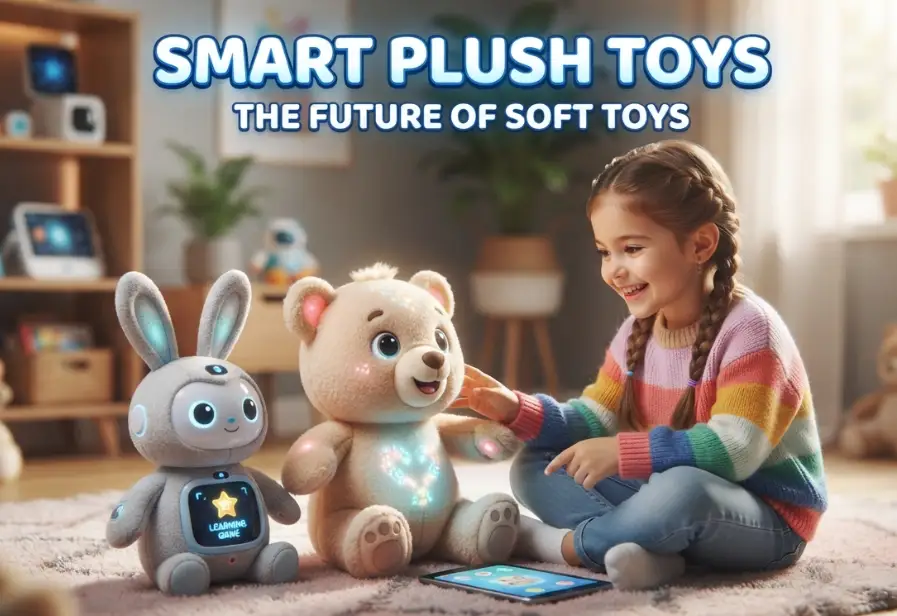
Smart plush toys embed electronics — sensors, speakers, microcontrollers, and increasingly connectivity or AI-driven voice interaction — inside a traditional soft toy shell. Where a standard plush toy offers comfort through texture and shape alone, a smart plush toy adds a layer of responsiveness: it might react to touch, respond to voice, sync with a companion app, or even hold simple conversations.
This shift is transforming plush toys from passive comfort objects into interactive products that compete directly with tablets and screen-based entertainment for a child’s attention, while still delivering the tactile, huggable qualities that make plush toys distinct in the first place.
What Defines a Smart Plush Toy?
A smart plush toy is defined by the presence of embedded electronic components that enable some form of interactivity beyond the toy’s physical shape and texture. This can range from simple sound-triggered plush toys with a basic sound chip and pressure sensor to sophisticated connected companions with Bluetooth or Wi-Fi connectivity, onboard microphones, and cloud-based voice processing that allows the toy to hold a rudimentary conversation.
The defining challenge of smart plush design is that these two ingredients — soft, huggable fabric construction and rigid electronic components — are fundamentally in tension. A traditional plush toy is soft throughout; a smart plush toy has to hide hard components, batteries, and wiring inside a shell that still needs to feel soft, safe, and washable enough for a child to sleep with every night.
The Spectrum of Interactivity
Smart plush toys generally fall into a few broad tiers of interactivity, each requiring progressively more sophisticated engineering and higher component cost. Understanding which tier a product targets early in development shapes nearly every subsequent design and sourcing decision.
- Reactive plush: Basic sound or light triggers activated by touch, squeeze, or motion sensors — the simplest and most cost-effective tier.
- Interactive plush: Multiple sensor inputs (touch, sound, orientation) driving varied responses, often with a small speaker and pre-recorded phrase library.
- Connected plush: Bluetooth or Wi-Fi connectivity linking the toy to a companion mobile app for content updates, parental controls, or expanded interaction libraries.
- AI-enabled plush: Onboard or cloud-connected voice processing enabling more open-ended conversation, often with natural language responses rather than fixed phrase libraries.
Tip: Decide which interactivity tier your product targets before finalizing the plush pattern, not after — the electronics tier determines battery size, speaker placement, and access-panel location, all of which affect the plush silhouette and seam layout in ways that are very difficult to retrofit later.
Core Electronic Components in Smart Plush Toys
Behind the fabric and stuffing of a smart plush toy sits a small but carefully engineered electronics package, and each component has to be selected and positioned with the plush toy’s soft, huggable use case in mind, not just its raw technical specification.
Sensors
Pressure and touch sensors, often placed in the paws, belly, or ears, detect when a child squeezes or pets the toy and trigger a corresponding sound or motion response. Motion and orientation sensors (accelerometers) allow some smart plush toys to detect when they are picked up, rocked, or laid down, enabling context-aware responses such as a lullaby triggered by a rocking motion.
Sound Systems
A small embedded speaker paired with either a simple sound chip (for basic pre-recorded phrases and sound effects) or a more advanced audio processing module (for voice interaction or app-synced content) forms the toy’s primary output channel. Speaker placement needs to balance sound quality against the muffling effect of surrounding plush fabric and stuffing, which is a genuinely difficult acoustic engineering problem unique to soft toy electronics.
Connectivity Modules
Bluetooth Low Energy (BLE) is the most common connectivity standard for smart plush toys because of its low power consumption relative to Wi-Fi, which matters significantly given the small battery capacity that fits inside a plush shell. Wi-Fi-enabled smart plush toys, which support cloud-based voice processing and more elaborate content updates, trade battery life for expanded interactive capability and typically require more frequent charging.
Batteries and Power Management
Battery selection in smart plush toys must balance interactive runtime against safety and weight constraints, since a battery that is too large or improperly secured creates both a comfort problem (an uncomfortable rigid lump inside a soft toy) and a genuine child-safety risk if it becomes accessible.
Core Electronic Components in Smart Plush Toys
| Component | Function | Typical Placement |
|---|---|---|
| Pressure/touch sensor | Detects squeeze, pat, or touch input | Paws, belly, ears |
| Accelerometer | Detects motion, orientation, and rocking | Central body cavity |
| Speaker | Produces sound effects, phrases, or voice responses | Chest or head cavity |
| Bluetooth/Wi-Fi module | Enables app pairing, content updates, and cloud processing | Central body cavity, near the battery pack |
| Rechargeable battery pack | Powers all onboard electronics | Sealed compartment, typically lower back or base |
Designing the Electronics Housing Without Losing the Plush Feel
The central design challenge in smart plush manufacturing is integrating a rigid electronics housing into a soft toy shell without creating an uncomfortable hard lump or a construction weak point where the housing meets the surrounding plush fabric.
Sealed Electronics Pods
Most smart plush toys use a sealed plastic housing, often injection molded, that contains the sensitive electronics and battery, surrounded on all sides by a buffer layer of foam or extra fiberfill to soften the housing’s edges against the surrounding fabric. This pod is typically positioned in the torso, where it can be adequately padded on all sides while remaining reasonably central for balanced sound output.

Access Panel Design for Battery Replacement or Charging
Non-rechargeable smart plush toys need a secure but child-resistant access panel for battery replacement, typically using a screw-secured panel or a specialized safety closure that requires a tool to open, meeting child-resistant battery compartment requirements common in toy safety regulations. Rechargeable designs instead route a charging port to an external, low-profile connection point, reducing the need for a large access panel altogether.
Wiring, Routing, and Strain Relief
Wiring between the electronics pod, sensors, and speaker needs generous slack and strain relief at each connection point to survive the repeated flexing, squeezing, and washing that a plush toy experiences throughout its life. Wiring that is pulled taut during assembly is one of the most common causes of early electronic failure in smart plush products, since even normal hugging motion can eventually fatigue and break an unrelieved connection.
Tip: Build in at least 20–30% extra wire slack at every connection point inside a smart plush toy, and secure that slack with strain-relief clips or adhesive anchors rather than leaving it loose — this single design detail prevents the majority of early-life electronic failures reported in smart plush products.
Washability and Durability Challenges
Washability is one of the most difficult unresolved problems in smart plush toy design, because parents expect to be able to wash a plush toy the same way they would a standard stuffed animal, while electronics and water are fundamentally incompatible.
Removable Electronics Modules
The most common and reliable solution is a fully removable electronics module, secured inside a zippered or hook-and-loop-sealed pocket, that a parent can take out before machine washing the plush shell. This approach shifts the washability burden to a manual removal step rather than attempting to make the electronics themselves waterproof.

Water-Resistant Sealing Approaches
Some premium smart plush products use conformal coating on circuit boards and gasket-sealed housings to achieve limited water resistance, allowing surface wiping or very light exposure without full machine washability. This approach adds meaningful cost and is generally reserved for products where a fully removable module is not practical given the toy’s design or interaction requirements.
Washability Approaches for Smart Plush Toys
| Approach | How It Works | Trade-off |
|---|---|---|
| Removable electronics module | Zippered pocket allows full electronics removal before washing | Requires the parent to remember the removal step every wash cycle |
| Conformal-coated circuit boards | Protective coating resists moisture on exposed components | Adds cost; does not permit full machine washing |
| Gasket-sealed housing | Sealed enclosure resists light and moisture exposure | Limited to wiping or light exposure, not submersion |
| Non-removable, non-washable design | Electronics permanently sealed inside the plush body | The product must be spot-cleaned only for its entire lifespan |
Tip: If a removable electronics module is part of the design, make the removal process genuinely simple — a single zipper or hook-and-loop closure that a parent can operate without instructions — since a complicated removal process leads to the module being left in during washing far more often than product testing under ideal conditions would suggest.
Safety and Regulatory Considerations Unique to Smart Plush Toys
Smart plush toys must comply with standard plush toy safety regulations covering small parts, flammability, and stuffing material safety, but they also carry additional safety obligations tied specifically to their embedded electronics.
Battery Safety
Battery compartments in children’s products typically need to meet child-resistant closure requirements, and lithium battery-powered products carry additional regulatory scrutiny around thermal safety, charging circuit protection, and transport classification, particularly for products shipped internationally by air.
Electromagnetic Compliance and Wireless Certification
Any smart plush toy with Bluetooth or Wi-Fi connectivity needs to meet the wireless emissions and electromagnetic compatibility certification requirements of each market it will be sold in, a regulatory step that is entirely separate from, and in addition to, standard toy safety certification.
Data Privacy for Connected and Voice-Enabled Products
Connected and AI-enabled smart plush toys that capture audio or usage data, especially those marketed to children, are subject to children’s privacy regulations in many markets, which typically require parental consent mechanisms, data minimization, and clear disclosure of what data is collected and how it is used or stored.

Additional Compliance Areas for Smart Plush Toys
| Compliance Area | What It Covers |
|---|---|
| Child-resistant battery compartments | Prevents young children from accessing batteries without a tool |
| Wireless emissions certification | Confirms Bluetooth/Wi-Fi modules meet market-specific electromagnetic standards |
| Lithium battery transport classification | Governs safe shipping, particularly for air freight |
| Children’s data privacy compliance | Applies to products capturing voice, usage, or app-connected data |
Where Smart Plush Toys Are Headed
The near-term trajectory of smart plush toys is shaped by two converging forces: increasingly compact and affordable AI voice processing, and growing parental comfort with connected products in the home, provided privacy and safety concerns are addressed transparently. As on-device processing becomes more capable, some smart plush toys are shifting away from cloud-dependent voice processing toward local, on-device response generation, which reduces both latency and the data privacy footprint of the product.
At the same time, manufacturing techniques are maturing to better resolve the tension between soft, huggable construction and rigid electronics — including more flexible circuit designs, smaller and more efficient battery formats, and improved removable-module systems that make washability less of a compromise than it has been in earlier product generations. The plush toys that succeed in this category the longest are likely to be the ones that treat interactivity as an enhancement to the toy’s tactile, comforting qualities rather than a replacement for them.
Frequently Asked Questions
What is the difference between a smart plush toy and a regular plush toy?
A regular plush toy offers comfort purely through its texture, softness, and shape, with no embedded electronics. A smart plush toy adds sensors, speakers, and, in more advanced products, connectivity or voice processing, allowing it to react to touch, sound, or motion, and in some cases hold basic conversations through app or cloud-based voice interaction.
Can smart plush toys be machine washed?
Most smart plush toys are not designed for standard machine washing unless they include a fully removable electronics module. The most common washability solution is a zippered or hook-and-loop pocket that allows the electronics to be taken out before washing the plush shell, since fully submersible electronics inside a soft toy remain a difficult and costly engineering problem.
Are smart plush toys safe for young children?
Smart plush toys intended for young children need to meet standard plush toy safety requirements plus additional obligations specific to electronics, including child-resistant battery compartments and wireless emissions certification for any Bluetooth or Wi-Fi connectivity. Products with voice interaction or app connectivity also typically need to comply with children’s data privacy regulations.
Why do smart plush toys use Bluetooth instead of Wi-Fi?
Bluetooth Low Energy is the more common connectivity standard in smart plush toys because of its significantly lower power consumption compared to Wi-Fi, which matters given the limited battery capacity that can realistically fit inside a soft toy shell. Wi-Fi-enabled designs support more advanced cloud-based features but trade off battery life and require more frequent charging.
How do manufacturers keep the electronics from feeling like a hard lump inside the toy?
Electronics are typically enclosed in a sealed housing surrounded by a buffer layer of foam or extra fiberfill, softening the housing’s edges against the surrounding plush fabric. Careful placement, usually in the torso where padding can be applied on all sides, further reduces the perception of a rigid object inside an otherwise soft toy.
What causes electronic failures in smart plush toys over time?
Wiring that is pulled taut during assembly, without adequate slack or strain relief at connection points, is one of the most common causes of early electronic failure, since normal hugging and handling motion gradually fatigues an unrelieved wire connection. Building in extra wire slack and securing it with strain-relief clips significantly reduces this failure mode.
Do smart plush toys with voice features require special privacy compliance?
Yes. Connected or AI-enabled smart plush toys that capture audio or usage data, particularly those marketed to children, are generally subject to children’s privacy regulations requiring parental consent mechanisms, data minimization practices, and clear disclosure of what data is collected and how it is stored or used.
What is the biggest design challenge in smart plush toy manufacturing?
The central challenge is integrating rigid electronic components — sensors, speakers, batteries, and connectivity modules — into a shell that still needs to feel soft, safe, and washable enough for daily child use. Every design decision, from housing placement to wiring routing to access panel design, has to resolve this tension between functional electronics and genuine plush comfort.