Skip to content
Why grown adults are filling their homes, desks, and Instagram feeds with stuffed animals — and what that shift means for design, materials, and manufacturing.
A decade ago, a plush toy sitting on an adult’s desk was treated as a quirky exception. Today it is closer to the norm. Walk through any co-working space, scroll any lifestyle influencer’s feed, or look at the fastest-growing SKUs on major e-commerce marketplaces, and stuffed animals designed explicitly for adult buyers show up everywhere — not tucked into a “novelty” corner but positioned as collectibles, home décor, self-care objects, and even fashion accessories clipped to bags.
This is not simply children’s plush being purchased by adults out of nostalgia. It is a distinct and rapidly expanding product category — one with its own design language, its own materials logic, its own retail channels, and its own manufacturing requirements. Brands, retailers, and manufacturers who treat “adult plush” as a marketing label slapped onto a kids’ product are consistently outperformed by those who understand it as a genuinely different product brief.
This guide explains what is actually driving the plush toys for adults trend, who the buyer is, how adult-focused plush differs from children’s plush at the design and materials level, what manufacturing and compliance considerations shift when the end user is no longer a child, and how a brand can build a plush line that captures this growing demand rather than simply resizing an existing kids’ product and hoping it sticks.
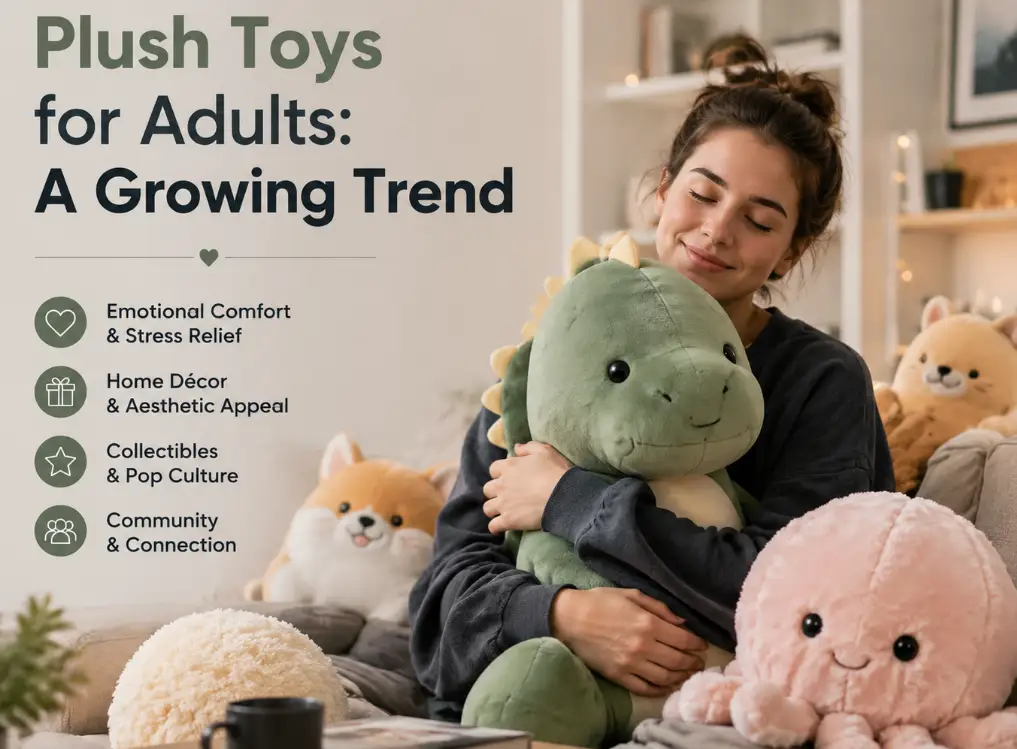
The stakes of getting this category right are higher than they might first appear. Because adult plush buyers are self-directed purchasers evaluating a product against adult aesthetic and quality standards rather than a child’s play preferences, the margin for a mediocre or poorly executed product is much thinner — a design that would pass as “good enough” in a children’s toy aisle will simply be scrolled past or picked up and set back down in an adult retail or gifting context. That makes the category simultaneously a significant opportunity and a category where design and manufacturing shortcuts are punished more visibly and more quickly than in traditional children’s plush production.
What Is Driving Growth in Adult Plush Toy Demand?
The plush toys for adults trend is not a single phenomenon with one cause. It is the convergence of several separate cultural and economic forces that happen to be reinforcing each other at the same time — which is part of why the growth has been sustained rather than a short-lived fad.
Adult plush toy demand is being driven by rising interest in comfort-oriented self-care products, the mainstreaming of “kidult” spending among adult consumers, the explosive growth of collectible and blind-box toy culture, social media’s amplification of cute and nostalgic aesthetics, and the normalization of visible emotional-comfort objects in adult spaces such as offices, cars, and living rooms. None of these forces alone would have produced a durable market category — together, they have.
Core Drivers Behind the Adult Plush Toy Trend
| Driver | What It Looks Like in Practice | Why It Sustains Demand |
|---|---|---|
| Self-care and comfort culture | Plush marketed alongside candles, weighted blankets, and wellness products | Ties plush to an existing, growing spending category rather than “toys” |
| Kidult consumer spending | Adults allocating discretionary income to toys, games, and collectibles | Reflects a structural shift in how adults define acceptable leisure spending |
| Blind-box and collectible culture | Designer plush released in series, limited editions, and mystery formats | Creates repeat-purchase behavior rather than one-time buying |
| Social and visual media | Unboxing videos, desk-setup posts, plush styled as fashion accessories | Turns individual purchases into free marketing that reaches new buyers |
| Nostalgia and comfort-object normalization | Adults openly displaying plush at work and in shared spaces | Removes the social friction that once limited adult plush ownership |
Market data across toy and gift categories consistently shows adult buyers now account for a meaningfully larger share of plush and collectible-toy spending than they did five years ago, with growth concentrated in categories — designer plush, character collaborations, comfort and emotional-support plush — that barely existed as distinct retail segments a decade ago. This is not adults quietly buying children’s products; it is a demand curve that retailers and manufacturers have had to build new product lines to serve.
It is also worth noting what is not driving this trend, because the distinction shapes product strategy. Adult plush demand is not primarily a novelty or gag-gift phenomenon, and it is not simply nostalgia purchasing by adults revisiting childhood characters. Both dynamics exist within the category, but the largest and fastest-growing sub-segments — designer collectible plush, comfort-object plush, and lifestyle-décor plush — are purchased by adults evaluating the product on its own aesthetic and tactile merits, in the same way they would evaluate any other home or personal object. Brands that position adult plush purely as a nostalgia or novelty play are targeting a smaller and slower-growing slice of the actual demand.
Who Is Buying Plush Toys as an Adult Consumer?
Understanding the adult plush buyer matters because this audience does not shop, evaluate quality, or respond to design cues the same way a parent buying for a child does. A parent is buying durability and safety for someone else. An adult plush buyer is usually buying an object for themselves, evaluated on aesthetics, tactile quality, brand or IP association, and emotional resonance.
Adult Plush Buyer Segments
| Buyer Segment | Primary Motivation | Typical Price Sensitivity |
|---|---|---|
| Collectors and IP enthusiasts | Character loyalty, series completion, limited editions | Lower — will pay premium for scarcity and licensing |
| Comfort and self-care buyers | Stress relief, emotional grounding, sensory comfort | Moderate — values material quality over branding |
| Gift-givers (adult-to-adult) | Sentimental or humorous gifting between adults | Moderate — packaging and presentation matter heavily |
| Home décor and lifestyle buyers | Aesthetic object for a curated living or work space | Higher — treats plush as a design object, not a toy |
| Fashion and accessory buyers | Bag charms, keychain plush, wearable mini-plush | Lower unit price, higher purchase frequency |
Tip: Segment the product line before segmenting the marketing. A single “adult plush” SKU rarely performs well across collectors, comfort buyers, and gift-givers at once — each segment responds to different size ranges, price points, and packaging, and a line built around one segment’s expectations will underperform with the others.
These segments are not mutually exclusive, and a single buyer may move between them depending on the occasion — the same person who collects designer plush for themselves may also buy a comfort-oriented plush as a gift for a friend going through a difficult period. What matters for product development is not forcing every buyer into a single profile, but recognizing that a product built with one segment’s priorities in mind will communicate those priorities clearly, while a product designed to appeal broadly to all segments at once often ends up appealing strongly to none of them.

What Cultural and Social Media Forces Are Fueling the Kidult Trend?
The term “kidult” — an adult who actively participates in categories historically marketed to children, from toys to animation to theme parks — has moved from a niche descriptor to a recognized consumer segment tracked by toy industry analysts. Plush toys sit at the center of this shift because, unlike most toy categories, plush carries an inherent comfort and sensory function that does not require justification through nostalgia or collecting alone.
Social media has compounded this shift by making plush ownership visually shareable in a way it never was before. Unboxing videos for blind-box plush series, desk-setup and “shelfie” content featuring curated plush collections, and short-form video showing plush being used as bag accessories have all normalized adult plush ownership as an aesthetic and identity signal rather than something to be hidden. A product that photographs well, unboxes well, and displays well now has a genuine marketing advantage that did not exist when plush toys were sold primarily through physical toy aisles.
Character IP and Designer Collaborations
A significant share of adult plush growth is concentrated in character-driven and designer-collaboration products — plush tied to animation franchises, gaming properties, art-toy designers, and social-media-native characters that have built dedicated adult fan bases. These products succeed because the buyer’s relationship to the character predates the plush purchase; the plush is a physical extension of an existing emotional attachment rather than a cold product discovery.
This has real implications for manufacturers and brands entering the category. A generic “cute animal” plush competes purely on aesthetics and price. A character-driven or designer-collaboration plush competes on the strength of the underlying IP relationship, and buyers in this segment are demonstrably willing to pay a premium and tolerate smaller production runs in exchange for authenticity and scarcity.
Art-toy culture in particular has contributed a design vocabulary that now shows up widely across adult plush — stylized proportions, restrained color palettes, and a deliberate ambiguity of expression that leaves room for the buyer to project their own mood or personality onto the character. This is a meaningful departure from children’s plush design, where clarity and immediate emotional legibility are the priority. Designers working in this space often treat the plush less as a toy and more as a wearable or displayable art object, and pricing, packaging, and marketing typically follow that positioning rather than a conventional toy marketing approach.
How Do Adult Plush Toys Differ From Children’s Plush in Design?
Designing plush for adult buyers is not a matter of using a smaller or larger version of a children’s pattern. The design brief changes across nearly every dimension — proportion, color palette, facial expression, texture, and finishing detail — because the buyer is evaluating the product against adult aesthetic standards rather than a child’s play preferences.
Adult plush toys differ from children’s plush in design because the purchase decision is driven by visual sophistication, tactile premium feel, and display value rather than play durability and stimulation. Children’s plush is designed to survive rough handling, invite active play, and appeal to a child’s developing visual preferences. Adult plush is designed to be displayed, photographed, and handled gently — which shifts the entire design brief toward refinement rather than robustness.
Design Differences Between Children’s and Adult-Focused Plush
| Design Element | Children’s Plush Approach | Adult-Focused Plush Approach |
|---|---|---|
| Color palette | Bright, high-contrast, primary colors | Muted, tonal, or curated palettes that suit adult interiors |
| Facial expression | Exaggerated, simple, immediately readable | Subtle, often minimalist or “blank” expressions open to projection |
| Proportions | Rounded, oversized head-to-body ratio for approachability | Varies by segment — designer plush often stylized, comfort plush often realistic |
| Fabric texture | Standard short-pile plush prioritizing cost and washability | Premium long-pile, minky, or brushed fabrics prioritizing hand-feel |
| Finishing detail | Simple embroidery, molded safety eyes | Fine embroidery, fabric-blended seams, hand-finished accessories |
| Packaging | Functional, brightly branded retail packaging | Gift-quality packaging designed for unboxing and display |
Tip: Test facial expression separately from body design. Adult buyers respond strongly and specifically to expression — a face that reads as “too childlike” can undercut an otherwise well-designed body, while a face that reads as “too neutral” can feel unfinished. Small adjustments to eye size, mouth curvature, and eyebrow placement often account for a disproportionate share of how a design is received.

What Materials and Construction Standards Matter Most for Adult-Focused Plush?
Material selection carries more weight in the adult plush category than almost any other design decision, because adult buyers handle a plush toy the way they would evaluate any premium tactile object — by touching it before deciding whether they want it. A design that photographs beautifully but feels thin, stiff, or cheap in hand will consistently underperform a simpler design executed in genuinely premium materials.
Materials and construction standards matter most for adult-focused plush because hand-feel, drape, and visual density of the fabric pile directly influence the buyer’s perceived value of the product — often more than the character design itself. Adult buyers are typically purchasing at a higher price point than the average children’s plush item, and the fabric and fill quality need to visibly justify that price on contact.
Material Considerations for Adult Plush Products
| Material Element | Standard Option | Premium Option for Adult Plush | Impact on Perceived Value |
|---|---|---|---|
| Outer fabric | Short-pile polyester plush | Long-pile or minky-weight plush with dense fiber count | Higher fiber density reads as “luxury” on contact |
| Filling | Standard PP cotton | Weighted fill blends, memory-foam-style fill for comfort plush | Weight and give affect the comfort-object appeal directly |
| Seams and stitching | Standard machine seams | Reinforced, minimally visible seams with fabric-matched thread | Visible seam quality is scrutinized more closely by adult buyers |
| Embroidery | Basic satin-stitch detail | Fine gradient or multi-thread embroidery for facial detail | Directly affects how refined the character reads at close range |
| Accessories and trims | Standard plastic or fabric add-ons | Fabric-covered, hand-finished, or metal-accented details | Small details disproportionately signal overall product quality |
Tip: Request physical fabric swatches with pile height and density specified in writing before approving a design. Photographs of plush fabric are notoriously unreliable for judging hand-feel and density — two fabrics that look nearly identical on camera can feel dramatically different in hand, and that difference is exactly what an adult buyer will notice first.
Weighted and Sensory-Focused Fill Options
A meaningful sub-segment of adult plush — particularly within the comfort and self-care category — uses weighted or textured fill to create a more deliberate sensory experience than standard PP cotton provides. Weighted fill, typically achieved through fine plastic pellets or glass-bead blends distributed through internal fabric compartments, adds a grounding, hand-held weight that buyers in this segment specifically seek out, echoing the sensory logic behind weighted blankets.
Because weighted fill introduces additional construction requirements — reinforced internal compartments, secure seam closure, and consistent weight distribution across units — factories producing this style of product need construction experience specific to weighted plush rather than standard soft-toy assembly alone.
What Product Categories Make Up the Adult Plush Market?
The plush toys for adults trend is not one product type — it spans several distinct categories, each with its own design conventions, price points, and buying occasions. Treating “adult plush” as a single category leads to unfocused product development; understanding the sub-categories allows a brand to pick a lane and design deliberately for it.
Adult Plush Product Categories
| Category | Typical Size Range | Primary Buying Occasion | Design Priority |
|---|---|---|---|
| Collectible and blind-box plush | 10–25 cm | Series collecting, gifting, unboxing content | Distinctiveness within a themed series |
| Comfort and emotional-support plush | 30–60 cm | Self-purchase for stress relief and sensory comfort | Weight, softness, and huggability |
| Home décor and display plush | 25–80 cm | Interior styling, shelf and bed display | Aesthetic coherence with adult interior design trends |
| Fashion and accessory plush | 5–15 cm | Bag charms, keychains, wearable accessories | Durability under frequent handling, secure attachment hardware |
| Gifting and novelty plush | 15–40 cm | Adult-to-adult gifting for humor or sentiment | Packaging and presentation as much as the object itself |
These categories often overlap in practice — a well-designed collectible plush can also function as a desk-décor object, and a comfort plush is frequently purchased as a gift rather than a self-purchase. The value of separating them analytically is not to force a product into a single rigid category, but to make deliberate decisions about which occasion and buyer motivation a specific design is being optimized for, since size, price point, and packaging trade-offs genuinely differ across these use cases even when the underlying plush construction is similar.

What Should Brands Consider When Designing a Plush Line for Adult Consumers?
Moving from concept to a manufacturable adult plush line requires decisions that a children’s plush brief typically does not force. Because the buyer is evaluating the product on adult aesthetic and tactile standards, and because the price point is generally higher, the margin for design or execution error is smaller — an adult buyer who feels a product looks “cheap” or “childish” simply will not purchase it, where a child’s parent might overlook the same issue for a lower-priced item.
- Define the buyer segment before the design brief. A collector buying a limited-edition designer plush has different expectations than a self-care buyer looking for a weighted comfort companion — the size, price, packaging, and even fabric choice should follow from this decision, not precede it.
- Design the facial expression and proportions specifically for adult aesthetic sensibility. This is the single most common failure point when children’s plush patterns are simply resized — the result reads as a scaled toy rather than a purpose-built adult product.
- Prioritize fabric and fill quality over feature complexity. Adult buyers respond more strongly to how a plush feels than to how many features it has — an understated, beautifully executed plush consistently outsells an overdesigned one with mediocre materials.
- Invest in packaging as part of the product experience. Unboxing is now a meaningful part of how adult plush is marketed and shared; packaging that photographs and unboxes well extends the product’s marketing life well past the point of sale.
Adult Plush Product Development Checklist
| Development Stage | Key Question to Resolve | Common Mistake to Avoid |
|---|---|---|
| Concept and audience | Which buyer segment is this design built for? | Designing a generic plush and hoping it appeals to every segment |
| Design and proportion | Does the expression and proportion read as adult-appropriate? | Directly resizing a children’s pattern without redesigning the face |
| Materials | Do the fabric and fill justify the intended price point? | Using standard children’s-grade fabric on a premium-priced product |
| Compliance | Is the product being labeled and tested appropriately for its market? | Assuming adult-marketed products are exempt from toy safety rules |
| Packaging | Does the unboxing experience match the product’s positioning? | Using standard toy packaging for a premium-positioned product |
What Manufacturing and Quality Considerations Change When the End User Is an Adult?
Manufacturing an adult-focused plush line requires the same core production discipline as any plush product — consistent stitching, accurate color matching, reliable fill weight — but several considerations shift in emphasis, and one area in particular requires careful handling: compliance labeling and marketing language.
Manufacturing and quality considerations change for adult plush because the product’s marketing claims, not just its physical construction, determine which safety standards and labeling requirements apply in most markets. A plush toy explicitly marketed for adult use and clearly differentiated from a children’s toy may fall under different regulatory expectations than one marketed as suitable for children — but many regulators still apply toy safety standards by default unless a product is unambiguously positioned, packaged, and labeled as an adult item, and small parts, embellishments, and trims still need to meet basic safety and durability expectations regardless of the target buyer’s age.
Manufacturing Considerations for Adult-Focused Plush
| Consideration | Why It Changes for Adult Plush | Practical Implication |
|---|---|---|
| Compliance labeling | Marketing claims and target-age labeling affect which safety standards apply | Work with the factory and legal counsel to confirm labeling language for each target market |
| Fabric grade consistency | Higher scrutiny of hand-feel makes fabric batch consistency more visible to buyers | Request tighter fabric lot control and pre-production swatch approval |
| Embroidery and finishing QC | Fine facial embroidery has a smaller acceptable tolerance than simple children’s designs | Build embroidery precision into the AQL inspection checklist explicitly |
| Packaging production | Premium packaging often uses more complex materials and printing techniques | Confirm packaging supplier capability early — it is a frequent bottleneck |
| Small-batch and limited-run capability | Collector and designer segments favor limited editions over mass runs | Confirm the factory can economically support smaller production runs |
Tip: Never assume “adult-marketed” removes a product from toy safety scrutiny. Regulators in most major markets look at how a reasonable consumer would perceive and use the product, not just the marketing label — a plush toy with a cute, toy-like design will often still be evaluated against standard toy safety requirements even when marketed to adults, so material and small-parts compliance should be treated as a baseline requirement, not an optional add-on.
Quality control processes also need to be recalibrated rather than simply carried over from a children’s plush production line. Standard AQL inspection checklists built for children’s plush typically emphasize safety-critical items — secure eye and nose attachment, seam strength, choking-hazard checks on small parts — and give comparatively little weight to cosmetic and tactile consistency, since a slightly uneven fabric pile or minor embroidery variation rarely affects a child’s play experience.
For adult-focused plush, cosmetic and tactile consistency is often the primary driver of customer satisfaction and return rates, which means inspection checklists need explicit criteria for fabric pile direction and density, embroidery symmetry, color-lot consistency across a production run, and seam visibility — items that a standard children’s-toy inspection protocol may not weigh heavily enough to catch problems before they reach the buyer.
How Big Is the Market Opportunity, and Where Is Growth Concentrated?
The scale of the plush toys for adults trend is easiest to understand by looking at where growth is concentrated rather than at aggregate market size alone, since the category spans multiple retail channels — specialty toy retail, general e-commerce marketplaces, direct-to-consumer brand sites, and gift and lifestyle retail — that are not always tracked together.
Where Adult Plush Growth Is Concentrated
| Growth Area | Observed Pattern | Implication for Manufacturers and Brands |
|---|---|---|
| Designer and collector plush | Fastest-growing sub-category by revenue in several major markets | Higher margins available for distinctive, well-executed designs |
| E-commerce and social commerce | Growing share of adult plush sales originates from social-video discovery | Product photography and unboxing quality now function as marketing assets |
| East Asian and Western markets | Trend originated strongly in East Asian markets and is scaling into Western retail | Design cues from early-adopter markets often predict Western demand shifts |
| Gifting occasions beyond childhood | Rising adult-to-adult plush gifting for birthdays, comfort, and sentiment | Packaging and personalization options add incremental revenue per unit |
| Licensed and collaboration plush | Character and artist collaborations consistently outperform generic designs | Licensing relationships are becoming a meaningful competitive differentiator |
What makes this growth pattern durable rather than speculative is that it is anchored in a genuine, verifiable shift in adult discretionary spending toward comfort, self-care, and collectible categories — not in a single viral product cycle. Brands that build design and manufacturing capability specifically for this buyer, rather than repositioning leftover children’s inventory, are positioned to capture a disproportionate share of this growth as it continues to mature.

It is also worth noting that this growth is occurring alongside, rather than instead of, continued demand in the traditional children’s plush market. The two markets are increasingly served by different design teams, different fabric specifications, and often different production lines within the same manufacturing relationship, rather than by a single undifferentiated plush product line stretched to cover both audiences. Brands that recognize this early — building distinct product development processes for adult-focused and children’s-focused plush rather than trying to serve both from one generic design brief — are typically the ones that see the strongest performance in the adult segment specifically.
What Are the Risks and Challenges of Entering the Adult Plush Market?
Despite the growth, entering the adult plush category is not without risk, and several failure patterns show up consistently among brands that treat it as a low-effort extension of an existing children’s line.
The most common risk is misjudging the design brief — launching a product that is simply a resized or recolored children’s design and finding that adult buyers do not respond to it, because the facial expression, proportions, and fabric quality read as juvenile rather than refined. A second common risk is underestimating compliance requirements, assuming that “adult” marketing exempts a plush product from toy safety testing, and discovering otherwise after a retail partner or regulator raises the issue.
A third risk is quality inconsistency at scale — a beautifully executed sample that does not hold its embroidery precision, fabric density, or color consistency through a full production run, which is especially damaging in a category where tactile and visual quality are the primary purchase drivers.
Tip: Pilot with a small production run before committing to full-scale manufacturing. Because adult plush buyers evaluate quality more critically than the average children’s toy buyer, a limited first run — sold through a direct channel with close attention to customer feedback on hand-feel, sizing, and expression — surfaces design and quality issues at a much lower cost than discovering them after a large retail order has shipped.
A fourth, less discussed risk is positioning drift over time — a brand successfully establishes an adult-focused plush line, then gradually broadens its designs, pricing, and marketing to chase a wider audience, diluting the aesthetic and quality signals that made the original product resonate with its core adult buyer segment in the first place.
Category discipline matters as much after a successful launch as it does before one; brands that maintain a clear point of view about who the product is for, and design consistently to that standard across every new release, tend to retain the loyalty and repeat-purchase behavior that make the collector and comfort-plush segments particularly valuable over time.
How Can a Brand Successfully Launch an Adult-Oriented Plush Toy Product?
A successful adult plush launch generally follows a sequence that treats the category as its own product discipline rather than an extension of existing children’s toy processes.
- Define the target buyer segment and price point first. Collector, comfort, gifting, décor, or fashion-accessory — the segment choice shapes every downstream decision, from size to fabric to packaging.
- Develop the design specifically for adult aesthetic standards, testing facial expression, proportion, and color palette with the target audience rather than assuming a scaled children’s design will translate.
- Select fabric and fill grades that visibly justify the intended price point, and confirm hand-feel with physical swatches before committing to production.
- Confirm compliance and labeling requirements for every target market before finalizing packaging, treating toy safety standards as a baseline rather than an optional consideration for “adult” products.
- Invest in packaging and presentation proportional to the product’s positioning, recognizing that unboxing quality now functions as a marketing asset in its own right.
- Run a limited pilot production before scaling, using early buyer feedback to catch design or quality issues while the cost of correction is still low.
How Should Pricing and Retail Channel Strategy Differ for Adult Plush?
Pricing an adult plush product using children’s plush benchmarks is a common early mistake. Children’s plush pricing is typically anchored to parent price sensitivity and mass-retail margin structures, which pushes prices toward the lower end of what the fabric and construction quality would otherwise support. Adult plush buyers, by contrast, are generally purchasing a considered, self-directed object rather than a routine purchase for a child, and they benchmark price against comparable adult categories — home décor, self-care products, designer collectibles — rather than against the toy aisle.
Pricing and retail channel strategy differ for adult plush because the buyer’s price anchor, purchase frequency, and channel expectations are fundamentally different from those of a parent buying for a child. A pricing strategy built around mass-retail toy margins will consistently undervalue a well-designed adult plush product, while a channel strategy built around traditional toy retail will miss the direct-to-consumer, social-commerce, and specialty gift channels where adult buyers are increasingly discovering and purchasing these products.
Retail Channel Considerations for Adult Plush
| Channel | Buyer Expectation | Strategic Consideration |
|---|---|---|
| Direct-to-consumer brand sites | Curated presentation, brand story, limited-edition framing | Highest margin potential; requires investment in content and packaging |
| General e-commerce marketplaces | Competitive pricing, fast shipping, clear sizing information | High discoverability but more price-competitive environment |
| Social commerce and live shopping | Authentic, in-the-moment presentation; unboxing appeal | Strong for driving discovery and impulse purchase among collectors |
| Specialty gift and lifestyle retail | Premium presentation, gift-readiness, curated assortment | Supports higher price points; smaller order volumes per retailer |
| Traditional toy retail | Family and children’s shopping context | Weakest fit for adult-positioned products unless clearly segmented in-store |
A practical implication of this channel mismatch is that many successful adult plush brands intentionally avoid framing their products as “toys” in retail contexts where that framing would place them alongside children’s products and invite the wrong price comparison. Instead, positioning language, packaging design, and channel selection are coordinated to place the product alongside comparable adult lifestyle categories, where both the price point and the buyer’s expectations are already calibrated to what the product is actually offering.

Conclusion
Plush toys for adults have moved from a novelty niche to a genuine, structurally supported product category — driven by the convergence of self-care culture, kidult spending, collectible and blind-box formats, and the visual amplification effect of social media. This is not children’s plush being repurposed; it is a distinct product discipline with its own design language, materials standards, and manufacturing considerations.
Brands and manufacturers who succeed in this category are the ones who treat the adult buyer as a genuinely different customer — designing facial expression and proportion for adult aesthetic sensibility, selecting fabric and fill quality that justifies a premium price point on contact, taking compliance and labeling seriously rather than assuming adult marketing removes toy safety obligations, and investing in packaging and presentation as part of the product experience rather than an afterthought. Done well, the result is a product category with genuine staying power — not a trend that fades once the novelty wears off, but a durable shift in how adults relate to comfort, collecting, and self-expression through physical objects.
FAQ
Q1: Is the plush toys for adults trend likely to be a short-term fad, or is it a durable market shift?
The available evidence points toward a durable shift rather than a short-lived fad. The trend is anchored in several independent, structural forces — growing adult self-care and comfort spending, the mainstreaming of kidult consumer behavior, the rise of collectible and blind-box retail formats, and the amplification effect of social media on visually shareable products — rather than a single viral product cycle.
Categories driven by one product or one influencer moment tend to contract quickly once attention moves elsewhere; categories driven by converging spending and cultural patterns, as this one is, tend to persist and mature into a stable retail segment with its own established sub-categories and buyer expectations. That said, individual designs and character properties within the category will still rise and fall in popularity the way any collectible or fashion-adjacent product does — durability at the category level does not guarantee durability for any specific product line, which is why continued design investment matters even for brands already established in the space.
Q2: Can an existing children’s plush design simply be resized or recolored to target adult buyers?
Resizing or recoloring an existing children’s design is the most common mistake brands make when entering this category, and it typically underperforms. Adult buyers evaluate plush against adult aesthetic standards — facial expression, proportion, color palette, and fabric hand-feel — that differ meaningfully from what appeals to a child or a parent buying for a child. A resized children’s pattern usually still reads as a children’s product at a larger size, which undermines the premium positioning that adult plush buyers respond to. A genuinely adult-oriented product requires redesigning the expression, proportion, and materials specifically for the target buyer segment, not simply scaling an existing pattern.
Q3: What price point do adult consumers typically expect for plush toys in this category?
Price expectations vary significantly by sub-category rather than following a single benchmark. Fashion-accessory and keychain-format plush are typically purchased at lower unit prices but higher frequency, functioning more like an accessory purchase than a considered gift. Collector and designer plush command a meaningful premium over standard children’s plush of comparable size, reflecting both material quality expectations and the value buyers place on limited availability or character association.
Comfort and home décor plush sit in the middle, with buyers generally willing to pay more than a children’s-equivalent product but expecting that premium to be visibly justified through fabric quality, weight, and finishing detail rather than through packaging or marketing alone. Across all sub-categories, the general pattern holds that adult plush buyers are more price-tolerant than children’s-toy buyers but also more quality-sensitive — meaning a higher price point only sustains repeat purchasing when the product’s construction and materials genuinely support it.
Q4: Do adult-marketed plush toys still need to meet children’s toy safety standards?
In most major markets, regulators evaluate a product based on how it is reasonably likely to be perceived and used, not solely on its marketing label. A plush toy with a cute, toy-like design and construction may still be evaluated against standard toy safety requirements even when explicitly marketed to adults, particularly if the product could plausibly end up in a household with children present. Brands should treat material safety, small-parts security, and basic construction standards as a baseline requirement for any plush product, and should work with their manufacturer and, where appropriate, legal counsel to confirm the specific labeling and compliance obligations that apply in each target market before finalizing packaging and marketing claims.
Q5: What materials differences matter most when moving from a children’s plush brief to an adult-focused one?
The most significant differences are fabric pile density and hand-feel, fill quality and weight, and the precision of embroidery and finishing detail. Adult buyers typically handle a product physically before purchasing or judge it heavily on close-up photography and video, which makes fabric quality and finishing precision far more visible to the buying decision than in a typical children’s plush purchase. Upgrading from standard short-pile plush and basic PP cotton fill to denser, higher-quality fabric and weighted or premium fill blends — combined with finer embroidery detail and cleaner seam construction — is usually the single highest-impact set of changes a brand can make when adapting a product for this audience.
Q6: How should a brand decide between designing an original character versus licensing an existing one for an adult plush line?
Both approaches can succeed, but they carry different risk and cost profiles. Licensed or collaboration-based characters benefit from an existing emotional relationship between the buyer and the IP, which typically produces faster initial sales and supports a higher price point, but licensing costs, approval timelines, and revenue-sharing terms need to be weighed against the expected volume. Original character development requires more investment in design, testing, and audience-building before a character resonates, but it avoids licensing costs and gives the brand full control over the product’s positioning and long-term development. Brands entering the category for the first time often benefit from starting with a small licensed or collaboration release to validate demand before committing to the larger investment of developing and building an original character franchise.
Q7: What is the biggest manufacturing risk when scaling an adult plush design from sample to full production?
The most consistent risk is quality drift on the details that matter most to adult buyers — fabric density and color consistency across production lots, and embroidery or facial-finishing precision across a full production run. A single well-executed sample does not guarantee that fine facial embroidery, subtle color-matching, or premium fabric density will hold consistently across a run of several thousand units, and because adult buyers scrutinize these details more closely than the average children’s toy buyer, even minor inconsistency is more likely to generate returns or negative reviews.
Building explicit fabric density and embroidery precision checkpoints into the AQL inspection process, rather than relying on standard children’s plush inspection criteria, is the most effective way to manage this risk at scale. Maintaining fabric lot records and requiring pre-shipment sample approval against an agreed physical reference sample, rather than a photograph, further reduces the chance that subtle quality drift goes unnoticed until customer complaints surface it after the product has already reached the market.